

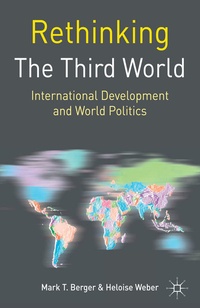
Rethinking the Third World
International Development and World Politics
Published on 22. September 2014
Book
Paperback/Softback
200 pages
978-1-4039-9589-6 (ISBN)
Description
A systematic reassessment, by two leading figures in the field, of the paradigm of international development in both theory and practice. It offers an overview and critique of development theory and strategy, and a new framework for the analysis of global inequality, poverty and development in an era of globalization.
Reviews / Votes
The book is organized chronologically, encompassing the late colonial to post-Cold War era ... In a world where the core principles of the modern nation-state system are increasingly under pressure by non-state and some state actors, any discussion which problematizes our assumptions about sovereignty, development, and security should be encouraged. In this respect, Rethinking the Third World is a critical and fascinating starting point to stimulate such debates. * Seyed Saeed Mousavi, Journal of Global Analysis, Vol. 7 (2) *More details
Series
Edition
2014
Language
English
Place of publication
London
United Kingdom
Publishing group
Bloomsbury Publishing PLC
Target group
College/higher education
Dimensions
Height: 23.5 cm
Width: 15.5 cm
Thickness: 12 mm
Weight
268 gr
ISBN-13
978-1-4039-9589-6 (9781403995896)
DOI
10.1007/978-1-137-44112-6
Schweitzer Classification
Other editions
Additional editions
Mark T. Berger | Heloise Weber
Rethinking the Third World
International Development and World Politics
Book
09/2014
Red Globe Press
€191.40
Shipment within 10-20 days
Mark T. Berger | Heloise Weber
Rethinking the Third World
International Development and World Politics
E-Book
09/2014
1st Edition
Bloomsbury Academic
€167.99
Available for download
Persons
Dr. Mark T. Berger is Director of the US-México Security-Development Partnership Project and Adjunct Professor in the Department of Defense Analysis at the Naval Postgraduate School, USA. He has published and taught widely on development and security issues, international studies and modern international history. His latest books include The Crisis of Global Modernity and the Fate of Humanity: From a World of Empires to a World of Sovereign Nation-States to a New Global Order for the 21st Century (Forthcoming: 2014).
Heloise Weber is Senior Lecturer in International Relations and Development at the University of Queensland, Australia. She researches and publishes on the global politics of development and inequalities, and poverty reduction strategies, including on theoretical and methodological aspects. She is co-editor (with M. T. Berger) of Recognition and Redistribution: Beyond International Development (Routledge 2013) and editor of Politics of Development (Routledge, 2014). She is currently working on a monograph on the global politics of microcredit and poverty.
Heloise Weber is Senior Lecturer in International Relations and Development at the University of Queensland, Australia. She researches and publishes on the global politics of development and inequalities, and poverty reduction strategies, including on theoretical and methodological aspects. She is co-editor (with M. T. Berger) of Recognition and Redistribution: Beyond International Development (Routledge 2013) and editor of Politics of Development (Routledge, 2014). She is currently working on a monograph on the global politics of microcredit and poverty.
Content
1. Introduction: International Development, World Politics and Global Modernity.- 2. Global Modernity and International Development: The Origins of the Third World.- 3. Third World Rising: Decolonization, the Cold War and Third Worldism.- 4. The Golden Age of Third Worldism: International Development, the Cold War and the Contradictions of Global Modernity.- 5. Third Worldism in Decline: International Development, the End of the Cold War and the Crisis of Global Modernity.- 6. The Resurrection of Nation-Building and Modernization: Security and International Development in the Third World after the Cold War.- 7. A New Agenda for Negotiating Global Modernity: A Regional Development-Security Framework After Third Worldism.- 8. Conclusion: Rethinking the Third World.