

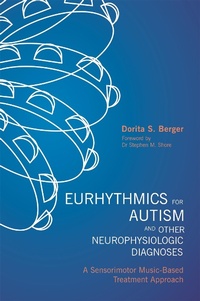
Eurhythmics for Autism and Other Neurophysiologic Diagnoses
A Sensorimotor Music-Based Treatment Approach
Published on 21. October 2015
Book
Paperback/Softback
264 pages
978-1-84905-989-3 (ISBN)
Description
In Eurhythmics for Autism and Other Neurophysiologic Diagnoses, Dorita S. Berger reveals how Eurhythmics, a method of teaching the musical concepts of rhythm, structure and expression kinaesthetically through movement, can help develop sensorimotor skills in children and adults with autism and other special needs.
Covering both theory and practice, she explains this innovative, music-based approach and how it can also address cognitive and sensory issues in adults with debilitating conditions, such as dementia or post-traumatic stress disorder. With a particular emphasis on autism, she provides clear and adaptable session plans, suitable for working with children and adults of all ages.
Covering both theory and practice, she explains this innovative, music-based approach and how it can also address cognitive and sensory issues in adults with debilitating conditions, such as dementia or post-traumatic stress disorder. With a particular emphasis on autism, she provides clear and adaptable session plans, suitable for working with children and adults of all ages.
Reviews / Votes
In a book like no other, Dr. Berger masterfully introduces the science behind the power of music and movement, followed by artistically presented, easy-to-implement, and practical intervention solutions for the clinician, parent, or other person to connect with individuals with autism and other neurophysiological diagnoses. -- Stephen M. Shore, Clinical Assistant Professor of Special Education, Adelphi University Dorita Berger's book is a gift to all individuals on the autism spectrum. As a music therapist and scientist, Dr. Berger combines cutting-edge research with a healthy dose of practical advice to show how eurhythmics in a music therapy-based clinical environment can be used to support a wide range of neurophysiologic diagnoses. This book is an outstanding resource for therapists, neuroscientists, and families. -- Frances H. Rauscher, Professor Emerita, University of Wisconsin Oshkosh, and co-author of 'Neurosciences in Music Pedagogy' Dori Berger is that rare combination of musician, scientist and clinician. Based on her extensive research experience, she unfolds a detailed prescription of protocols, culled from Eurhythmics and the most recent science, that can lead to dramatically improved results. In doing so, she makes a clear argument for how music moves from a passive therapy to a potent intervention! -- Dr. Patricia Gray, Director of The BioMusic Program, University of North Carolina, Greensboro, USA A professional musician and practitioner in sensorimotor treatment of autism and related diagnoses, Dorita Berger writes brilliantly to inspire therapists who help persons with disorders of intention and awareness share life with self-confidence and joy. With up-to-date brain science of intentions and feelings, this book will also be a resource for students of psychology, medicine and education. Born musical, our sense of others' rhythms and melodies of affection, invention and discovery can be enhanced to overcome confusion and anxiety. -- Colwyn Trevarthen, PhD, FRSE, Professor (Emeritus) of Child Psychology and Psychobiology, Department of Psychology, The University of Edinburgh, UK [I]t was with great anticipation and enthusiasm that I welcomed the news of an addition to the literature in Dorita S. Berger's Eurhythmics for Autism and Other Neurophysiologic Diagnoses: A Sensorimotor Music-Based Treatment Approach... Reading this book as a specialist in Dalcroze Eurhythmics, I learnt a great deal about the science behind what I do... Her work focuses on finding a process of adaptation for those with special needs, which allows them to respond with courage to the demands of their environment, and to life in general... The scientific theories introduced in the opening section permeate the second section; the reader is led to understand why a particular exercise has a particular effect... As a whole, this is an accessible and inviting text to read... the reader is taken on a journey of understanding through carefully placed introductions and summaries... This is a book for learners, for those seeking to deepen their practise and who welcome the new. I encourage you to read it. -- Bethan Habron-James * Approaches: An interdisciplinary journal of music therapy *More details
Language
English
Place of publication
London
United Kingdom
Target group
Primary & secondary/elementary & high school
College/higher education
Product notice
Paperback (UK-trade)
Illustrations
10 black and white figures and photographs
Dimensions
Height: 228 mm
Width: 151 mm
Thickness: 17 mm
Weight
389 gr
ISBN-13
978-1-84905-989-3 (9781849059893)
Copyright in bibliographic data and cover images is held by Nielsen Book Services Limited or by the publishers or by their respective licensors: all rights reserved.
Schweitzer Classification
Other editions
Additional editions
Dorita S. Berger
Eurhythmics for Autism and Other Neurophysiologic Diagnoses
A Sensorimotor Music-Based Treatment Approach
E-Book
10/2015
Jessica Kingsley Publishers
€37.99
Available for download
Persons
Dorita S. Berger is a concert pianist, an educator and a Board Certified music therapist with over 20 years of clinical experience in sensorimotor music-based treatment for autism spectrum and neurophysiologic-related diagnoses in children and adults. She conducts workshops and lectures on the role of music in science and medicine and continues to provide consultations and music therapy services, in addition to researching the role of music in human adaptation. Dorita resides in Durham, North Carolina, USA and is the author of Music Therapy, Sensory Integration and the Autistic Child and co-author of The Music Effect: Music Physiology and Clinical Applications, both published by Jessica Kingsley Publishers.
Content
Prelude. Part I. The Theory. 1. Coming to Our Senses. 2. This is Your Brain on Sensations! 3. Interpreting Autism and Sensory Characteristics. Part 2. The Practice. 4. What is This Thing Called Eurhythmics? 5. Eurhythmics in Music-Based Clinical Work. 6. Sensory Organization through Quick Response Movement. 7. Free To Be Me. 8. Observing with a Clinical Eye. Part 3. The Conclusion. 9. Reviewing the Paradigm, Treating Other Diagnoses. Coda: Conclusion. Appendix 1. Sample Tracking Log for Eurhythmics Interventions. Sample Brief Report of Clinical Work and Recommendations for XoXoXo. Appendix II. Understanding the Included Special Needs Child in Music Class. Appendix III. Music Soothes the Ravaged Brain. Bibliography. Index.