

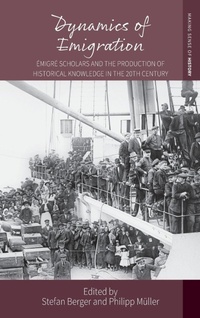
Dynamics of Emigration
Emigre Scholars and the Production of Historical Knowledge in the 20th Century
Published on 12. August 2022
Book
Hardback
308 pages
978-1-80073-609-2 (ISBN)
Description
As a pioneering volume to consider the impact of exile on historical scholarship in the twentieth century in a systematic and global way, looking at Europe, North America, South America and Asia, Dynamics of Emigration asks about epistemic repercussions on the experience of exile and exiles. Analyzing both the impact that exile scholars had on their host societies and on the societies they had to leave, the volume investigates exiles' pathways to integration into new host societies and the many difficulties they face establishing themselves in new surroundings. Focusing on the age of extremes and the realms of exile from fascist and right-wing dictatorships as well as communist regimes, the contributions look at the reasons scholars have for going into exile while providing side-by-side examination of the support organizations and paths for success involved with living in exile.
Reviews / Votes
"Dynamics of Emigration is an excellent volume that consolidates an emerging European historiography that is probably unfamiliar to many interested readers in the English language. The contributions address the problem from an admirable range of questions: more traditional intellectual history, the "persona" adopted by exiles in their adopted countries, their contributions to the intellectual situations there, the question of whether they became integrated in their new intellectual environments, the question of gender for exiles, and more." * Benjamin Tromly, University of Puget SoundMore details
Series
Language
English
Place of publication
Oxford
United Kingdom
Target group
Professional and scholarly
Product notice
Library binding
Illustrations
Bibliography; Index
Dimensions
Height: 235 mm
Width: 157 mm
Thickness: 19 mm
Weight
543 gr
ISBN-13
978-1-80073-609-2 (9781800736092)
Copyright in bibliographic data and cover images is held by Nielsen Book Services Limited or by the publishers or by their respective licensors: all rights reserved.
Schweitzer Classification
Other editions
Additional editions
Stefan Berger | Philipp Müller
Dynamics of Emigration
Émigré Scholars and the Production of Historical Knowledge in the 20th Century
E-Book
08/2022
1st Edition
Berghahn Books
€24.49
Available for download
Stefan Berger | Philipp Mueller
Dynamics of Emigration
Emigre Scholars and the Production of Historical Knowledge in the 20th Century
E-Book
08/2022
1st Edition
Berghahn Books
€24.49
Available for download
Persons
Stefan Berger is Professor of Social History and Director of the Institute for Social Movements at Ruhr-Universitaet Bochum in Germany. He is also Executive Chair of the Foundation History of the Ruhr and an Honorary Professor at Cardiff University in the UK. Before 2011 he had full chairs of History at the Universities of Manchester (2005 - 2011) and University of Glamorgan (2000 - 2005).
Content
Introduction: Dynamics of Emigre Scholarship in the Age of Extremes
Stefan Berger and Philipp Mueller
Chapter 1. 'A Private Perch': Cosmopolitanism, Nostalgia and Commitment in the Emigre Historian's Persona
Jo Tollebeek
Chapter 2. The Emigre Historian: A Scholarly Persona?
Herman Paul
Chapter 3. The Dictator's Long Arm: Cross-Border Persecution of Exile Historians
Antoon de Baets
Chapter 4. Nativism and the Specter of Anti-Semitism in the Placement of German Refugee Scholars, 1933-1945
Joseph Malherek
Chapter 5. Defending Objectivity: Paul Oskar Kristeller and the Controversy on the Historical Knowledge in the United States
Irina Mykhailova
Chapter 6. Emigre Historians and the Postwar Transatlantic Dialogue
Philipp Stelzel
Chapter 7. Between Integration and Institutional Self-Organisation: Polish Emigre Scholarship in the United States, 1939-1989
Kai Willms
Chapter 8. The Unlikely Careers of Laura Polanyi (1882-1959) as a Historian: The Intersections of Exile, Gender, Class and Age
Judith Szapor
Chapter 9. 'From Geistesgeschichte to Public History': The Years of Emigration of the Hungarian Historian Bela Ivanyi Gruenwald, Jr.
Vilmos Eroes
Chapter 10. Building New Networks: Russian Emigre Scholars in Yugoslavia
Branimir Jankovic
Chapter 11. Networking in Santa Barbara, Writing History: Dimitrije Dordevic and the Comparative History of Balkan Nations
Michael Antolovic
Chapter 12. Antonio Sergio and Jose Ortega y Gasset: History, Theory and Experiences of Exile
Sergio Campos Matos
Chapter 13. Emigre Portuguese Historians in France between the Second World War and 25th April 1974: New Ways and Places of Thinking and Writing Portuguese History?
Christophe Araujo
Conclusion: New Perspectives on Emigre Scholarship and What Remains to be Done
Stefan Berger and Philipp Mueller
Index
Stefan Berger and Philipp Mueller
Chapter 1. 'A Private Perch': Cosmopolitanism, Nostalgia and Commitment in the Emigre Historian's Persona
Jo Tollebeek
Chapter 2. The Emigre Historian: A Scholarly Persona?
Herman Paul
Chapter 3. The Dictator's Long Arm: Cross-Border Persecution of Exile Historians
Antoon de Baets
Chapter 4. Nativism and the Specter of Anti-Semitism in the Placement of German Refugee Scholars, 1933-1945
Joseph Malherek
Chapter 5. Defending Objectivity: Paul Oskar Kristeller and the Controversy on the Historical Knowledge in the United States
Irina Mykhailova
Chapter 6. Emigre Historians and the Postwar Transatlantic Dialogue
Philipp Stelzel
Chapter 7. Between Integration and Institutional Self-Organisation: Polish Emigre Scholarship in the United States, 1939-1989
Kai Willms
Chapter 8. The Unlikely Careers of Laura Polanyi (1882-1959) as a Historian: The Intersections of Exile, Gender, Class and Age
Judith Szapor
Chapter 9. 'From Geistesgeschichte to Public History': The Years of Emigration of the Hungarian Historian Bela Ivanyi Gruenwald, Jr.
Vilmos Eroes
Chapter 10. Building New Networks: Russian Emigre Scholars in Yugoslavia
Branimir Jankovic
Chapter 11. Networking in Santa Barbara, Writing History: Dimitrije Dordevic and the Comparative History of Balkan Nations
Michael Antolovic
Chapter 12. Antonio Sergio and Jose Ortega y Gasset: History, Theory and Experiences of Exile
Sergio Campos Matos
Chapter 13. Emigre Portuguese Historians in France between the Second World War and 25th April 1974: New Ways and Places of Thinking and Writing Portuguese History?
Christophe Araujo
Conclusion: New Perspectives on Emigre Scholarship and What Remains to be Done
Stefan Berger and Philipp Mueller
Index