

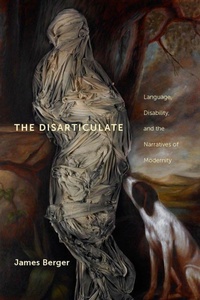
The Disarticulate
Language, Disability, and the Narratives of Modernity
Published on 23. May 2014
Book
Paperback/Softback
320 pages
978-0-8147-2530-6 (ISBN)
Description
Language is integral to our
social being. But what is the status of those who stand outside of language?
The mentally disabled, "wild" children, people with autism and other
neurological disorders, as well as animals, infants, angels, and artificial
intelligences, have all engaged with language from a position at its borders.
In the intricate verbal constructions of modern literature, the
'disarticulate'-those at the edges of language-have, paradoxically, played
essential, defining roles.
Drawing on the disarticulate figures in
modern fictional works such as Billy Budd, The Sound and the Fury,
Nightwood, White Noise, and The Echo Maker, among others,
James Berger shows in this intellectually bracing study how these characters
mark sites at which aesthetic, philosophical, ethical, political, medical, and
scientific discourses converge. It is also the place of the greatest ethical
tension, as society confronts the needs and desires of "the least of its
brothers." Berger argues that the disarticulate is that which is unaccountable
in the discourses of modernity and thus stands as an alternative to the
prevailing social order. Using literary history and theory, as well as
disability and trauma theory, he examines how these disarticulate figures
reveal modernity's anxieties in terms of how it constructs its others.
social being. But what is the status of those who stand outside of language?
The mentally disabled, "wild" children, people with autism and other
neurological disorders, as well as animals, infants, angels, and artificial
intelligences, have all engaged with language from a position at its borders.
In the intricate verbal constructions of modern literature, the
'disarticulate'-those at the edges of language-have, paradoxically, played
essential, defining roles.
Drawing on the disarticulate figures in
modern fictional works such as Billy Budd, The Sound and the Fury,
Nightwood, White Noise, and The Echo Maker, among others,
James Berger shows in this intellectually bracing study how these characters
mark sites at which aesthetic, philosophical, ethical, political, medical, and
scientific discourses converge. It is also the place of the greatest ethical
tension, as society confronts the needs and desires of "the least of its
brothers." Berger argues that the disarticulate is that which is unaccountable
in the discourses of modernity and thus stands as an alternative to the
prevailing social order. Using literary history and theory, as well as
disability and trauma theory, he examines how these disarticulate figures
reveal modernity's anxieties in terms of how it constructs its others.
Reviews / Votes
"[T]he book is a valuable contribution to disability studies both for its speculations and specific readings. It is a very thoughtful and thought-filled work, nuanced and wide-ranging, which should have an effect on the field." (Critical Inquiry)More details
Series
Language
English
Place of publication
New York
United States
Target group
Professional and scholarly
Product notice
Paperback (trade)
Dimensions
Height: 226 mm
Width: 151 mm
Thickness: 22 mm
Weight
421 gr
ISBN-13
978-0-8147-2530-6 (9780814725306)
Copyright in bibliographic data and cover images is held by Nielsen Book Services Limited or by the publishers or by their respective licensors: all rights reserved.
Schweitzer Classification
Other editions
Additional editions
E-Book
05/2014
New York University Press
€0.00
Available for download
E-Book
05/2014
New York University Press
€142.99
Available for download
Person
James Berger is Senior Lecturer in American Studies and English at Yale University. He is author of After the End: Representations of Post-Apocalypse (1999) and a book of poetry, Prior (2013). He is the editor of Helen Keller's The Story of My Life: The Restored Edition (2003).
Content
Acknowledgments Introduction: Disarticulate and Dysarticulate 1. The Bearing Across of Language: Care, Catachresis, and Political Failure 2. Linguistic Impairment and the Default of Modernism: Totality and Otherness: Dys-/Disarticulate Modernity 3. Post-Modern Wild Children, Falling Towers, and the Counter-Linguistic Turn 4. Dys-/Disarticulation and Disability 5. Alterity Is Relative: Impairment, Narrative, and Care in an Age of Neuroscience Epilogue: "Language in Dissolution" and "A World without Words" Notes Works Cited Index About the Author