

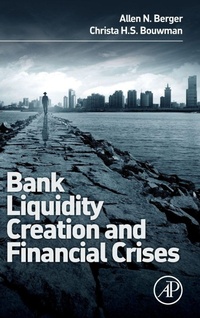
Bank Liquidity Creation and Financial Crises
New Perspectives
Published on 17. November 2015
Book
Hardback
294 pages
978-0-12-800233-9 (ISBN)
Description
Bank Liquidity Creation and Financial Crises delivers a consistent, logical presentation of bank liquidity creation and addresses questions of research and policy interest that can be easily understood by readers with no advanced or specialized industry knowledge.
Authors Allen Berger and Christa Bouwman examine ways to measure bank liquidity creation, how much liquidity banks create in different countries, the effects of monetary policy (including interest rate policy, lender of last resort, and quantitative easing), the effects of capital, the effects of regulatory interventions, the effects of bailouts, and much more. They also analyze bank liquidity creation in the US over the past three decades during both normal times and financial crises.
Narrowing the gap between the "academic world" (focused on theories) and the "practitioner world" (dedicated to solving real-world problems), this book is a helpful new tool for evaluating a bank's performance over time and comparing it to its peer group.
Authors Allen Berger and Christa Bouwman examine ways to measure bank liquidity creation, how much liquidity banks create in different countries, the effects of monetary policy (including interest rate policy, lender of last resort, and quantitative easing), the effects of capital, the effects of regulatory interventions, the effects of bailouts, and much more. They also analyze bank liquidity creation in the US over the past three decades during both normal times and financial crises.
Narrowing the gap between the "academic world" (focused on theories) and the "practitioner world" (dedicated to solving real-world problems), this book is a helpful new tool for evaluating a bank's performance over time and comparing it to its peer group.
Reviews / Votes
"A key economic function of banks is to create liquidity in the economy, financing illiquid assets with liquid labilities and enhancing overall funding of investment projects in the economy. Knowing how to measure how much liquidity is being created at any point in time is of central importance for economists, policymakers and bankers. This book, based on the path-breaking empirical measure for bank liquidity creation developed by the authors in their earlier published research, provides an exhaustive and enlightening discussion of the variety of interesting issues related to bank liquidity creation, including its implications for bank stability and regulation. A must read!" --Anjan Thakor, Washington University in St. Louis"This text provides an excellent insight into the features of banks and the dynamics of financial intermediation. The authors provide terrific coverage of the liquidity creation process and how financial crises inhibit such activity. This is an essential guide for all students of banking and financial system behavior." --Philip Molyneux, Bangor University
More details
Language
English
Place of publication
San Diego
United States
Publishing group
Elsevier Science Publishing Co Inc
Target group
Professional and scholarly
Upper-division undergraduates, graduate students, academics, and professionals worldwide working in banking, financial intermediation, and regulation.
Product notice
Laminated cover
Dimensions
Height: 236 mm
Width: 156 mm
Thickness: 22 mm
Weight
615 gr
ISBN-13
978-0-12-800233-9 (9780128002339)
Copyright in bibliographic data and cover images is held by Nielsen Book Services Limited or by the publishers or by their respective licensors: all rights reserved.
Schweitzer Classification
Other editions
Additional editions
Allen N. Berger | Christa Bouwman
Bank Liquidity Creation and Financial Crises
E-Book
11/2015
Academic Press
€57.95
Available for download
Persons
Allen N. Berger is H. Montague Osteen, Jr., Professor in Banking and Finance at the University of South Carolina, President of the Financial Intermediation Research Society, Senior Fellow at the Wharton Financial Institutions Center, and Fellow of the European Banking Center.
He has published over 125 articles in refereed journals, including in top finance journals, Journal of Finance, Journal of Financial Economics, and top economics journals, Journal of Political Economy and American Economic Review. He is co-author of two research books and co-edited all three editions of the Oxford Handbook of Banking. He serves on nine journal editorial boards, co-edited eight special issues of research journals, and formerly edited the Journal of Money, Credit, and Banking.
His research has been cited over 90,000 times, including 30 articles with over 1,000 citations each, and another 19 with over 500 citations each. He has given invited keynote addresses on five continents. Christa H.S. Bouwman is Associate Professor of Finance and RepublicBank Research Fellow at Mays Business School at Texas A&M University; Fellow of the Wharton Financial Institutions Center; and a Research Associate at the Federal Reserve Bank of Cleveland. She was Associate Professor of Banking & Finance at Case Western Reserve University, where she also held the Lewis-Progressive Chair; Visiting Assistant Professor of Finance at MIT's Sloan School of Management; and Visiting Scholar at the Federal Reserve Bank of Boston. Professor Bouwman's research interests are in Financial Intermediation and Corporate Finance. She is an Associate Editor at three journals. Her research papers have been published in the Journal of Financial Economics, Review of Financial Studies, Journal of Banking & Finance, MIT / Sloan Management Review, and Oxford Handbook of Banking. She is co-author of Bank Liquidity Creation and Financial Crises (Elsevier). Professor Bouwman worked for five years at ABN AMRO Bank and as a part-time litigative consultant for the U.S. Department of Justice. She has been nominated for numerous undergraduate and MBA Excellence in Teaching awards. She received a Ph.D. in Finance from the University of Michigan in 2005, an MBA from Cornell University in 1993, and a B.A./M.A. in Economics and Business (cum laude) from the University of Groningen - the Netherlands in 1993..
He has published over 125 articles in refereed journals, including in top finance journals, Journal of Finance, Journal of Financial Economics, and top economics journals, Journal of Political Economy and American Economic Review. He is co-author of two research books and co-edited all three editions of the Oxford Handbook of Banking. He serves on nine journal editorial boards, co-edited eight special issues of research journals, and formerly edited the Journal of Money, Credit, and Banking.
His research has been cited over 90,000 times, including 30 articles with over 1,000 citations each, and another 19 with over 500 citations each. He has given invited keynote addresses on five continents. Christa H.S. Bouwman is Associate Professor of Finance and RepublicBank Research Fellow at Mays Business School at Texas A&M University; Fellow of the Wharton Financial Institutions Center; and a Research Associate at the Federal Reserve Bank of Cleveland. She was Associate Professor of Banking & Finance at Case Western Reserve University, where she also held the Lewis-Progressive Chair; Visiting Assistant Professor of Finance at MIT's Sloan School of Management; and Visiting Scholar at the Federal Reserve Bank of Boston. Professor Bouwman's research interests are in Financial Intermediation and Corporate Finance. She is an Associate Editor at three journals. Her research papers have been published in the Journal of Financial Economics, Review of Financial Studies, Journal of Banking & Finance, MIT / Sloan Management Review, and Oxford Handbook of Banking. She is co-author of Bank Liquidity Creation and Financial Crises (Elsevier). Professor Bouwman worked for five years at ABN AMRO Bank and as a part-time litigative consultant for the U.S. Department of Justice. She has been nominated for numerous undergraduate and MBA Excellence in Teaching awards. She received a Ph.D. in Finance from the University of Michigan in 2005, an MBA from Cornell University in 1993, and a B.A./M.A. in Economics and Business (cum laude) from the University of Groningen - the Netherlands in 1993..
Author
Professor in Banking and Finance, University of South Carolina, President, Financial Intermediation Research Society, Senior Fellow, Wharton Financial Institutions Center, and Fellow of the European Banking Center, SC, USA
Texas A&M University, College Station, TX, and Wharton Financial Institutions Center, Philadelphia, PA, USA
Content
PART I - INTRODUCTORY MATERIALS
1. Introduction
2. Liquidity Creation Theories
3. Understanding Financial Statements
PART II - LIQUIDITY CREATION MEASUREMENT AND USES
4. Measurement of Bank Liquidity Creation
5. Using Liquidity Creation to Measure Bank Output
6. Using Liquidity Creation to Measure Bank Liquidity
Part III - FINANCIAL CRISES, LIQUIDITY CREATION, AND THEIR LINKS
7. Defining and Dating Financial Crises
8. How Much Liquidity Do Banks Create During Normal Times and Financial Crises?
9. The Links between Bank Liquidity Creation and Future Financial Crises
PART IV - CAUSES AND CONSEQUENCES OF LIQUIDITY CREATION
10. Do Better-Capitalized Banks Create More or Less Liquidity?
11. Which Banks Create the Most and Least Liquidity?
12. How do Government Policies and Actions affect Bank Liquidity Creation during Normal Times and Financial Crises?
13. Bank Liquidity Creation: Value, Performance, and Persistence
Part V - LOOKING TOWARD THE FUTURE
14. How Can Bank Executives, Financial Analysts, Researchers, and Policy Makers (Including Legislators, Regulators, and Central Bankers) Use Bank Liquidity Creation Data to Their Advantages?
15. Where We Now Stand and the Open Research and Policy Questions
16. Links to Websites Containing Data, Documents, and Other Information Useful for U.S. Bank Performance Benchmarking, Research, and Policy Work
References
1. Introduction
2. Liquidity Creation Theories
3. Understanding Financial Statements
PART II - LIQUIDITY CREATION MEASUREMENT AND USES
4. Measurement of Bank Liquidity Creation
5. Using Liquidity Creation to Measure Bank Output
6. Using Liquidity Creation to Measure Bank Liquidity
Part III - FINANCIAL CRISES, LIQUIDITY CREATION, AND THEIR LINKS
7. Defining and Dating Financial Crises
8. How Much Liquidity Do Banks Create During Normal Times and Financial Crises?
9. The Links between Bank Liquidity Creation and Future Financial Crises
PART IV - CAUSES AND CONSEQUENCES OF LIQUIDITY CREATION
10. Do Better-Capitalized Banks Create More or Less Liquidity?
11. Which Banks Create the Most and Least Liquidity?
12. How do Government Policies and Actions affect Bank Liquidity Creation during Normal Times and Financial Crises?
13. Bank Liquidity Creation: Value, Performance, and Persistence
Part V - LOOKING TOWARD THE FUTURE
14. How Can Bank Executives, Financial Analysts, Researchers, and Policy Makers (Including Legislators, Regulators, and Central Bankers) Use Bank Liquidity Creation Data to Their Advantages?
15. Where We Now Stand and the Open Research and Policy Questions
16. Links to Websites Containing Data, Documents, and Other Information Useful for U.S. Bank Performance Benchmarking, Research, and Policy Work
References