

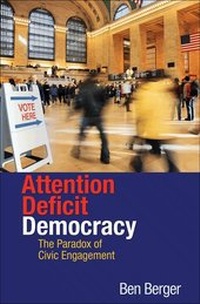
Attention Deficit Democracy
The Paradox of Civic Engagement
Published on 11. September 2011
Book
Hardback
224 pages
978-0-691-14468-9 (ISBN)
Description
Handwringing about political apathy is as old as democracy itself. As early as 425 BC, the playwright Aristophanes ridiculed his fellow Athenians for gossiping in the market instead of voting. In more recent decades, calls for greater civic engagement as a democratic cure-all have met with widespread agreement. But how realistic - or helpful - is it to expect citizens to devote more attention and energy to politics? In "Attention Deficit Democracy", Ben Berger provides a surprising new perspective on the problem of civic engagement, challenging idealists who aspire to revolutionize democracies and their citizens, but also taking issue with cynics who think that citizens cannot - and need not - do better. "Civic engagement" has become an unwieldy and confusing catchall, Berger argues. We should talk instead of political, social, and moral engagement, figuring out which kinds of engagement make democracy work better, and how we might promote them.
Focusing on political engagement and taking Alexis de Tocqueville and Hannah Arendt as his guides, Berger identifies ways to achieve the political engagement we want and need without resorting to coercive measures such as compulsory national service or mandatory voting. By providing a realistic account of the value of political engagement and practical strategies for improving it, while avoiding proposals we can never hope to achieve, "Attention Deficit Democracy" makes a persuasive case for a public philosophy that much of the public can actually endorse.
Focusing on political engagement and taking Alexis de Tocqueville and Hannah Arendt as his guides, Berger identifies ways to achieve the political engagement we want and need without resorting to coercive measures such as compulsory national service or mandatory voting. By providing a realistic account of the value of political engagement and practical strategies for improving it, while avoiding proposals we can never hope to achieve, "Attention Deficit Democracy" makes a persuasive case for a public philosophy that much of the public can actually endorse.
Reviews / Votes
Winner of the 2012 Book Award, North American Society for Social Philosophy "Acknowledging that there are real limits to how involved citizens will be in political activity, [Berger] develops a sophisticated and balanced argument for policies to enhance political engagement, mainly through institutional changes to encourage and especially to make better use of citizens' activity. The book is clearly written and accessible."--Choice "I applaud Berger's effort to add analytic rigor to discussions that frequently devolve into reflexive paeans to civic engagement."--Justin Buchler, Perspectives on Politics "Arendt and/or Tocqueville scholars may find Attention Deficit Democracy of interest. Berger offers contributions to scholarship on both, although his readings are not revolutionary... [T]he strength of Berger's treatment of Arendt and Tocqueville is not novel interpretations, but the creative application of their thinking in explaining ADD."--Michael T. Rogers, Political Studies ReviewMore details
Language
English
Place of publication
New Jersey
United States
Target group
College/higher education
Professional and scholarly
Product notice
Trade binding
Illustrations
2 line illus. 2 tables.
Dimensions
Height: 229 mm
Width: 152 mm
Weight
454 gr
ISBN-13
978-0-691-14468-9 (9780691144689)
Copyright in bibliographic data and cover images is held by Nielsen Book Services Limited or by the publishers or by their respective licensors: all rights reserved.
Schweitzer Classification
Other editions
Additional editions
E-Book
06/2015
1st Edition
Princeton University Press
from
€109.95
Available for download
Person
Ben Berger is associate professor of political science at Swarthmore College.
Content
Preface vii CHAPTER 1: Introduction 1 CHAPTER 2: The Rules of Engagement 24 CHAPTER 3: Political Engagement as Intrinsic Good: Arendt and Company 52 CHAPTER 4: Political Engagement as Instrumental Good: Tocqueville, Attention Deficit, and Energy 83 CHAPTER 5: Is Political Engagement Better Than Sex? 121 CHAPTER 6: Conclusion: Tocqueville vs. the Full Monty 144 Bibliography 175 Index 195