

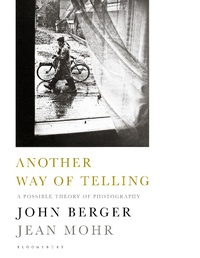
Another Way of Telling
A Possible Theory of Photography
Published on 10. March 2016
Book
Paperback/Softback
304 pages
978-1-4088-6445-6 (ISBN)
Description
A new edition of John Berger and Jean Mohr's classic investigation into the nature of photography and what makes it so different from other art forms
'One of the world's most influential art critics ... Berger sees clearly with fresh surprise yet profound understanding' Washington Times
In one of the most eloquent accounts of photography ever devised, the writer John Berger and the photographer Jean Mohr set out to understand the fundamental nature of photography and how it makes its impact.
Asking a range of questions - What is a photograph? What do photographs mean? How can they be used? - they give their answers in terms of a photograph as 'a meeting place where the interests of the photographer, the photographed, the viewer and those who are using the photography are often contradictory'. From these beginnings they develop a theory of photography that has at its centre the form's essential ambiguity, arguing that photography is totally unlike a film and has nothing to do with reportage. Rather, it constitutes 'another way of telling'.
The unique combination of critic and photographer results in a work that moves beyond the landmarks established by Walter Benjamin, Roland Barthes and Susan Sontag to establish a new theory of photography.
This unique combination of words and pictures includes 230 photographs by Jean Mohr.
'One of the world's most influential art critics ... Berger sees clearly with fresh surprise yet profound understanding' Washington Times
In one of the most eloquent accounts of photography ever devised, the writer John Berger and the photographer Jean Mohr set out to understand the fundamental nature of photography and how it makes its impact.
Asking a range of questions - What is a photograph? What do photographs mean? How can they be used? - they give their answers in terms of a photograph as 'a meeting place where the interests of the photographer, the photographed, the viewer and those who are using the photography are often contradictory'. From these beginnings they develop a theory of photography that has at its centre the form's essential ambiguity, arguing that photography is totally unlike a film and has nothing to do with reportage. Rather, it constitutes 'another way of telling'.
The unique combination of critic and photographer results in a work that moves beyond the landmarks established by Walter Benjamin, Roland Barthes and Susan Sontag to establish a new theory of photography.
This unique combination of words and pictures includes 230 photographs by Jean Mohr.
Reviews / Votes
One of the world's most influential art critics ... Berger sees clearly with fresh surprise yet profound understanding * <i><b>Washington Times</b></i> * A wonderful artist and thinker * <b>Susan Sontag</b> * Polemical, meditative, radical, always original, Berger's essays are extremely wide-ranging * <b>Geoff Dyer</b> * One of the most influential intellectuals of our time * <b>Sean O'Hagan</b> *More details
Language
English
Place of publication
London
United Kingdom
Product notice
Paperback (UK-trade)
Dimensions
Height: 198 mm
Width: 154 mm
Thickness: 22 mm
Weight
603 gr
ISBN-13
978-1-4088-6445-6 (9781408864456)
Copyright in bibliographic data and cover images is held by Nielsen Book Services Limited or by the publishers or by their respective licensors: all rights reserved.
Schweitzer Classification
Other editions
Additional editions
E-Book
04/2016
1st Edition
Bloomsbury Publishing PLC
€24.49
Available for download
Previous edition

Book
Bloomsbury Publishing PLC
€43.51
The article will not be published
Persons
John Berger was born in London in 1926. His many books, innovative in form and far-reaching in their historical and political insight, include the Booker Prize-winning novel G, To the Wedding and King. Amongst his outstanding studies of art and photography are The Success and Failure of Picasso, About Looking and the internationally acclaimed Ways of Seeing. He lives and works in a small village in the French Alps, the setting for his trilogy Into Their Labours (Pig Earth, Once in Europa and Lilac and Flag).
Jean Mohr was born in Geneva in 1925. A documentary photographer who has worked with many of the world's leading humanitarian organisations, he has collaborated with John Berger on a number of projects including A Fortunate Man and The Seventh Man.
Jean Mohr was born in Geneva in 1925. A documentary photographer who has worked with many of the world's leading humanitarian organisations, he has collaborated with John Berger on a number of projects including A Fortunate Man and The Seventh Man.