

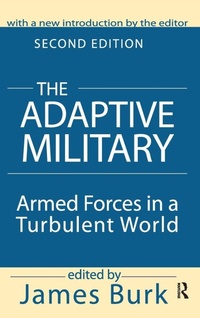
The Adaptive Military
Armed Forces in a Turbulent World
2nd Edition
Published on 9. August 2017
Book
Hardback
238 pages
978-1-138-53407-0 (ISBN)
Description
When the cold war ended, many hoped it signified enhanced prospects for a more stable world. However, despite favorable political developments, the post-cold war period has been marked by turbulence, uncertainty, and challenge. The actions of rogue states such as Iraq and North Korea have made nuclear proliferation more unpredictable. Violence in Somalia and Bosnia has cast doubt on the viability of international peacekeeping arrangements. Hopes for expanding democratization have been dimmed by assertions that the values of liberal democracy and human rights are incompatible with non-Western cultures. The Adaptive Military describes how military security policies and practices have adapted to these new times and explains why such changes are necessary.
The central argument is that current conflicts have been shaped by long-term trends, which increased the number and complexity of threats that the developed world is supposed to meet, and correspondingly decreased the stock of social and political options available to meet them.
Although the authors differ in their assessments about the current prospects for peace and ways to maintain security, the issues they address are as critical as they were at the end of the Cold War. Mobilizing resources and political support for remote and difficult enterprises will always remain contentious, but if we recognize the hazard of letting violence run unopposed throughout the world, then we bear some responsibility to consider how it might be checked. This volume is an exercise of that responsibility. It will be of great interest to experts in military studies and international relations.
The central argument is that current conflicts have been shaped by long-term trends, which increased the number and complexity of threats that the developed world is supposed to meet, and correspondingly decreased the stock of social and political options available to meet them.
Although the authors differ in their assessments about the current prospects for peace and ways to maintain security, the issues they address are as critical as they were at the end of the Cold War. Mobilizing resources and political support for remote and difficult enterprises will always remain contentious, but if we recognize the hazard of letting violence run unopposed throughout the world, then we bear some responsibility to consider how it might be checked. This volume is an exercise of that responsibility. It will be of great interest to experts in military studies and international relations.
More details
Edition
2nd edition
Language
English
Place of publication
London
United Kingdom
Publishing group
Taylor & Francis Ltd
Target group
College/higher education
Dimensions
Height: 235 mm
Width: 157 mm
Thickness: 18 mm
Weight
504 gr
ISBN-13
978-1-138-53407-0 (9781138534070)
Copyright in bibliographic data and cover images is held by Nielsen Book Services Limited or by the publishers or by their respective licensors: all rights reserved.
Schweitzer Classification
Other editions
Additional editions
E-Book
07/2017
2nd Edition
Routledge
€44.99
Available for download
E-Book
07/2017
2nd Edition
Routledge
€44.99
Available for download
Book
09/1998
2nd Edition
Transaction Publishers
€51.10
Shipment within 10-20 days
Person
James Burk
Content
List of Tables
Acknowledgments
Introduction, 1998: Ten Years of New Times
James Burk
1. Thinking Through the End of the Cold War
James Burk
2. Armed Force and Armed Forces in a Turbulent World
James N. Rosenau
3. The Future of Transitional Warfare
William R. Thompson
4. The Shifting Threat and American National Security:
Sources and Consequences of Change
Donald M. Snow
5. A Farewell to Arms? The Military and the Nation-State
in a Changing World
Christopher Dandeker
6. The Postmodern Military
Charles C. Moskos and James Burk
7. Multinational Peacekeeping Operations:
Background and Effectiveness
David R. Segal and Robert J. Waldman
8. The Challenge of Nonviolence in the New World Order
Robert L. Holmes
Contributors
Index
Acknowledgments
Introduction, 1998: Ten Years of New Times
James Burk
1. Thinking Through the End of the Cold War
James Burk
2. Armed Force and Armed Forces in a Turbulent World
James N. Rosenau
3. The Future of Transitional Warfare
William R. Thompson
4. The Shifting Threat and American National Security:
Sources and Consequences of Change
Donald M. Snow
5. A Farewell to Arms? The Military and the Nation-State
in a Changing World
Christopher Dandeker
6. The Postmodern Military
Charles C. Moskos and James Burk
7. Multinational Peacekeeping Operations:
Background and Effectiveness
David R. Segal and Robert J. Waldman
8. The Challenge of Nonviolence in the New World Order
Robert L. Holmes
Contributors
Index