

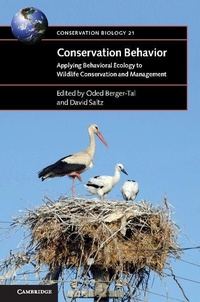
Conservation Behavior
Applying Behavioral Ecology to Wildlife Conservation and Management
Published on 5. May 2016
Book
Hardback
402 pages
978-1-107-04010-6 (ISBN)
Description
Conservation behavior assists the investigation of species endangerment associated with managing animals impacted by anthropogenic activities. It employs a theoretical framework that examines the mechanisms, development, function, and phylogeny of behavior variation in order to develop practical tools for preventing biodiversity loss and extinction. Developed from a symposium held at the International Congress on Conservation Biology in 2011, this is the first book to offer an in-depth, logical framework that identifies three vital areas for understanding conservation behavior: anthropogenic threats to wildlife, conservation and management protocols, and indicators of anthropogenic threats. Bridging the gap between behavioral ecology and conservation biology, this volume ascertains key links between the fields, explores the theoretical foundations of these linkages, and connects them to practical wildlife management tools and concise applicable advice. Adopting a clear and structured approach throughout, this book is a vital resource for graduate students, academic researchers, and wildlife managers.
Reviews / Votes
'This volumes takes a comprehensive and practical look at a crucial question in wildlife conservation ... [it] has a very practical feel throughout ... [and] every chapter is exceptionally rich in practical examples, with useful citations that form classic case studies of the principle involved. ... [The volume is] rigorous and detailed, yet readable, and will appeal to a wide audience.' Arik Kershenbaum, The Quarterly Review of BiologyMore details
Series
Language
English
Place of publication
Cambridge
United Kingdom
Target group
Professional and scholarly
Illustrations
3 Tables, black and white; 19 Halftones, unspecified; 12 Line drawings, unspecified
Dimensions
Height: 235 mm
Width: 157 mm
Thickness: 26 mm
Weight
736 gr
ISBN-13
978-1-107-04010-6 (9781107040106)
Copyright in bibliographic data and cover images is held by Nielsen Book Services Limited or by the publishers or by their respective licensors: all rights reserved.
Schweitzer Classification
Other editions
Additional editions
Oded Berger-Tal | David Saltz
Conservation Behavior
Applying Behavioral Ecology to Wildlife Conservation and Management
E-Book
06/2016
Cambridge University Press
€44.49
Available for download
Oded Berger-Tal
Conservation Behavior
Applying Behavioral Ecology to Wildlife Conservation and Management
E-Book
05/2016
Cambridge University Press
€36.99
Available for download
Oded Berger-Tal | David Saltz
Conservation Behavior
Applying Behavioral Ecology to Wildlife Conservation and Management
Book
05/2016
Cambridge University Press
€59.50
Shipment within 15-20 days
Persons
Oded Berger-Tal is a senior lecturer at the Mitrani Department of Desert Ecology of Ben Gurion University, Israel. His research centers upon the integration of behavioral ecology into wildlife conservation and management. David Saltz is Professor of Conservation Biology at the Mitrani Department of Desert Ecology, and the director of the Swiss Institute for Desert Energy and Environmental Research of Ben Gurion University of the Negev, Israel. His research focuses on wildlife conservation and management.
Content
List of contributors; Preface; Part I. The Integration of Two Disciplines: Conservation and Behavioral Ecology: 1. Introduction: the whys and the hows of conservation behavior Oded Berger-Tal and David Saltz; 2. Evolution and conservation behavior John P. Swaddle; 3. Learning and conservation behavior: an introduction and overview Zachary Schakner and Daniel T. Blumstein; Part II. Anthropogenic Impacts on Animal Behavior and their Implications for Conservation and Management: 4. Behavioral rigidity in the face of rapid anthropogenic changes Oded Berger-Tal and David Saltz; 5. Anthropogenic impacts on behavior: the pros and cons of plasticity Daniel I. Rubenstein; Part III. Behavior-Based Management: Using Behavioral Knowledge to Improve Conservation and Management Efforts: 6. The role of animal sensory perception in behavior-based management Esteban Fernandez-Juricic; 7. Behavior-based contributions to reserve design and management Colleen Cassady St Clair, Rob Found, Aditya Gangadharan and Maureen Murray; 8. Behavior-based management: conservation translocations Ben D. Bell; 9. From individual behavior to population viability, implications for conservation and management Carmen Bessa-Gomes and Francois Sarrazin; 10. Manipulating animal behavior to ensure reintroduction success Debra M. Shier; Part IV. Behavioral Indicators: 11. Direct behavioral indicators as a conservation and management tool Burt P. Kotler, Douglas W. Morris and Joel S. Brown; 12. Indirect behavioral indicators and their uses in conservation and management Oded Berger-Tal and David Saltz; Index.