

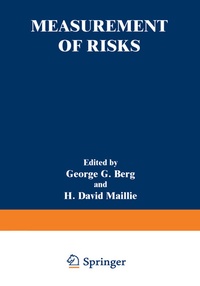
Measurement of Risks
Published on 26. November 2012
Book
Paperback/Softback
X, 550 pages
978-1-4684-4054-6 (ISBN)
Description
The risks of measuring risk.- Session I: Statistical Inference of Risks.- The proper interpretation of significance tests in risk assessment.- Remarks on sequential designs in risk assessment.- Epidemiologic studies of toxic response ¿ significance requirements.- Biological models in epidemiology: radiation carcinogenesis.- Session II: Risks of Prenatal Exposures.- Dose-response relationships for adult and prenatal exposures to methylmercury.- Risk factors for deficits in early cognitive development.- Utilization of critical periods during development to study the effects of low levels of environmental agents.- Epidemiologic studies of environmental exposures in human reproduction.- Session III: Risks of Contaminated Air and Drinking Water.- Health risks of lead as judged from autopsy material.- Use of tests of pulmonary function to measure effect of air pollutants.- Experimental evaluation of air pollutants in humans as a basis for estimating risk.- Problems and possibilities of determining the carcinogenic potency of inhalable fibrous dusts and polycyclic aromatic hydrocarbons.- Session IV: Comparative Risks of Energy Sources.- Some probabilistic aspects of safety assessment.- What is the total risk of energy systems?.- Have the nuclear power risk assessors failed?.- Session V: Genetic and Cancer Hazards.- Cytogenetic bases for risk inference.- Problems and solutions in the estimation of genetic risks from radiation and chemicals.- Evaluation of genetic risks.- Session VI: Extrapolation to Low Doses.- Extrapolation from long term low dose animal studies -I. Review.- Extrapolation from long term low dose animal studies -II. The ED01 study.- The shapes of the radiation dose ¿ mutation response curves in Drosophila: mechanisms and implications.- The cancer risk from low level radiation.- A simple threshold model for the classical bioassay problem.- A biological basis for the linear non-threshold dose ¿ response relationship for low-level carcinogen response.- Participants.
More details
Series
Edition
Softcover reprint of the original 1st ed. 1981
Language
English
Place of publication
New York
United States
Target group
Professional and scholarly
Research
Illustrations
12 s/w Abbildungen
X, 550 p. 12 illus.
Dimensions
Height: 244 mm
Width: 170 mm
Thickness: 31 mm
Weight
961 gr
ISBN-13
978-1-4684-4054-6 (9781468440546)
DOI
10.1007/978-1-4684-4052-2
Schweitzer Classification
Other editions
Additional editions

George G. Berg
Measurement of Risks
Book
10/1981
Springer
€111.07
Article exhausted; check different version
Content
The risks of measuring risk.- Session I: Statistical Inference of Risks.- The proper interpretation of significance tests in risk assessment.- Remarks on sequential designs in risk assessment.- Epidemiologic studies of toxic response - significance requirements.- Biological models in epidemiology: radiation carcinogenesis.- Session II: Risks of Prenatal Exposures.- Dose-response relationships for adult and prenatal exposures to methylmercury.- Risk factors for deficits in early cognitive development.- Utilization of critical periods during development to study the effects of low levels of environmental agents.- Epidemiologic studies of environmental exposures in human reproduction.- Session III: Risks of Contaminated Air and Drinking Water.- Health risks of lead as judged from autopsy material.- Use of tests of pulmonary function to measure effect of air pollutants.- Experimental evaluation of air pollutants in humans as a basis for estimating risk.- Problems and possibilities of determining the carcinogenic potency of inhalable fibrous dusts and polycyclic aromatic hydrocarbons.- Session IV: Comparative Risks of Energy Sources.- Some probabilistic aspects of safety assessment.- What is the total risk of energy systems?.- Have the nuclear power risk assessors failed?.- Session V: Genetic and Cancer Hazards.- Cytogenetic bases for risk inference.- Problems and solutions in the estimation of genetic risks from radiation and chemicals.- Evaluation of genetic risks.- Session VI: Extrapolation to Low Doses.- Extrapolation from long term low dose animal studies -I. Review.- Extrapolation from long term low dose animal studies -II. The ED01 study.- The shapes of the radiation dose - mutation response curves in Drosophila: mechanisms and implications.- The cancer risk fromlow level radiation.- A simple threshold model for the classical bioassay problem.- A biological basis for the linear non-threshold dose - response relationship for low-level carcinogen response.- Participants.