

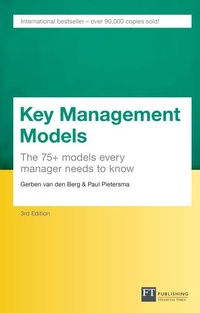
Key Management Models, Travel Edition
Published on 18. December 2015
Book
Paperback/Softback
344 pages
978-1-292-08176-2 (ISBN)
Description
This best selling management book is a true classic. If you want to be a model manager, keep this new, even better 3rd edition close at hand.Key Management Models has the winning combination of brevity and clarity, giving you short, practical overviews of the top classic and cutting edge management models in an easy-to-use, ready reference format. Whether you want to remind yourself about models you've already come across, or want to find new ones, you'll find yourself referring back to it again and again. It's the essential guide to all the management models you'll ever need to know about. Includes the classic and essential management models from the previous 2 editions. Thoroughly updated to include cutting edge new models. Two-colour illustrations and case studies throughout.
More details
Language
English
Place of publication
Harlow
United Kingdom
Publishing group
Pearson Education Limited
Target group
Professional and scholarly
Dimensions
Height: 216 mm
Width: 136 mm
Thickness: 22 mm
Weight
423 gr
ISBN-13
978-1-292-08176-2 (9781292081762)
Copyright in bibliographic data and cover images is held by Nielsen Book Services Limited or by the publishers or by their respective licensors: all rights reserved.
Schweitzer Classification
Persons
Marcel van Assen is a senior consultant at the Operations Management group of Berenschot. His industrial consulting experience covers a range of manufacturing, supply chain, and strategic issues, from operational excellence to value-innovation based on strategic conversation, roadmapping and foresight. Marcel is also an assistant professor of manufacturing management at the Department of Management of Technology and Innovation Department of RSM Erasmus University. He has written several books and articles on operations and innovation management. He holds an MSc in mechanical engineering from the University of Twente, an MSc in business administration (strategy and organisation) from the Open University, and a PhD in business administration from RSM Erasmus University. In addition he is associate member of ERIM (Erasmus Research Institute of Management).Gerben van den Berg read business administration at the University of Groningen. He works at Berenschot as consultant in the Business Strategies group. He is a co-author of the book Excellence = optimization and innovation and (co)author of several articles concerning strategic management.Paul Pietersma MSc. BA is a strategy consultant and managing director of Business Strategies at Berenschot. He has more than 10 years of experience in the consultancy business during which time he has advised many CEOs and boards of directors on a variety of strategic issues. He has won the Dutch Professionals Award of Management Consultancy, he has published several articles on strategy and he is the (co)author of two leading Dutch strategy books 'Het Strategieboek I' and 'Het Strategieboek II'.
Content
About the authors Publisher's acknowledgements Preface Using this book Part 1: Corporate and business strategy1 Ansoff's matrix and product market grid 2 BCG-matrix 3 Strategic dialogue4 BHAG 5 Blue ocean strategy 6 Business model canvas 7 Business scope (Abell)8 Competitive analysis: Porter's five forces model 9 Core competencies 10 Internationalisation strategy framework 11 Road-mapping12 Scenario planning13 Strategy maps 14 SWOT analysis15 Value-disciplines Part 2: Organisation and governance16 7-S Framework 17 Balanced scorecard 18 Benchmarking19 Organisational growth model (Greiner)20 Offshoring/outsourcing21 Organisational configurations (Mintzberg) 22 Overhead value analysis23 Risk management24 The value chain Part 3: Finance25 Activity-based costing26 Capital asset pricing model (CAPM)27 Discounted cash flow (DCF) and net present value (NPV) 28 DuPont scheme29 Economic value added (EVA) and weighted average cost of capital (WACC) 30 Financial ratio analysis: liquidity, solvency and profitability ratios31 Investment stages 32 Real options theory33 Risk-reward analysis34 Value-based management Part 4: Marketing and sales35 4Ps of marketing (Kotler) 36 Branding pentagram37 Client pyramid (Curry) 38 Crowdsourcing39 Customer journey mapping40 MABA analysis41 Social network analysis42 Stakeholder management Part 5: Operations, supply chain management and procurement43 Business process redesign 44 House of purchasing and supply 45 Kaizen/Gemba46 Lean thinking/just-in-time 47 Purchasing model (Kraljic) 48 Root cause analysis/Pareto analysis49 Six sigma50 The EFQM model51 Value stream mapping Part 6: Innovation, technology management and e-business52 Diffusion model53 Disruptive innovation 54 Hype cycle 55 Innovation circle56 Information Technology Infrastructure Library (ITIL (R)) 57 Stage-Gate model58 Strategic IT-alignment model 59 The Open Group Architecture Framework (TOGAF (R)) Part 7: Human Resources (HR) and change management60 Change quadrants 61 Compensation model 62 Eight phases of change (Kotter)63 HR business roles 64 Motivational insights 65 Six thinking hats (De Bono) 66 Socially engineered change 67 Team roles (Belbin) 68 The Deming cycle: plan-do-check-act Part 8: Leadership and (inter)cultural management69 Bottom of the pyramid 70 CAGE distance framework 71 Competing values 72 Core quadrants 73 Cultural dimensions (Hofstede) 74 Culture dimensions (Trompenaars) 75 Focus-energy matrix76 Seven habits of highly effective people (Covey) 77 Situational leadership Appendix: Model matrix and categorizationIndex