

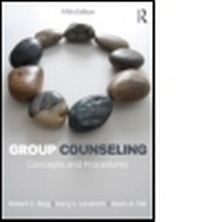
Group Counseling
Concepts and Procedures
5th Edition
Published on 8. February 2013
Book
Paperback/Softback
246 pages
978-0-415-53291-4 (ISBN)
Description
First published in 1979, Group Counseling has consistently been a widely used and praised text, providing both novice and experienced counselors with a framework from which to expand their group counseling skills and knowledge. This fifth edition has been thoroughly revised and updated to reflect the newest work in the field, the 2009 CACREP standards, and the Association for Specialists in Group Work practice standards. As in the previous editions, the authors draw upon their extensive experience and share their own styles of leading groups as a personal and practical way to illustrate the differences in group leadership.
Berg, Landreth, and Fall present a thorough discussion of the rationale for using group counseling with an emphasis on the group's role as a preventive environment and as a setting for self-discovery. The authors examine the group facilitator's internal frame of reference and ways to overcome of initial anxiety about leading groups, and they also explore typical problems in the development, facilitation, and termination of the group process and provide suggested solutions. Application of group counseling is considered with children, adolescents, adults, as well as with special populations, such as abused children, juvenile offenders, and individuals with emotional difficulties. A helpful glossary of group counseling terminology provides a quick reference source for important terms.
New to this edition are
a chapter on diversity and social justice in group work
an expanded chapter on co-leadership, a topic often ignored in other group counseling texts
separate chapters on group work with children and group work with adolescents so that reader can focus more easily on the unique aspects of working with each population
a chapter on evaluating groups at the leader, group, and individual member levels.
A collection of supplemental resources is available online to benefit both instructors and students. Instructors will find PowerPoint slides and test banks to aid in conducting their courses, and students can access questions for thought and reflection to supplement their review of the chapters in the text. These materials can be accessed at www.routledgementalhealth.com/cw/Berg
?
Berg, Landreth, and Fall present a thorough discussion of the rationale for using group counseling with an emphasis on the group's role as a preventive environment and as a setting for self-discovery. The authors examine the group facilitator's internal frame of reference and ways to overcome of initial anxiety about leading groups, and they also explore typical problems in the development, facilitation, and termination of the group process and provide suggested solutions. Application of group counseling is considered with children, adolescents, adults, as well as with special populations, such as abused children, juvenile offenders, and individuals with emotional difficulties. A helpful glossary of group counseling terminology provides a quick reference source for important terms.
New to this edition are
a chapter on diversity and social justice in group work
an expanded chapter on co-leadership, a topic often ignored in other group counseling texts
separate chapters on group work with children and group work with adolescents so that reader can focus more easily on the unique aspects of working with each population
a chapter on evaluating groups at the leader, group, and individual member levels.
A collection of supplemental resources is available online to benefit both instructors and students. Instructors will find PowerPoint slides and test banks to aid in conducting their courses, and students can access questions for thought and reflection to supplement their review of the chapters in the text. These materials can be accessed at www.routledgementalhealth.com/cw/Berg
?
More details
Edition
5th New edition
Language
English
Place of publication
London
United Kingdom
Publishing group
Taylor & Francis Ltd
Target group
College/higher education
Edition type
New edition
Illustrations
4 s/w Tabellen
Accompanying Workbook and DVD: ISBN is 978-0-415-64480-8; 4 Tables, black and white
Dimensions
Height: 254 mm
Width: 178 mm
Weight
476 gr
ISBN-13
978-0-415-53291-4 (9780415532914)
Copyright in bibliographic data and cover images is held by Nielsen Book Services Limited or by the publishers or by their respective licensors: all rights reserved.
Schweitzer Classification
Other editions
New editions
Book
10/2017
6th Edition
Routledge
€93.00
Article exhausted; check for reprint
Additional editions
Book
09/2015
5th Edition
Routledge
€155.99
Article exhausted; check for reprint
Previous edition
Robert C. Berg | Garry L. Landreth | Kevin A. Fall
Group Counseling, fourth edition
Concepts and Procedures
Book
07/2006
4th Edition
Routledge
€67.03
Article exhausted; check for reprint
Persons
Robert C. Berg, EdD, is Professor Emeritus at the University of North Texas and Adjunct Professor at Southern Methodist University.
Garry L. Landreth, EdD, is Regents Professor and founding Director of the Center for Play Therapy at the University of North Texas.
Kevin A. Fall, PhD, is Professor and Program Coordinator in the Department of Counseling, Leadership, Adult Education, and School Psychology at Texas State University-San Marcos.
Garry L. Landreth, EdD, is Regents Professor and founding Director of the Center for Play Therapy at the University of North Texas.
Kevin A. Fall, PhD, is Professor and Program Coordinator in the Department of Counseling, Leadership, Adult Education, and School Psychology at Texas State University-San Marcos.
Content
Rationale and History of Group Counseling. Diversity and Social Justice in Group Work. Group Work and Theory. Holistic Leadership Training. The Group Leader's Internal Experience. Co-Leadserhip: Rationale and Interpretation. Initiating a Counseling Group. Maintaining a Group: Process and Development. Working Effectively with Resistance in Groups. Evaluating the Leader and Group. Group Counseling of Children. Group Counseling with Adolescents.