

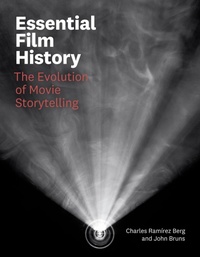
Essential Film History
Description
A guide to the fundamentals of understanding film history, filmmaking, and film appreciation.
Film is not just a medium; it is also a language—and a global one at that. Essential Film History describes how this language emerged and how it has matured over the course of more than 125 years. Beginning with the experiments of the late nineteenth century, and tracking the development of cinematic storytelling, commercial distribution, and audience reception into the era of digital recording, Charles Ramírez Berg and John Bruns offer a comprehensive course in both the history and artistry of film.
Essential Film History breaks cinematic language into three core components: image, sound, and narrative. Between the 1890s and 1940s, this audiovisual language both consolidated and spread, becoming comprehensible worldwide. Since then, filmmakers have adapted and extended the language of cinema to suit an ever-growing range of aesthetic and narrative projects, from documentaries and full-length animation to avant-garde and made-for-TV movies. Covering major figures, studios, and events as well as key technological and sociopolitical developments, Essential Film History is an indispensable guide to the evolution of cinematic style.
More details
Persons
Charles Ramírez Berg is the Joe M. Dealey, Sr. Professor in Media Studies at the University of Texas at Austin. He is the author of The Classical Mexican Cinema: The Poetics of the Exceptional Golden Age Films and Latino Images in Film: Stereotypes, Subversion, and Resistance.
John Bruns is Professor of Film Studies and a faculty affiliate of the Women's and Gender Studies program at the College of Charleston. He is the author of Loopholes: Reading Comically and Hitchcock's People, Places, and Things.
Content
- Preface
- 1. Early Cinema, 1891–1905
- 2. The Emergence of Narrative, 1906–1916
- 3. The Dawning of the Hollywood Studio Style, 1917–1927
- 4. The Golden Age of German Cinema, 1919–1933
- 5. Film and Revolution: The Rise of Soviet Cinema
- 6. Sound and Narration: The Transition to Talking Pictures, 1927–1933
- 7. The Golden Age of French Cinema, 1920–1939
- 8. Classical Hollywood, 1930–1945: Narrative Structure and Five Key Directors
- 9. Italian Neorealism
- 10. American Cinema After World War II
- 11. After Neorealism: Global Cinema in the 1950s
- 12. The French New Wave
- 13. Global New Waves: World Cinema in the 1960s
- 14. The New Hollywood: From Art House to Blockbuster, 1960–1985
- 15. Recent European Cinema: From 1980 to the Present
- 16. New Cinemas in a Transnational World, Part 1
- 17. New Cinemas in a Transnational World, Part 2
- 18. Indiewood, Hollywood, and the Age of Franchise Moviemaking
- 19. New Narratives in Film
- 20. Cinematic Alternatives in (Digital) Filmmaking, 1990 to the Present
- Index