

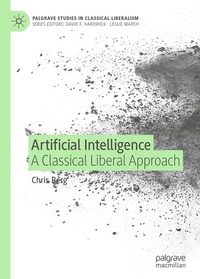
Artificial Intelligence
Description
This book presents a classical liberal perspective on the governance and economic implications of artificial intelligence. As generative AI transforms industries and institutions, this book reframes urgent debates on safety, regulation, labour, and autonomy through the lens of classical liberal economic and political philosophy.
Drawing on Austrian economics, liberal growth theory, and institutional economics, this book argues that classical liberalism and its philosophical framework has not only historically inspired the design of artificial intelligence but also remains a critical guide for its future development and application. From neural networks as emergent orders to AI agents as capital goods, the book explores how liberal principles can guide innovation, mitigate risk, and preserve individual rights. Chapters examine interpretability, the future of work, open-source commons, and the calculation debate, engaging with theorists such as Hayek, Kirzner, Simon, and Schumpeter. The book proposes polycentric governance models for AI safety and rights protection, emphasizing pluralism, contestability, and due process over precautionary control.
This book will be an essential resource for scholars in political economy, law and economics, technology policy, and digital governance. It will also appeal to a broader readership interested in academically rigorous, liberal approaches to the challenges and opportunities of the intelligence explosion.
More details
Person
Chris Berg is Professor of Economics at RMIT University in Melbourne, Australia. He is the author of twelve books, including Institutional Acceleration (Cambridge University Press 2025), Understanding the Blockchain Economy (Edward Elgar, 2019), The Classical Liberal Case for Privacy in a World of Surveillance and Technological Change (2018) and The Libertarian Alternative (Melbourne University Press, 2016). He has published more than 30 peer reviewed papers including in top journals, across the areas of free markets and individual liberty, regulation, technological change, and civil liberties.
Content
Chapter 1: Introduction.- Chapter 2: Design Versus Discovery in the Development of Artificial Intelligence.- Chapter 3: Artificial Intelligence as an Emergent Order.- Chapter 4: Intelligence and Prosperity.- Chapter 5: Agents and Agency.- Chapter 6: AI and the Calculation Debate.- Chapter 7: Alignment as an Institutional Problem.- Chapter 8: Doomerism and the Institutions of Liberty.- Chapter 9: Conclusion.