

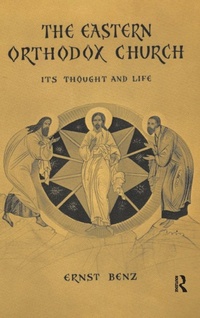
The Eastern Orthodox Church
Its Thought and Life
1st Edition
Published on 22. September 2017
Book
Hardback
240 pages
978-1-138-53530-5 (ISBN)
Description
Western European Christendom finds it difficult to comprehend the Eastern Orthodox Church because it knows little about the practice and doctrines of Orthodoxy. Even what is known is overlaid by many strata of prejudices and misunderstandings, partly political in nature. One of the obstacles has been the natural tendency to confound the ideas and customs of the Orthodox Church with familiar parallels in Roman Catholicism. To escape this tradition pitfall, Ernst Benz focuses on icon painting as a logical place to begin his examination of the Orthodox Church.
Beginning with a brilliant discussion of the importance of icons in the Eastern Church--and the far-reaching effects of icons on doctrine as well as art--Benz counteracts the confusion, explaining simply and clearly the liturgy and sacraments, dogma, constitution and law of Eastern Orthodoxy. In brief history, he describes the rise of Orthodox national churches, schismatic churches, and churches in exile; the role of monasticism and its striking differences from Roman Catholic monasticism; the missionary work of the Orthodox Church; and the influence of Orthodoxy on politics and culture.
The role of the church can be defined in terms of the image. Benz writes that the church exists so that "members may be incorporated into the image of Jesus Christ a in that individual believers are aechanged into his likeness'" as Paul writes in the second letter to the Corinthians. Thus, Orthodox theology holds up the icon as the true key to the understanding of Orthodox dogma. The Eastern Orthodox Church will be valuable to anyone interested in learning more about the church, its thought, its life, and its ideals.
Beginning with a brilliant discussion of the importance of icons in the Eastern Church--and the far-reaching effects of icons on doctrine as well as art--Benz counteracts the confusion, explaining simply and clearly the liturgy and sacraments, dogma, constitution and law of Eastern Orthodoxy. In brief history, he describes the rise of Orthodox national churches, schismatic churches, and churches in exile; the role of monasticism and its striking differences from Roman Catholic monasticism; the missionary work of the Orthodox Church; and the influence of Orthodoxy on politics and culture.
The role of the church can be defined in terms of the image. Benz writes that the church exists so that "members may be incorporated into the image of Jesus Christ a in that individual believers are aechanged into his likeness'" as Paul writes in the second letter to the Corinthians. Thus, Orthodox theology holds up the icon as the true key to the understanding of Orthodox dogma. The Eastern Orthodox Church will be valuable to anyone interested in learning more about the church, its thought, its life, and its ideals.
More details
Language
English
Place of publication
London
United Kingdom
Publishing group
Taylor & Francis Ltd
Target group
College/higher education
Dimensions
Height: 235 mm
Width: 157 mm
Thickness: 18 mm
Weight
504 gr
ISBN-13
978-1-138-53530-5 (9781138535305)
Copyright in bibliographic data and cover images is held by Nielsen Book Services Limited or by the publishers or by their respective licensors: all rights reserved.
Schweitzer Classification
Other editions
Additional editions
E-Book
09/2017
Routledge
€67.49
Available for download
E-Book
09/2017
Routledge
€67.49
Available for download
Book
07/2008
1st Edition
AldineTransaction
€73.40
Shipment within 10-15 days
Person
Ernst Benz
Content
1: The Orthodox Icon; 2: Liturgy and Sacraments; 3: Dogma; 4: Constitution and Law of the Orthodox Church; 5: National Churches, Schismatic Churches, Emigrant Churches; 6: Monasticism; 7: Missionary Work and the Spread of the Orthodox Church; 8: Orthodox Culture; 9: The Ethical Ideas of Orthodoxy; 10: The Political Ideas of Orthodoxy; 11: Rome, Byzantium, Moscow; 12: Russia and Europe; 13: Orthodoxy within the Universal Church Today; 14: Greatness and Weakness of Orthodoxy