

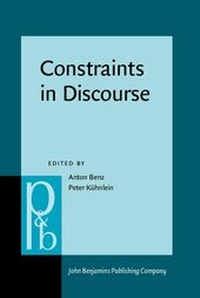
Constraints in Discourse
Published on 10. April 2008
Book
Hardback
292 pages
978-90-272-5416-0 (ISBN)
Description
It is a commonplace to say that the meaning of text is more than the conjunction of the meaning of its constituents. But what are the rules governing its interpretation, and what are the constraints that define well-formed discourse? Answers to these questions can be given from various perspectives. In this edited volume, leading scientists in the field investigate these questions from structural, cognitive, and computational perspectives. The last decades have seen the development of numerous formal frameworks in which the structure of discourse can be analysed, the most important of them being the Linguistic Discourse Model, Rhetorical Structure Theory and Segmented Discourse Representation Theory. This volume contains an introduction to these frameworks and the fundamental topics in research about discourse constraints. Thus it should be accessible to specialists in the field as well as advanced graduate students and researchers from neighbouring areas. The volume is of interest to discourse linguists, psycholinguists, cognitive scientists, and computational linguists.
More details
Series
Language
English
Place of publication
Amsterdam
Netherlands
Target group
Professional and scholarly
Dimensions
Height: 245 mm
Width: 164 mm
Weight
690 gr
ISBN-13
978-90-272-5416-0 (9789027254160)
Copyright in bibliographic data and cover images is held by Nielsen Book Services Limited or by the publishers or by their respective licensors: all rights reserved.
Schweitzer Classification
Other editions
Additional editions
Anton Benz | Peter Kühnlein
Constraints in Discourse
E-Book
04/2008
1st Edition
John Benjamins Publishing Company
€130.99
Available for download
Persons
Content
1. Acknowledgements; 2. 1. Constraints in discourse: An introduction; 3. Part I. The Right Frontier; 4. 2. Troubles on right frontier (by Asher, Nicholas); 5. 3. The moving right frontier (by Prevot, Laurent); 6. Part II. Comparing Frameworks; 7. 4. Strong generative capacity of RST, SDRT and discourse dependency DAGSs (by Danlos, Laurence); 8. 5. Rhetorical distance revisited: A parameterized approach (by Chiarcos, Christian); 9. 6. Underspecified discourse representation (by Egg, Markus); 10. Part III. The Cognitive Perspective; 11. 7. Dependency precedes independence: Online evidence from discourse processing (by Schumacher, Petra B.); 12. 8. Accessing discourse referents introduced in negated phrases: Evidence for accomodation? (by Kaup, Barbara); 13. Part IV. Language Specific Phenomena; 14. 9. Complex anaphors in discourse (by Consten, Manfred); 15. 10. The discourse functions of the present perfect (by Nishiyama, Atsuko); 16. 11. German right dislocation and afterthought in discourse (by Averintseva-Klisch, Maria); 17. 12. A discourse-relational approach to continuation (by Holler, Anke); 18. 13. German vorfeld-filling as constraint interaction (by Speyer, Augustin); 19. Index