

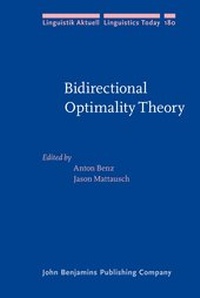
Bidirectional Optimality Theory
Published on 28. November 2011
Book
Hardback
279 pages
978-90-272-5563-1 (ISBN)
Description
Bidirectional Optimality Theory (BiOT) emerged at the turn of the millennium as a fusion of Radical Pragmatics and Optimality Theoretic Semantics. It stirred a wealth of new research in the pragmatics-semantics interface and heavily influenced e.g. the development of evolutionary and game theoretic approaches. Optimality Theory holds that linguistic output can be understood as the optimized products of ranked constraints. At the centre of BiOT is the insight that this optimisation has to take place both in production and interpretation, and that the production-interpretation cycle has to lead back to the original input. BiOT is now generally interpreted as a description of diachronically stable and cognitively optimal form-meaning pairs. It found applications beyond the semantics-pragmatics interface in language acquisition, historical linguistics, phonology, syntax, and typology. This book provides a state of the art overview of these developments. It collects nine chapters by leading scientists in the field.
More details
Series
Language
English
Place of publication
Amsterdam
Netherlands
Target group
Professional and scholarly
Illustrations
+ index
Dimensions
Height: 245 mm
Width: 164 mm
Weight
680 gr
ISBN-13
978-90-272-5563-1 (9789027255631)
Copyright in bibliographic data and cover images is held by Nielsen Book Services Limited or by the publishers or by their respective licensors: all rights reserved.
Schweitzer Classification
Other editions
Additional editions
Anton Benz | Jason Mattausch
Bidirectional Optimality Theory
E-Book
12/2011
1st Edition
John Benjamins Publishing Company
€123.99
Available for download
Persons
Content
1. Bidirectional Optimality Theory: An introduction (by Benz, Anton); 2. A programme for bidirectional phonology and phonetics and their acquisition and evolution (by Boersma, Paul); 3. A note on the emergence of subject salience (by Mattausch, Jason); 4. Language acquisition and language change in bidirectional Optimality Theory (by Hendriks, Petra); 5. Sense and simplicity: Bidirectionality in differential case marking (by Swart, Peter de); 6. On the interaction of tense, aspect and modality in Dutch (by Gerrevink, Richard van); 7. Production and comprehension in context: The case of word order freezing (by Bouma, Gerlof); 8. Bayesian interpretation and Optimality Theory (by Zeevat, Henk); 9. Bidirectional grammar and bidirectional optimization (by Blutner, Reinhard); 10. On bidirectional Optimality Theory for dynamic contexts (by Benz, Anton)