

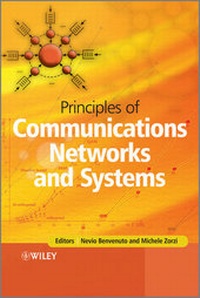
Principles of Communications Networks and Systems
Published on 30. September 2011
Book
Hardback
810 pages
978-0-470-74431-4 (ISBN)
Description
Addressing the fundamental technologies and theories associated with designing complex communications systems and networks, Principles of Communications Networks and Systems provides models and analytical methods for evaluating their performance. Including both the physical layer (digital transmission and modulation) and networking topics, the quality of service concepts belonging to the different layers of the protocol stack are interrelated to form a comprehensive picture.
The book is designed to present the material in an accessible but rigorous manner. It jointly addresses networking and transmission aspects following a unified approach and using a bottom up style of presentation, starting from requirements on transmission links all the way up to the corresponding quality of service at network and application layers. The focus is on presenting the material in an integrated and systematic fashion so that students will have a clear view of all the principal aspects and of how they interconnect with each other.
A comprehensive introduction to communications systems and networks, addressing both network and transmission topics
* Structured for effective learning, with basic principles and technologies being introduced before more advanced ones are explained
* Features examples of existing systems and recent standards as well as advanced digital modulation techniques such as CDMA and OFDM
* Contains tools to help the reader in the design and performance analysis of modern communications systems
* Provides problems at the end of each chapter, with answers on an accompanying website
Reviews / Votes
"I think the book is very well designed as a textbook for students and as a handbook for engineers." (Zentralblatt MATH, 1 December 2012)More details
Edition
1. Auflage
Language
English
Place of publication
New York
United States
Target group
Professional and scholarly
Product notice
sewn/stitched
Paper over boards
Dimensions
Height: 250 mm
Width: 175 mm
Thickness: 48 mm
Weight
1555 gr
ISBN-13
978-0-470-74431-4 (9780470744314)
Schweitzer Classification
Other editions
Additional editions
Nevio Benvenuto | Michele Zorzi
Principles of Communications Networks and Systems
E-Book
09/2011
Wiley
€85.99
Available for download
Nevio Benvenuto | Michele Zorzi
Principles of Communications Networks and Systems
E-Book
08/2011
Wiley
€85.99
Available for download
Persons
Professor Nevio Benvenuto, University of Padova, Italy Professor Benvenuto was employed by Bell Laboratories to work on signal analysis problems and held faculty positions at the universities of Ancona and L'Aquila before being appointed as a Professor in the Electrical Engineering Department at the University of Padova. He is an Editor for Modulation/Detection of the IEEE Communications Society and is the author of Algorithms for Communications Systems and their Applications.
Professor Michele Zorzi, University of Padova, Italy Professor Zorzi joined the faculty at the Information Engineering Department at the University of Padova in 2003. He has been a member of faculty at the Politecnico di Milano and the University of Ferrara in Italy, and he spent three years with the Center for Wireless Communications at UCSD. Zorzi was the Editor-In-Chief of the IEEE Wireless Communications Magazine in 2003-2005, is currently the Editor-In-Chief of the IEEE Transactions on Communications, and serves on the Editorial Boards for a variety of respected journals. He is a Fellow of the IEEE.
Professor Michele Zorzi, University of Padova, Italy Professor Zorzi joined the faculty at the Information Engineering Department at the University of Padova in 2003. He has been a member of faculty at the Politecnico di Milano and the University of Ferrara in Italy, and he spent three years with the Center for Wireless Communications at UCSD. Zorzi was the Editor-In-Chief of the IEEE Wireless Communications Magazine in 2003-2005, is currently the Editor-In-Chief of the IEEE Transactions on Communications, and serves on the Editorial Boards for a variety of respected journals. He is a Fellow of the IEEE.
Content
Preface xiii
List of Acronyms xvii
List of Symbols xxi
1 Introduction to Telecommunication Services, Networks and Signaling 1
1.1 Telecommunication Services 1
1.2 Telecommunication Networks 5
1.3 Circuit-Switched and Packet-Switched Communication Modes 11
1.4 Introduction to the ISO/OSI Model 13
1.5 Signaling 18
References 25
2 Deterministic and Random Signals 27
2.1 Time and Frequency Domain Representation 27
2.2 Energy and Power 39
2.3 Systems and Transformations 46
2.4 Bandwidth 54
2.5 The Space of Signals 66
2.6 Random Variables and Vectors 81
2.7 Random Processes 99
2.8 Systems with Random Inputs and Outputs 118
Appendix: The Complementary Normalized Gaussian Distribution Function 126
Problems 130
References 136
3 Sources of Digital Information 137
3.1 Digital Representation of Waveforms 137
3.2 Examples of Application 158
3.3 Information and Entropy 162
3.4 Source Coding 173
Problems 188
References 196
4 Characterization of Transmission Media and Devices 197
4.1 Two-Terminal Devices 198
4.2 Two-Port Networks 206
4.3 Transmission System Model 216
4.4 Transmission Media 223
Problems 250
References 256
5 Digital Modulation Systems 259
5.1 Introduction 259
5.2 Digital Modulation Theory for an AWGN Channel 260
5.3 Binary Modulation 277
5.4 M-ary Modulation 288
5.5 The Digital Modulation System 296
5.6 Examples of Digital Modulations 307
5.7 Comparison of Digital Modulation Systems 336
5.8 Advanced Digital Modulation Techniques 339
5.9 Digital Transmission of Analog Signals 344
Problems 355
References 370
6 Channel Coding and Capacity 373
6.1 Principles of Channel Coding 373
6.2 Linear Block Codes 383
6.3 Convolutional Codes 397
6.4 Channel Capacity 405
6.5 Codes that Approach Capacity 420
Problems 424
References 429
7 Markov Chains Theory 431
7.1 Introduction 432
7.2 Discrete-Time Markov Chains 432
7.3 Continuous-Time Markov Chains 467
7.4 Birth-Death Processes 492
Problems 507
References 516
8 Queueing Theory 517
8.1 Objective of Queueing Theory 518
8.2 Specifications of a Queueing System 518
8.3 Performance Characterization of a QS 527
8.4 Little's Law 534
8.5 Markovian Queueing Models 537
8.6 The M/G/1 Queueing System 581
8.7 The M/D/1 Queueing System 589
Problems 590
References 596
9 Data Link Layer 597
9.1 Introduction 598
9.2 Medium Access Control 599
9.3 Automatic Retransmission Request 662
9.4 Examples of LAN Standards 679
Problems 697
References 703
10 Network Layers 707
10.1 Introduction 708
10.2 Routing 714
10.3 The Internet and IP 747
10.4 The Transport Layer 759
10.5 The Application Layer 769
References 774
Index 777