

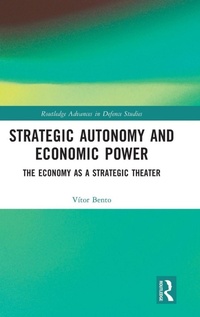
Strategic Autonomy and Economic Power
The Economy as a Strategic Theater
1st Edition
Published on 4. August 2022
Book
Hardback
280 pages
978-1-032-16402-1 (ISBN)
Description
This book examines the effect of economic power on a state's strategic autonomy.
Strategic autonomy is a fundamental condition for the availability of strategic options in the interaction of states. This book provides the first clear operational definition of the concept and offers an analysis of the relevance of the national economy to strategic autonomy. The main sources of economic power - size of the economy, position in trade and technological networks, savings, wealth, and finance - and their impact on strategic autonomy are analyzed in depth. The strategic governance of the national economy is also addressed as a way of ensuring that national economic power can work as strategic power for a country, providing it with strategic autonomy. The strategies pursued by China - which in under four decades has gone from an underdeveloped state to the main challenger of the dominant world power - and Germany - which, despite being defeated in World War II, having no nuclear weapons and having chosen to be a "civilian power", became the dominant power in Europe - are analyzed in depth, as two paradigmatic examples of the theory developed by the book.
This book will be of much interest to students of strategic studies, economics, foreign policy and International Relations.
Strategic autonomy is a fundamental condition for the availability of strategic options in the interaction of states. This book provides the first clear operational definition of the concept and offers an analysis of the relevance of the national economy to strategic autonomy. The main sources of economic power - size of the economy, position in trade and technological networks, savings, wealth, and finance - and their impact on strategic autonomy are analyzed in depth. The strategic governance of the national economy is also addressed as a way of ensuring that national economic power can work as strategic power for a country, providing it with strategic autonomy. The strategies pursued by China - which in under four decades has gone from an underdeveloped state to the main challenger of the dominant world power - and Germany - which, despite being defeated in World War II, having no nuclear weapons and having chosen to be a "civilian power", became the dominant power in Europe - are analyzed in depth, as two paradigmatic examples of the theory developed by the book.
This book will be of much interest to students of strategic studies, economics, foreign policy and International Relations.
More details
Series
Language
English
Place of publication
London
United Kingdom
Publishing group
Taylor & Francis Ltd
Target group
College/higher education
Professional and scholarly
Postgraduate, Professional, and Undergraduate Advanced
Illustrations
26 s/w Abbildungen, 26 s/w Zeichnungen, 37 s/w Tabellen
37 Tables, black and white; 26 Line drawings, black and white; 26 Illustrations, black and white
Dimensions
Height: 240 mm
Width: 161 mm
Thickness: 21 mm
Weight
611 gr
ISBN-13
978-1-032-16402-1 (9781032164021)
Copyright in bibliographic data and cover images is held by Nielsen Book Services Limited or by the publishers or by their respective licensors: all rights reserved.
Schweitzer Classification
Other editions
Additional editions
Book
05/2024
1st Edition
Routledge
€63.70
Shipment within 10-20 days
E-Book
08/2022
1st Edition
Routledge
€55.49
Available for download
E-Book
08/2022
1st Edition
Routledge
€55.49
Available for download
Person
Vitor Bento has a PhD in Strategic Studies (2020) from the University of Lisbon.
Content
INTRODUCTION, PART I - ON STRATEGY, 1. The Historical Evolution of the Thought on Strategy, 2. A Modern Perspective, 3. The Economy as a Strategic Theater, PART II - ON STRATEGIC AUTONOMY, 4. Strategic Autonomy: A Proposed Framework, PART III - ECONOMIC POWER AND STRATEGIC AUTONOMY, 5. On Economic Power: Overview, 6. Size Matters, 7. Worldwide Webs: Trade and Technology, 8. Saving, Wealth and Finance, PART IV - ON STRATEGIC GOVERNANCE, 9. National Strategy and its Governance, 10. The Challenges of Strategic Economic Governance, PART V - TWO PARADIGMATIC CASES: CHINA AND GERMANY, 11. Why These Cases, 12. The Case of China, 13. The Case of Germany, CONCLUSIONS