

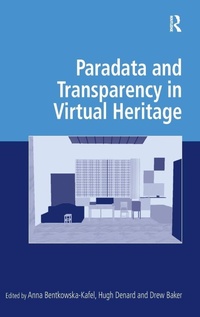
Paradata and Transparency in Virtual Heritage
1st Edition
Published on 22. February 2012
Book
Hardback
344 pages
978-0-7546-7583-9 (ISBN)
Description
Computer-Generated Images (CGIs) are widely used and accepted in the world of entertainment but the use of the very same visualization techniques in academic research in the Arts and Humanities remains controversial. The techniques and conceptual perspectives on heritage visualization are a subject of an ongoing interdisciplinary debate. By demonstrating scholarly excellence and best technical practice in this area, this volume is concerned with the challenge of providing intellectual transparency and accountability in visualization-based historical research. Addressing a range of cognitive and technological challenges, the authors make a strong case for a wider recognition of three-dimensional visualization as a constructive, intellectual process and valid methodology for historical research and its communication. Intellectual transparency of visualization-based research, the pervading theme of this volume, is addressed from different perspectives reflecting the theory and practice of respective disciplines. The contributors - archaeologists, cultural historians, computer scientists and ICT practitioners - emphasize the importance of reliable tools, in particular documenting the process of interpretation of historical material and hypotheses that arise in the course of research. The discussion of this issue refers to all aspects of the intellectual content of visualization and is centred around the concept of 'paradata'. Paradata document interpretative processes so that a degree of reliability of visualization outcomes can be understood. The disadvantages of not providing this kind of intellectual transparency in the communication of historical content may result in visual products that only convey a small percentage of the knowledge that they embody, thus making research findings not susceptible to peer review and rendering them closed to further discussion. It is argued, therefore, that paradata should be recorded alongside more tangible outcomes of research, preferably as an integral part of virtual models, and sustained beyond the life-span of the technology that underpins visualization.
Reviews / Votes
'By addressing a range of conceptual and technological challenges this title demonstrates that providing intellectual accountability, or 'transparency', is the key to establishing computerised visualisation methods as a rigorous, constructive, and vital contribution to historical research and its communication.' Library and Information ResearchMore details
Series
Language
English
Place of publication
London
United Kingdom
Publishing group
Taylor & Francis Ltd
Target group
College/higher education
Dimensions
Height: 240 mm
Width: 161 mm
Thickness: 23 mm
Weight
681 gr
ISBN-13
978-0-7546-7583-9 (9780754675839)
Copyright in bibliographic data and cover images is held by Nielsen Book Services Limited or by the publishers or by their respective licensors: all rights reserved.
Schweitzer Classification
Other editions
Additional editions
Anna Bentkowska-Kafel | Hugh Denard
Paradata and Transparency in Virtual Heritage
Book
10/2016
1st Edition
Routledge
€84.20
Shipment within 10-20 days
Anna Bentkowska-Kafel | Hugh Denard
Paradata and Transparency in Virtual Heritage
E-Book
05/2016
Routledge
€77.99
Available for download
Anna Bentkowska-Kafel | Hugh Denard
Paradata and Transparency in Virtual Heritage
E-Book
05/2016
Routledge
€77.99
Available for download
Persons
Anna Bentkowska-Kafel is a Research Associate at the Department of Digital Humanities; Hugh Denard is Lecturer at the Department of Digital Humanities and Associate Director of the King's Visualisation Lab and Drew Baker is Senior Research Fellow at the Department of Digital Humanities, all at Kings College London, UK
Content
Contents: Introduction, Anna Bentkowska-Kafel and Hugh Denard; Part I Conventions and Emerging Standards: Defining our terms in heritage visualization, Richard C. Beacham; Scientific method, chaA (R)ne operatoire and visualization: 3D modelling as a research tool in archaeology, Sorin Hermon; Setting standards for 3D visualization of cultural heritage in Europe and beyond, Franco Niccolucci; More than pretty pictures of the past: an American perspective on virtual heritage, Donald H. Sanders; A new introduction to the London Charter, Hugh Denard; The London Charter for the Computer-based Visualisation of Cultural Heritage (version 2.0, February 2009). Part II Data Interpretation: Methods and Tools: Walking with dragons: CGIs in wildlife 'documentaries', Mark Carnall; Hypothesizing Southampton in 1454: a 3-dimensional model of the medieval town, Matt Jones; Paradata in art-historical research: a visualization of Piet Mondrian's studio at 5 rue de Coulmiers, Ryan Egel-Andrews; Just how predictable is predictive lighting?, Kate Devlin; Lies, damned lies and visualizations: will metadata and paradata be a solution or a curse?, Martin J. Turner; Intricacies and potentials of gathering paradata in the 3D modelling workflow, Sven Havemann. Part III Data Management and Communication: Defining paradata in heritage visualization, Drew Baker; Transparency for empirical data, Mark Mudge; Behaviours, interactions and affordance in virtual archaeology, Maurizio Forte and Sofia Pescarin; How to make sustainable visualizations of the past: an EPOCH common infrastructure tool for interpretation management, Daniel Pletinckx. Part IV Conclusion: Processual scholia: the importance of paradata in heritage visualization, Anna Bentkowska-Kafel; Glossary of terms; Selected bibliography; Index.