

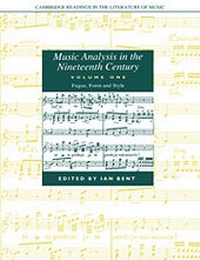
Music Analysis in the Nineteenth Century: Volume 1, Fugue, Form and Style
Published on 17. March 1994
Book
Hardback
391 pages
978-0-521-25969-9 (ISBN)
Description
This book demonstrates, in fascinating diversity, how musicians in the nineteenth century thought about and described music. The analysis of music took many forms (verbal, diagrammatic, tabular, notational, graphic), was pursued for many different purposes (educational, scholarly, theoretical, promotional) and embodied very different approaches. This, the first volume, is concerned with writing on fugue, form and questions of style in the music of Palestrina, Handel, Bach, Mozart, Beethoven and Wagner and presents analyses of complete works or movements by the most significant theorists and critics of the century. The analyses are newly translated into English and are introduced and thoroughly annotated by Ian Bent, making this a volume of enormous importance to our understanding of the nature of music reception in the nineteenth century.
More details
Series
Language
English
Place of publication
Cambridge
United Kingdom
Target group
Professional and scholarly
Illustrations
204 Printed music items
Dimensions
Height: 256 mm
Width: 180 mm
Thickness: 36 mm
Weight
910 gr
ISBN-13
978-0-521-25969-9 (9780521259699)
Copyright in bibliographic data and cover images is held by Nielsen Book Services Limited or by the publishers or by their respective licensors: all rights reserved.
Schweitzer Classification
Other editions
New editions
Ian Bent
Music Analysis in the Nineteenth Century: Volume 1, Fugue, Form and Style
Volume 1, Fugue, Form and Style
Book
11/2004
Cambridge University Press
€42.30
Shipment within 15-20 days
Additional editions
Ian Bent
Music Analysis in the Nineteenth Century: Volume 1, Fugue, Form and Style
Volume 1, Fugue, Form and Style
Book
11/2004
Cambridge University Press
€42.30
Shipment within 15-20 days
Person
Content
General introduction; Part I. Analysis of Fugue: Introduction: 1. J.-J. de Momigny: 'Double Fugue [Handel: Fugue from Harpsichord Suite No. 6 in F# minor]' (1805); 2. A. Reicha: 'Fruitful Method of Analysing a Piece of Music with Respect to Harmony' (?1816-18); 3. M. Hauptmann: Elucidations of Johann Sebastian Bach's 'Art of Fugue' (1841); 4. S. Sechter: 'Analysis of the Finale of Mozart's Symphony No. [41] in C [K551 ('Jupiter')] [1843]; 5. S. W. Dehn: 'Three-part Fugue [Bk I No. 6 in D minor] from J. S. Bach's Well-tempered Clavier' (1858); 6. H. Riemann: 'Prelude and Fugue in Bb minor, Bk II No. 22 [from J. S. Bach's Well-tempered clavier]' (1890); Part II. Technical Analysis of Form and Style: Introduction: 7. G. J. Vogler: '[prelude] No. 8 [in D minor from Vogler's Thirty-two Preludes]' (1806); 8. A . Reicha: 'Aria ['Non so piu'] from Mozart's The Marriage of Figaro' (1814); 9. A. Reicha: 'Analysis [of Reicha?: Andante for Wind Quintet in G] with Respect to Thematic Development' (1826); 10. G. Weber: 'A Particularly Remarkable Passage in a String Quartet in C by Mozart [K465 ('dissonance')]' (1832); 11. C. Czerny: 'Harmonic Groundwork of Beethoven's Sonata [No. 21 in C] Op. 53 [('Waldstein')]' (c. 1832-4); 12. J. C. Lobe: 'First-movement Form in the String Quartet [: Beethoven: Op. 18 no. 2 in G: Allegro]' (1850); 13. K. Mayrberger: The Harmonic Style of Richard Wagner, Elucidated with Respect to the Leitmotifs of 'Tristan and Isolde' (1881); Part III. The Classification of Personal Style: Introduction: 14. G. Baini: [The ten styles of Palestrina] (1828); 15. A. D. Ulibishev: '[Mozart's] String Quarters dedicated to Haydn' (1843); 16. Four essays on the styles of Beethoven's music: (a) J. A. Schlosser: 'Critical Assessment of Beethoven's Works' (1828); (b) F.-J. Fetis: [The three periods of Beethoven's music] (1837); (c) W. von Lenz: 'Beethoven's Three Styles' (1852); (d) A. D. Ulibishev: 'Beethoven's Three Manners' (1857); Appendix. (a) Hanel: Suite No. 6: 3. Allegro (Fugue); (b) G. J. Vogler: Prelude no. 8; (c) Reicha: Andante for Wind Quintet (keyboard reduction).