

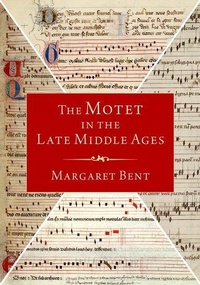
The Motet in the Late Middle Ages
Published on 1. February 2024
Book
Hardback
776 pages
978-0-19-006377-1 (ISBN)
Description
A unique capacity of measured polyphony is to give precisely fixed places not only to musical notes, but also to individual words in relation to them and each other. The Motet in the Late Middle Ages offers innovative approaches to the equal partnership of music and texts in motets of the fourteenth century and beyond, showcasing the imaginative opportunities afforded by this literal kind of intertextuality, and yielding a very different narrative from the common complaint that different simultaneous texts make motets incomprehensible. As leading musicologist Margaret Bent asserts, they simply require a different approach to preparation and listening.
In this book, Bent examines the words and music of motets from many different angles: foundational verbal quotations and pre-existent chant excerpts and their contexts, citations both of words and music from other compositions, function, dating, structure, theory, and number symbolism. Individual studies of these original creations tease out a range of strategies, ingenuity, playfulness, striking juxtapositions, and even subversion. Half of the thirty-two chapters consist of new material; the other half are substantially revised and updated versions of previously published articles and chapters, organized into seven Parts. With new analyses of text and music together, new datings, new attributions, and new hypotheses about origins and interrelationships, Bent uncovers little-explored dimensions, provides a window into the craft and thought processes of medieval composers, and opens up many directions for future work.
In this book, Bent examines the words and music of motets from many different angles: foundational verbal quotations and pre-existent chant excerpts and their contexts, citations both of words and music from other compositions, function, dating, structure, theory, and number symbolism. Individual studies of these original creations tease out a range of strategies, ingenuity, playfulness, striking juxtapositions, and even subversion. Half of the thirty-two chapters consist of new material; the other half are substantially revised and updated versions of previously published articles and chapters, organized into seven Parts. With new analyses of text and music together, new datings, new attributions, and new hypotheses about origins and interrelationships, Bent uncovers little-explored dimensions, provides a window into the craft and thought processes of medieval composers, and opens up many directions for future work.
Reviews / Votes
Bent's research on the motet has been fundamental to the fields of musicology and medieval studies, and it is a joy to see that work gathered into a single publication. The book is chronologically wide-ranging, covering the development of the genre from the fourteenth through the mid-fifteenth centuries, and geographically diverse, encompassing the motet in France and the Low Countries, England, Italy, with forays into eastern Europe and the Mediterranean region-an astonishing achievement. * Anne Walters Robertson, Claire Dux Swift Distinguished Service Professor of Music, University of Chicago * This extraordinary collection of essays by the reigning medieval musicologist of our time presents the fruits of Margaret Bent's intense engagement with different facets of late medieval motets over the course of more than fifty years. Almost half of the thirty-two chapters are new, and earlier essays are recast, taking measure of new scholarly work and then pushing it farther. One finds surprising discoveries at every turn. * Lawrence Earp, Emeritus Professor of Musicology, University of Wisconsin-Madison * In this impressive collection of essays, Margaret Bent assembles a lifetime of path-breaking research and engages with the rich scholarship it has engendered. Throughout, Bent thoughtfully reflects on her own contributions, and adds much previously unpublished material. As a study of the fourteenth- and early fifteenth-century motet in England, Italy, and France, it is a magisterial tour de force that will help map the field for decades to come. * Jessie Ann Owens, Distinguished Professor of Music Emeritus, University of California Davis * In this monumental study of the late medieval motet, Margaret Bent has brought together studies of a range of individual motets, English, French, and Italian, seeking through close reading to tease out the range of strategies employed to serve the uniqueness of these technically advanced, prestigious, compositions. These 32 essays-all now updated or offered for the first time-rest on a lifetime's study of compositional craft. Their richness cannot be overestimated. * Susan Rankin, Professor of Medieval Music, University of Cambridge * This book is a major achievement that assembles a significant portion of the life's work of a major scholar of medieval music and puts the author's classic studies in conversation with lesser-known essays, new material, and coverage of less-documented traditions. The audience for the book is primarily specialists and perhaps advanced graduate students; the analyses assume a high degree of existingknowledge of the motet in the later Middle Ages throughout France, England, and, to a lesser extent, Italy, including details of sources, theory, and notation. For any library that serves musicologists and for scholars of medieval music and poetry, The Motet in the Late Middle Ages will be an indispensable document of the contributions of a leading scholar. * Anna Grau Schmidt, Notes * This volume stands as a landmark study in the history of medieval music that will inspire the next generation of work on this rich repertoire. By bringing together previously scattered publications, revised in light of recent discoveries and augmented by substantial new material, Bent has created a testament to a lifetime of scholarly engagement with a repertoire that continues to challenge our understanding of medieval artistic practice. * Emily Zazulia, Speculum * Margaret Bent leaves us an inspiring book that no doubt will stimulate many further explorations into this intriguing musical society. * Jacques Boogaart, Tijdschrift van de Koninklijke Vereniging voor Nederlandse Muziekgeschiedenis *More details
Language
English
Place of publication
New York
United States
Target group
Professional and scholarly
Product notice
sewn/stitched
Cloth over boards
Illustrations
84 musical examples, 32 illustrations, 22 tables
Dimensions
Height: 263 mm
Width: 195 mm
Thickness: 57 mm
Weight
1547 gr
ISBN-13
978-0-19-006377-1 (9780190063771)
Copyright in bibliographic data and cover images is held by Nielsen Book Services Limited or by the publishers or by their respective licensors: all rights reserved.
Schweitzer Classification
Other editions
Additional editions
Person
Margaret Bent is an emeritus Fellow of All Souls College, Oxford, and a Fellow of several international societies and academies. Between 1975 and 1992 she taught at Brandeis and Princeton universities and served as President of the American Musicological Society. Her numerous publications range over English and continental music, repertories, notation, and theory of the fourteenth to sixteenth centuries. Her editorial publications include critical editions of Dunstaple, Ciconia, English masses, and a Rossini opera. Her many honours include the C.B.E. and three honorary degrees. In 2018, she received the inaugural Adler prize of the International Musicological Society.
Content
List of Illustrations
List of Tables
List of Music Examples
List of Sound Clips
List of Abbreviations
Introduction PART I. COMPOSITIONAL TECHNIQUES
1. Theoretical and Terminological Issues
2. What is Isorhythm? PART II. THE MARIGNY MOTETS, BEYOND FAUVEL, AND VITRY
3. Fauvel and Marigny: Which Came First?
4. Tribum que non abhorruit/Quoniam secta latronum/Merito hec patimur and its 'Quotations'; and Garrit gallus/In nova
Appendix: Commentary to Tribum/Quoniam; Commentary to Garrit/In nova
5. Aman novi/Heu Fortuna/Heu me
6. Floret/Florens: Intended for Fauvel?
7. Related Manuscripts, Related Motets; Vitry
8. Vos quid admiramini/Gratissima virginis species/Gaude gloriosa PART III. MACHAUT
9. Words and Music in Machaut's Motet 9
10. Deception, Exegesis and Sounding Number in Machaut's Motet 15
11. The 'Harmony' of the Machaut Mass
12. Machaut's Motet 10 and its Interconnections
13. Machaut's Motet 18: Bone pastor Guillerme/Bone pastor, qui pastores/Bone pastor
14. Text-Music Relationships in Machaut's Motets 4 and 8 PART IV. MUSICORUM COLLEGIUM: THE MUSICIAN MOTETS
15. Apollinis eclipsatur, its Progeny and their Sources
16. Apollinis eclipsatur/Zodiacum signis/In omnem terram and Later Versions with Added Parts
Appendix: Commentaries to Web Transcriptions for the Pieces with Multiple Sources
17. Musicalis sciencia/Sciencie laudabili; the Musicians Named in Apollinis and Musicalis
18. Musicorum collegio/In templo Dei/Auete
19. Alma polis religio/Axe poli cum artica and its Named Musicians
Appendix: Variants to Ex. 19.1, Alma polis religio/Axe poli cum artica
20. Sub arturo plebs/Fons citharizancium/In omnem terram and its Musicians
Appendix: Variants in Sub Arturo plebs
21. Fragmentary Motets and Other Possibly Linked Compositions PART V. ENGLISH MOTETS C. 1400-1420
22. The Yoxford Manuscript and the Motet O amicus/Precursoris
23. The Yoxford Credo
Appendix: Notes to Credo Transcription
24. Mayshuet and the Deo gratias Motets in the Old Hall Manuscript
25. Old Hall, the Agincourt Motets, and Dunstaple PART VI. ITALIAN MOTETS
26. The Fourteenth-Century Italian Motet
27. The Motet Collection of San Lorenzo 2211 (SL2211) and the Composer Hubertus de Salinis
28. The Motets of Johannes Ciconia
29. Ciconia, Prosdocimus, and the Workings of Musical Grammar as Exemplified in O felix templum and O Padua PART VII. MUSIC FOR POPES AND THE COURTS OF BURGUNDY AND CYPRUS
30. Early Papal Motets
Appendix: Music for Popes Clement VI to Eugene IV
31. Tremoille Revisited
Appendix: Transcription of Incipits as Listed in the Trem Index
32. Some Aspects of the Motets in the Cyprus Manuscript
Appendix: The Cyprus Motets Bibliography
Index of Manuscripts
Index of Compositions
General Index
List of Tables
List of Music Examples
List of Sound Clips
List of Abbreviations
Introduction PART I. COMPOSITIONAL TECHNIQUES
1. Theoretical and Terminological Issues
2. What is Isorhythm? PART II. THE MARIGNY MOTETS, BEYOND FAUVEL, AND VITRY
3. Fauvel and Marigny: Which Came First?
4. Tribum que non abhorruit/Quoniam secta latronum/Merito hec patimur and its 'Quotations'; and Garrit gallus/In nova
Appendix: Commentary to Tribum/Quoniam; Commentary to Garrit/In nova
5. Aman novi/Heu Fortuna/Heu me
6. Floret/Florens: Intended for Fauvel?
7. Related Manuscripts, Related Motets; Vitry
8. Vos quid admiramini/Gratissima virginis species/Gaude gloriosa PART III. MACHAUT
9. Words and Music in Machaut's Motet 9
10. Deception, Exegesis and Sounding Number in Machaut's Motet 15
11. The 'Harmony' of the Machaut Mass
12. Machaut's Motet 10 and its Interconnections
13. Machaut's Motet 18: Bone pastor Guillerme/Bone pastor, qui pastores/Bone pastor
14. Text-Music Relationships in Machaut's Motets 4 and 8 PART IV. MUSICORUM COLLEGIUM: THE MUSICIAN MOTETS
15. Apollinis eclipsatur, its Progeny and their Sources
16. Apollinis eclipsatur/Zodiacum signis/In omnem terram and Later Versions with Added Parts
Appendix: Commentaries to Web Transcriptions for the Pieces with Multiple Sources
17. Musicalis sciencia/Sciencie laudabili; the Musicians Named in Apollinis and Musicalis
18. Musicorum collegio/In templo Dei/Auete
19. Alma polis religio/Axe poli cum artica and its Named Musicians
Appendix: Variants to Ex. 19.1, Alma polis religio/Axe poli cum artica
20. Sub arturo plebs/Fons citharizancium/In omnem terram and its Musicians
Appendix: Variants in Sub Arturo plebs
21. Fragmentary Motets and Other Possibly Linked Compositions PART V. ENGLISH MOTETS C. 1400-1420
22. The Yoxford Manuscript and the Motet O amicus/Precursoris
23. The Yoxford Credo
Appendix: Notes to Credo Transcription
24. Mayshuet and the Deo gratias Motets in the Old Hall Manuscript
25. Old Hall, the Agincourt Motets, and Dunstaple PART VI. ITALIAN MOTETS
26. The Fourteenth-Century Italian Motet
27. The Motet Collection of San Lorenzo 2211 (SL2211) and the Composer Hubertus de Salinis
28. The Motets of Johannes Ciconia
29. Ciconia, Prosdocimus, and the Workings of Musical Grammar as Exemplified in O felix templum and O Padua PART VII. MUSIC FOR POPES AND THE COURTS OF BURGUNDY AND CYPRUS
30. Early Papal Motets
Appendix: Music for Popes Clement VI to Eugene IV
31. Tremoille Revisited
Appendix: Transcription of Incipits as Listed in the Trem Index
32. Some Aspects of the Motets in the Cyprus Manuscript
Appendix: The Cyprus Motets Bibliography
Index of Manuscripts
Index of Compositions
General Index