

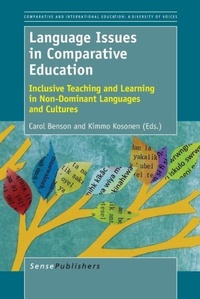
Language Issues in Comparative Education
Inclusive Teaching and Learning in Non-Dominant Languages and Cultures
Published on 1. January 2013
Book
Paperback/Softback
314 pages
978-94-6209-216-7 (ISBN)
Description
This volume compiles a unique yet complementary collection of chapters that take a strategic comparative perspective on education systems, regions of the world, and/or ethnolinguistic communities with a focus on non-dominant languages and cultures in education. Comparison and contrast within each article and across articles illustrates the potential for using home languages--which in many cases are in non-dominant positions relative to other languages in society--in inclusive multilingual and multicultural forms of education. The 22 authors demonstrate how bringing non-dominant languages and cultures into schooling has liberatory, transformative potential for learners from ethnolinguistic communities that have previously been excluded from access to quality basic education.
The authors deal not only with educational development in specific low-income and emerging countries in Asia (Afghanistan, Bangladesh, Cambodia, the Philippines Thailand and Vietnam), Latin America (Guatemala and Mexico) and Africa (Mozambique, Senegal and Tanzania), but also with efforts to reach marginalized ethnolinguistic communities in high-income North American countries (Canada and the USA). In the introductory chapter the editors highlight common and cross-cutting themes and propose appropriate, sometimes new terminology for the discussion of linguistic and cultural issues in education, particularly in low-income multilingual countries. Likewise, using examples from additional countries and contexts, the three final chapters address cross-cutting issues related to language and culture in educational research and development.
The authors and editors of this volume share a common commitment to comparativism in their methods and analysis, and aim to contribute to more inclusive and relevant education for all.
The authors deal not only with educational development in specific low-income and emerging countries in Asia (Afghanistan, Bangladesh, Cambodia, the Philippines Thailand and Vietnam), Latin America (Guatemala and Mexico) and Africa (Mozambique, Senegal and Tanzania), but also with efforts to reach marginalized ethnolinguistic communities in high-income North American countries (Canada and the USA). In the introductory chapter the editors highlight common and cross-cutting themes and propose appropriate, sometimes new terminology for the discussion of linguistic and cultural issues in education, particularly in low-income multilingual countries. Likewise, using examples from additional countries and contexts, the three final chapters address cross-cutting issues related to language and culture in educational research and development.
The authors and editors of this volume share a common commitment to comparativism in their methods and analysis, and aim to contribute to more inclusive and relevant education for all.
More details
Series
Language
English
Place of publication
Germany
Target group
Professional and scholarly
Product notice
Paperback (trade)
Unsewn / adhesive bound
Dimensions
Height: 234 mm
Width: 156 mm
Thickness: 17 mm
Weight
445 gr
ISBN-13
978-94-6209-216-7 (9789462092167)
Copyright in bibliographic data and cover images is held by Nielsen Book Services Limited or by the publishers or by their respective licensors: all rights reserved.
Schweitzer Classification
Other editions
Additional editions
Carol Benson | Kimmo Kosonen
Language Issues in Comparative Education
Inclusive Teaching and Learning in Non-Dominant Languages and Cultures
E-Book
06/2013
Brill
€37.45
Available for download
Carol Benson | Kimmo Kosonen
Language Issues in Comparative Education
Inclusive Teaching and Learning in Non-Dominant Languages and Cultures
Book
01/2013
Brill
€114.50
Shipment within 15-20 days