

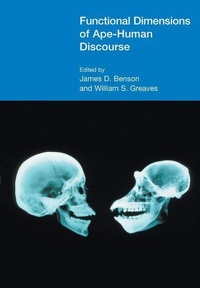
Functional Dimensions of Ape-Human Discourse
1st Edition
Published on 1. November 2005
Book
Hardback
128 pages
978-1-904768-05-0 (ISBN)
Description
PAPERBACK PUBLISHED JULY 2009
Functional Dimensions of Ape-Human Discourse asks the question ‘what do interactions between apes and humans mediated by language tell us?’. In order to answer this question the authors explore language-in-context, drawing on a multi-leveled, multi-functional linguistics. The levels are context of culture, context of situation, semantics, lexicogrammar, and phonology; and the functions are ideational, interpersonal, and textual.
Chapter One discusses a negotiation between the bonobo Kanzi and Sue Savage-Rumbaugh in terms of discourse-semantics and the ideational and interpersonal metafunctions of lexicogrammar. Chapter Two reinterprets Sue Savage-Rumbaugh et. al. Language Comprehension in Ape and Child (1993) in terms of the ideational metafunction, and provides corroborative evidence for Kanzi’s symbolic processing abilities, opening a window into the consciousness of at least one non-human primate. Chapter Three compares three snapshots from comprehensive studies based on large amounts of data (monkey calls, language development in a human child, and a dialogue between Kanzi’s sibling Panbanisha and Sue Savage-Rumbaugh) from an evolutionary perspective, showing different ways in which the level of grammar comes to be wedged in between semantics and expression. Chapter Four articulates a methodology incorporating public domain software for the comprehensive analysis of ape-human interaction. Although bonobo-human interaction is used as an example, the methodology could be utilized for studies of chimpanzees, gorillas, and orangutans.
Functional Dimensions of Ape-Human Discourse asks the question ‘what do interactions between apes and humans mediated by language tell us?’. In order to answer this question the authors explore language-in-context, drawing on a multi-leveled, multi-functional linguistics. The levels are context of culture, context of situation, semantics, lexicogrammar, and phonology; and the functions are ideational, interpersonal, and textual.
Chapter One discusses a negotiation between the bonobo Kanzi and Sue Savage-Rumbaugh in terms of discourse-semantics and the ideational and interpersonal metafunctions of lexicogrammar. Chapter Two reinterprets Sue Savage-Rumbaugh et. al. Language Comprehension in Ape and Child (1993) in terms of the ideational metafunction, and provides corroborative evidence for Kanzi’s symbolic processing abilities, opening a window into the consciousness of at least one non-human primate. Chapter Three compares three snapshots from comprehensive studies based on large amounts of data (monkey calls, language development in a human child, and a dialogue between Kanzi’s sibling Panbanisha and Sue Savage-Rumbaugh) from an evolutionary perspective, showing different ways in which the level of grammar comes to be wedged in between semantics and expression. Chapter Four articulates a methodology incorporating public domain software for the comprehensive analysis of ape-human interaction. Although bonobo-human interaction is used as an example, the methodology could be utilized for studies of chimpanzees, gorillas, and orangutans.
More details
Series
Language
English
Place of publication
United Kingdom
Target group
Professional and scholarly
Product notice
sewn/stitched
Paper over boards
Dimensions
Height: 243 mm
Width: 163 mm
Thickness: 12 mm
Weight
327 gr
ISBN-13
978-1-904768-05-0 (9781904768050)
Copyright in bibliographic data and cover images is held by Nielsen Book Services Limited or by the publishers or by their respective licensors: all rights reserved.
Schweitzer Classification
Other editions
Additional editions
Pamela J. Benson | James D. Benson | William S. Greaves
Functional Dimensions of Ape-Human Discourse
E-Book
11/2005
1st Edition
Equinox Publishing Ltd
€34.79
Available for download
Persons
James D. Benson is Associate Professor of English at Glendon College, York University, in Toronto. He is co-author (with William S. Greaves) of The Language People Really Use, You and Your Language. William S. Greaves is Emeritus Associate Professor in the English Department at Glendon College, York University, Toronto, which he joined in 1967. His co-authored book (with M.A.K. Halliday) Intonation in the Grammar of English will be published in 2004 by Equinox Publishing Ltd.
Content
Preface
Acknowledgements
List of contributors
Chapter 1. The interpersonal dimension: Confrontation and support in bonobo-human discourse
James D. Benson, Peter Fries, William S. Greaves, Kazyoshi Iwamoto, Sue Savage-Rumbaugh and Jared P. Taglialatela
Chapter 2. The ideational dimension: Evidence for symbolic language processing in a bonobo (Pan paniscus)
James D. Benson, William S. Greaves , Michael O’Donnell and Jared P. Taglialatela
Chapter 3. The evolutionary dimension: The thin edge of the wedge -- grammar and discourse in the evolution of langauge
James D. Benson, William S. Greaves, Sue Savage-Rumbaugh, Jared P. Taglialatela and Paul J. Thibault
Chapter 4. The multistratal dimension: A methodology for phonetic analysis of vocalizations of language competent Bonobos
James D. Benson, Meena Debashish, William S. Greaves, Jennifer Lukas, Sue Savage-Rumbaugh and Jared P. Taglialialatela
Acknowledgements
List of contributors
Chapter 1. The interpersonal dimension: Confrontation and support in bonobo-human discourse
James D. Benson, Peter Fries, William S. Greaves, Kazyoshi Iwamoto, Sue Savage-Rumbaugh and Jared P. Taglialatela
Chapter 2. The ideational dimension: Evidence for symbolic language processing in a bonobo (Pan paniscus)
James D. Benson, William S. Greaves , Michael O’Donnell and Jared P. Taglialatela
Chapter 3. The evolutionary dimension: The thin edge of the wedge -- grammar and discourse in the evolution of langauge
James D. Benson, William S. Greaves, Sue Savage-Rumbaugh, Jared P. Taglialatela and Paul J. Thibault
Chapter 4. The multistratal dimension: A methodology for phonetic analysis of vocalizations of language competent Bonobos
James D. Benson, Meena Debashish, William S. Greaves, Jennifer Lukas, Sue Savage-Rumbaugh and Jared P. Taglialialatela