

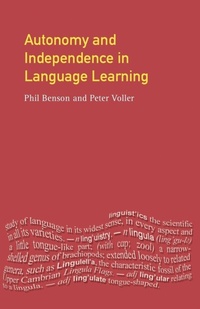
Autonomy and Independence in Language Learning
1st Edition
Published on 19. November 1996
Book
Paperback/Softback
288 pages
978-0-582-28992-5 (ISBN)
Description
The topics of autonomy and independence play an increasingly important role in language education. They raise issues such as learners' responsibility for their own learning, and their right to determine the direction of their own learning, the skills which can be learned and applied in self-directed learning and capacity for independent learning and the extents to which this can be suppressed by institutional education.
This volume offers new insights into the principles of autonomy and independence and the practices associated with them focusing on the area of EFL teaching. The editors' introduction provides the context and outlines the main issues involved in autonomy and independence. Later chapters discuss the social and political implications of autonomy and independence and their effects on educational structures. The consequences for the design of learner-centred materials and methods is discussed, together with an exploration of the practical ways of implementing autonomy and independence in language teaching and learning . Each section of the book opens with an introduction to give structure to the development of ideas and themes, with synopses to highlight salient features in the text and help build upon the material of previous chapters.
This volume offers new insights into the principles of autonomy and independence and the practices associated with them focusing on the area of EFL teaching. The editors' introduction provides the context and outlines the main issues involved in autonomy and independence. Later chapters discuss the social and political implications of autonomy and independence and their effects on educational structures. The consequences for the design of learner-centred materials and methods is discussed, together with an exploration of the practical ways of implementing autonomy and independence in language teaching and learning . Each section of the book opens with an introduction to give structure to the development of ideas and themes, with synopses to highlight salient features in the text and help build upon the material of previous chapters.
More details
Series
Language
English
Place of publication
London
United Kingdom
Publishing group
Taylor & Francis Ltd
Target group
Children/juvenile
Professional and scholarly
Dimensions
Height: 216 mm
Width: 140 mm
Thickness: 16 mm
Weight
363 gr
ISBN-13
978-0-582-28992-5 (9780582289925)
Copyright in bibliographic data and cover images is held by Nielsen Book Services Limited or by the publishers or by their respective licensors: all rights reserved.
Schweitzer Classification
Other editions
Additional editions
Phil Benson | Peter Voller
Autonomy and Independence in Language Learning
Book
08/2016
1st Edition
Routledge
€253.50
Shipment within 10-20 days
Phil Benson | Peter Voller
Autonomy and Independence in Language Learning
E-Book
06/2014
1st Edition
Routledge
€73.49
Available for download
Phil Benson | Peter Voller
Autonomy and Independence in Language Learning
E-Book
06/2014
1st Edition
Routledge
€73.99
Available for download
Persons
Phil Benson, Peter Voller
Content
Contributors; General Editor's Preface
1. Introduction: autonomy and independence in language learning, Phil Benson and Peter Voller
Part I: Philosophy and practice
2. The philosophy and politics of learner autonomy, Phil Benson
3. Cultural alternatives and autonomy, Alastair Pennycook
4. An exploration of the relationship between self-access and independent learning, Susan Sheerin
5. Teaching and language learning in self-access centres: changing roles?, Gill Sturtridge
6. Self-access: why do we want t and what can it do?, William Littlewood
Part II: Roles and relationships
7. Does the teacher have a role in autonomous leanguage learning?, Peter Voller
8. The guru and the conjurer: aspects of counselling for self-access, Philip Riley
9. Shooting arrows at the sun: perspectives on a pedagogy for autonomy, Michael P. Breen and Sarah J. Mann
10. Confidence building for classroom teachers, Felicity O'Dell
11. Learner training for autonomous language learning, Edith M. Esch
Part III: Methods and materials
12. Self-access work and curriculum ideologies, Andrew Littlejohn
13. Designing and adapting materials to encourage learner autonomy, David Nunan
14. Involving learners in developing learning methods: exploiting text corpora in self-access, Guy Aston
15. Preparing learners for independence: resources beyond the classroom, Stephen M. Ryan
16. Responding authentically to authentic texts: a problem for self-access language learning?, David Little
17. Providing computerized self-access opportunities for the development of writing skills, John Milton
References. Index.
1. Introduction: autonomy and independence in language learning, Phil Benson and Peter Voller
Part I: Philosophy and practice
2. The philosophy and politics of learner autonomy, Phil Benson
3. Cultural alternatives and autonomy, Alastair Pennycook
4. An exploration of the relationship between self-access and independent learning, Susan Sheerin
5. Teaching and language learning in self-access centres: changing roles?, Gill Sturtridge
6. Self-access: why do we want t and what can it do?, William Littlewood
Part II: Roles and relationships
7. Does the teacher have a role in autonomous leanguage learning?, Peter Voller
8. The guru and the conjurer: aspects of counselling for self-access, Philip Riley
9. Shooting arrows at the sun: perspectives on a pedagogy for autonomy, Michael P. Breen and Sarah J. Mann
10. Confidence building for classroom teachers, Felicity O'Dell
11. Learner training for autonomous language learning, Edith M. Esch
Part III: Methods and materials
12. Self-access work and curriculum ideologies, Andrew Littlejohn
13. Designing and adapting materials to encourage learner autonomy, David Nunan
14. Involving learners in developing learning methods: exploiting text corpora in self-access, Guy Aston
15. Preparing learners for independence: resources beyond the classroom, Stephen M. Ryan
16. Responding authentically to authentic texts: a problem for self-access language learning?, David Little
17. Providing computerized self-access opportunities for the development of writing skills, John Milton
References. Index.