

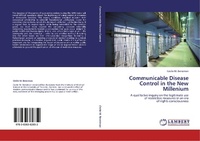
Communicable Disease Control in the New Millenium
A qualitative inquiry on the legitimate use of restrictive measures in an era of rights consciousness
Published on 1. July 2010
Book
Paperback/Softback
264 pages
978-3-8383-8285-2 (ISBN)
Description
The issuance of thousands of quarantine orders duringthe SARS outbreak raised difficult questions aboutthe legitimacy of using restrictive measures in democratic societies. This inquirycombines empirical research with conceptualscholarship to establish foundational justificatorypower for restrictive interventions, which thedominant utilitarian justification lacks. It isargued that, to respect rights, while being committedto the common good, we must move beyond thesee-sawing between ostensibly competing requirementstoward a conception that gives equal weight to public health and human rights; that is, one where bothimperatives - the community and the individual -refer to one another without dissolving into theother based on their intersubjective recognition.Following a Habermasian account of opening processesof decision-making to a moral-practical discourse, itis further argued that public health ethics offers animportant site for integrating his model of discourse ethics within public health deliberations to expand the scope of moral argumentation on-and ultimately to ground the justification of--the use of restrictive measures.
More details
Language
English
Place of publication
Germany
Product notice
Paperback (trade)
Unsewn / adhesive bound
Dimensions
Height: 220 mm
Width: 150 mm
Thickness: 17 mm
Weight
411 gr
ISBN-13
978-3-8383-8285-2 (9783838382852)
Copyright in bibliographic data and cover images is held by Nielsen Book Services Limited or by the publishers or by their respective licensors: all rights reserved.
Schweitzer Classification
Person
Cécile M. Bensimon obtained her doctorate from the Institute ofMedical Science at the University of Toronto, Canada. Her work onthe ethics of modern communicable disease control has positionedher as one of the early architects of the emerging scholarship on public health ethics.