

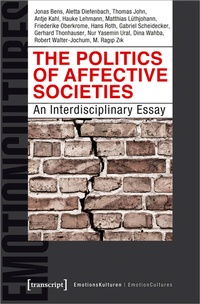
The Politics of Affective Societies
Description
More details
Other editions
Additional editions
Persons
Jonas Bens, Freie Universität Berlin, Deutschland
Jonas Bens (Dr. phil., Dipl.-Jur.), geb. 1984, forscht und lehrt am Institut für Sozial- und Kulturanthropologie an der Freien Universität Berlin.
ISNI:
Aletta Diefenbach, Freie Universität Berlin, Deutschland
Aletta Diefenbach (M.A.) is a sociologist and works as a research fellow at the Collaborative Research Centre »Affective Societies« (DFG-SFB 1171) at Freie Universität Berlin. She works on religion as a public force in the United States and in Germany.
Thomas John, Freie Universität Berlin, Deutschland
Thomas John (M.A.) is an anthropologist and works as a research fellow at the Collaborative Research Centre »Affective Societies« (DFG-SFB 1171) at Freie Universität Berlin. His research focuses and media ethnography and visual anthropology. In his dissertation project he is concerned with a local art scene of independent documentary filmmakers in Mexico.
Antje Kahl, Freie Universität Berlin, Deutschland
Antje Kahl (Dr. phil.) is a sociologist and works as a research fellow at the Collaborative Research Centre »Affective Societies« (DFG-SFB 1171) at Freie Universität Berlin. She is currently heading the method lab at the CRC »Affective Societies« at Freie Universität Berlin. Her research interests include methods and methodologies, sociology of knowledge, science research, medical sociology, sociology of the body, death and dying.
Hauke Lehmann, Freie Universität Berlin, Deutschland
Hauke Lehmann (Dr. phil.) is a film scholar and works as a research fellow at the Collaborative Research Centre »Affective Societies« (DFG-SFB 1171) at Freie Universität Berlin. His doctoral thesis as a film scholar is concerned with the poetics of affect of New Hollywood cinema. His research focuses on theories of cinematic affectivity and cinematic temporality.
Matthias Lüthjohann, Freie Universität Berlin, Deutschland
Friederike Oberkrome, Freie Universität Berlin, Deutschland
Friederike Oberkrome (M.A.), geb. 1988, ist Theaterwissenschaftlerin und arbeitet als wissenschaftliche Mitarbeiterin im Sonderforschungsbereich 1171 »Affective Societies« an der Freien Universität Berlin. Ihre Forschungsinteressen sind Theater und Räumlichkeit, Interferenzen von Kunst(-wissenschaft) und Theater(-wissenschaft) sowie Ästhetiken des Dokumentierens.
Hans Roth, Freie Universität Berlin, Deutschland
Hans Roth (M.A.) is a theatre scholar and works as a research fellow at the Collaborative Research Centre »Affective Societies« (DFG-SFB 1171) at Freie Universität Berlin. His PhD project focuses on the political ambiguities of ridicule and solidarity in ethnic humor and postmigrant theatre. Other research interests include the affective economies of theatre and media, the theatricality of society and the theatre of Bertolt Brecht and its controversial legacy.
Gabriel Scheidecker, Freie Universität Berlin, Deutschland
Gabriel Scheidecker, geb. 1982, ist Postdoktorand am SFB »Affective Societies« der Freien Universität Berlin und forscht zur Sozialisation von Emotionen im transkulturellen Kontext »vietnamesisches Berlin«. Der Sozial- und Kulturanthropologe promovierte am Exzellenzcluster »Languages of Emotion« (FU Berlin).
ISNI:
Gerhard Thonhauser, Technische Universität Darmstadt, Deutschland
Gerhard Thonhauser (Dr. phil.) is a philosopher and currently Erwin Schrödinger Fellow of the Austrian Science Fund and associated with the CRC 1171 Affective Societies at Freie Universität Berlin. He holds a PhD in philosophy and M.A.s in philosophy and political science from the University of Vienna. His research focuses on social and political philosophy and theories of emotion from a phenomenological perspective.
Nur Yasemin Ural, Freie Universität Berlin, Deutschland
Nur Yasemin Ural (Dr. phil.) is a sociologist and works as a research fellow at the Collaborative Research Centre »Affective Societies« (DFG-SFB 1171) at Freie Universität Berlin. She studied in Turkey, Germany, France and Canada. She obtained her PhD in Sociology at EHESS Paris. Her thesis focused on Muslim minorities and politisation of religion in France and Germany. She has taught on immigration, secularity and Islam in Europe.
ISNI:
Dina Wahba, Freie Universität Berlin, Deutschland
Dina Wahba (M.A.) is a political scientist and works as a research fellow at the Collaborative Research Centre »Affective Societies« (DFG-SFB 1171) at Freie Universität Berlin. Dina is a women's rights activist who worked with several local, regional and international organizations such as International Rescue Committee (IRC), UN Women, the League of Arab States and Women Living Under Muslim Laws (WLUML). She worked on a number of gender issues such as sexual and gender based violence, leadership, political participation and empowerment. Dina worked in several countries among them United Kingdom, South Sudan, Egypt and most recently Germany.
Robert Walter-Jochum, Freie Universität Berlin, Deutschland
Robert Walter-Jochum (Dr. phil.), geb. 1981, ist seit 2009 wissenschaftlicher Mitarbeiter im Bereich Neuere deutsche Literatur an der Freien Universität Berlin. Bis September 2018 war er tätig am dortigen Sonderforschungsbereich »Affective Societies«. In seiner aktuellen Forschung beschäftigt er sich mit der Schnittstelle von Hassrede und (Gegenwarts-)Literatur. Daneben publizierte er u.a. zur deutschen und österreichischen Gegenwartsliteratur sowie zu den Bereichen Autobiografik, »Literatur und Religion« sowie »Literatur - Affekt - Emotionen«.
ISNI:
M. Ragip Zik, Freie Universität Berlin, Deutschland
M. Ragip Zik (M.A.) is a sociologist and works as a research fellow at the Collaborative Research Centre »Affective Societies« (DFG-SFB 1171) at Freie Universität Berlin. Focusing on contemporary visual practices in political struggle, his project follows a critical approach to concepts of digitality, iconography, and affect. He has previously researched on artistic practices, collective memory, and resistance cultures. He currently serves as a board member at the International Sociological Association's Visual Sociology Research Committee.