

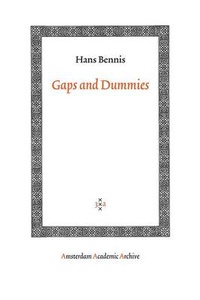
Gaps and Dummies
Published on 24. October 2005
Book
Paperback/Softback
352 pages
978-90-5356-859-0 (ISBN)
Description
In this study the syntactic properties of empty categories and dummy pronouns are investigated within the framework of Government-Binding theory.The assumption that clauses must have a subject is present in most, if not all, linguistic theories. In GB theory the requirement that clauses have a subject is stipulated as a consequence of the base rules or the Extended Projection Principle. In this book it is claimed that no such stipulation is necessary. The presence of a subject is exclusively determined by the theories of thematic roles and Case.This view is supported by the fact that the alleged dummy subjects Dutch, i.e. er and het, show a variety of properties, which can only be explained if they are not analyzed as dummy subjects. Further confirmation is derived from the fact that Dutch, subjectless sentences are found in precisely those circumstances in which neither -theory nor Case theory requires a subject to be present.Chapter 1 presents a theory of empty categories. This theory enables us to explain the distribution of gaps, and makes precise and correct predictions with respect to the occurrence of parasitic gaps.The non-dummy status of het, discussed in chapter 2, is supported by the fact that it can be the antecedent of PRO, reflexives, and parasitic gaps, and by an asymmetry in wh-movement from sentential complements. The analysis of het leads to a discussion of a variety of constructions, including constructions with raising, ergative, and psychological verbs.The adverbial pronoun er displays several distinct syntactic functions. In chapter 3 it is argued that none of these different functions justifies an analysis of er as a dummy subject.In chapter 4 some of the consequences of the theory introduced in the preceding chapters are investigated. These include a discussion of the status of the subject position in languages such as English, Italian, French, and Spanish, the structure of Old English, and the status of dummy pronouns in German and English.
More details
Series
Language
English
Place of publication
Amsterdam
Netherlands
Target group
Professional and scholarly
ISBN-13
978-90-5356-859-0 (9789053568590)
Copyright in bibliographic data and cover images is held by Nielsen Book Services Limited or by the publishers or by their respective licensors: all rights reserved.
Schweitzer Classification
Other editions
Additional editions
Person
Boudewijn van den Berg is research assistant at the Meertens Instituut (Royal Netherlands Academy of Arts and Sciences, Amsterdam).|Ton Goeman was senior researcher at the Meertens Instituut(Royal Netherlands AcademyofArts and Sciences, Amsterdam) and MAND-project coordinator.|Oele Koornwinder was postdoc at the Meertens Instituut and is researcher at Gridline Amsterdam.|Marc van Oostendorp is senior researcher at the Meertens Instituut and professor in linguistics at Leyden University.|Piet van Reenen is emeritus professor in linguistics at the Free University of Amsterdam and guest researcher at the Meertens Instituut.
Content
Introduction, Ch.1: Gaps and Parasitic Gaps, Ch.2: HET as a Referential Expression, Ch.3: The Adverbial Pronoun ER, Ch.4: Some Related Topics, References