

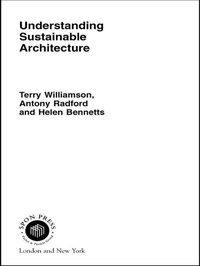
Understanding Sustainable Architecture
1st Edition
Will be published approx. on 24. October 2002
Book
Hardback
176 pages
978-0-415-28351-9 (ISBN)
Description
Understanding Sustainable Architecture is a review of the assumptions, beliefs, goals and bodies of knowledge that underlie the endeavour to design (more) sustainable buildings and other built developments.
Much of the available advice and rhetoric about sustainable architecture begins from positions where important ethical, cultural and conceptual issues are simply assumed. If sustainable architecture is to be a truly meaningful pursuit then it must be grounded in a coherent theoretical framework. This book sets out to provide that framework. Through a series of self-reflective questions for designers, the authors argue the ultimate importance of reasoned argument in ecological, social and built contexts, including clarity in the problem framing and linking this framing to demonstrably effective actions. Sustainable architecture, then, is seen as a revised conceptualisation of architecture in response to a myriad of contemporary concerns about the effects of human activity.
The aim of this book is to be transformative by promoting understanding and discussion of commonly ignored assumptions behind the search for a more environmentally sustainable approach to development. It is argued that design decisions must be based on both an ethical position and a coherent understanding of the objectives and systems involved. The actions of individual designers and appropriate broader policy settings both follow from this understanding.
Much of the available advice and rhetoric about sustainable architecture begins from positions where important ethical, cultural and conceptual issues are simply assumed. If sustainable architecture is to be a truly meaningful pursuit then it must be grounded in a coherent theoretical framework. This book sets out to provide that framework. Through a series of self-reflective questions for designers, the authors argue the ultimate importance of reasoned argument in ecological, social and built contexts, including clarity in the problem framing and linking this framing to demonstrably effective actions. Sustainable architecture, then, is seen as a revised conceptualisation of architecture in response to a myriad of contemporary concerns about the effects of human activity.
The aim of this book is to be transformative by promoting understanding and discussion of commonly ignored assumptions behind the search for a more environmentally sustainable approach to development. It is argued that design decisions must be based on both an ethical position and a coherent understanding of the objectives and systems involved. The actions of individual designers and appropriate broader policy settings both follow from this understanding.
More details
Language
English
Place of publication
London
United Kingdom
Target group
College/higher education
Professional and scholarly
Illustrations
4 s/w Tabellen
4 Tables, black and white
Dimensions
Height: 234 mm
Width: 156 mm
Weight
408 gr
ISBN-13
978-0-415-28351-9 (9780415283519)
Copyright in bibliographic data and cover images is held by Nielsen Book Services Limited or by the publishers or by their respective licensors: all rights reserved.
Schweitzer Classification
Other editions
Additional editions
Helen Bennetts | Antony Radford | Terry Williamson
Understanding Sustainable Architecture
E-Book
09/2003
Taylor & Francis
€69.99
Available for download
Helen Bennetts | Antony Radford | Terry Williamson
Understanding Sustainable Architecture
E-Book
09/2003
Taylor & Francis
€69.99
Available for download
Helen Bennetts | Antony Radford | Terry Williamson
Understanding Sustainable Architecture
Book
10/2002
1st Edition
Taylor & Francis
€77.20
Shipment within 15-20 days
Persons
Terry Williamson was educated in engineering and architecture in Australia and is Associate Professor and Dean of the School of Architecture, Landscape Architecture and Urban Design at Adelaide University, Australia. Anthony Radford was educated in architecture and planning in the United Kingdom and is Professor of Architecture in the same school. Helen Bennetts was educated in architecture in Australia and, after researching how architects actually use information in seeking to produce environmentally responsible buildings, now concentrates on the family business of wine- and cheese-making. All three have taught, researched and published in areas of energy, environment and sustainability. This book draws particularly on their development and teaching of a new course called Issues in Urban and Landscape Sustainability.
Content
1. Sustainability 2. Images 3. Ethics 4. Objectives 5. Systems 6. Green Houses 7. Cohesion. Bibliography