

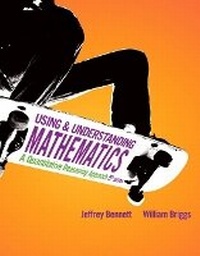
Using and Understanding Mathematics
A Quantitative Reasoning Approach plus NEW MyMathLab with Pearson eText -- Access Card Package
5th Edition
Published on 28. March 2011
Book
Mixed media product
744 pages
978-0-321-70895-3 (ISBN)
Description
This package consists of the textbook plus an access kit for MyMathLab/MyStatLab.
Using and Understanding Mathematics: A Quantitative Reasoning Approach, Fifth Edition increases readers' mathematical literacy so that they better understand the mathematics used in their daily lives, and can use math effectively to make better decisions every day. Contents are organized with that in mind, with engaging coverage in sections like Taking Control of Your Finances, Dividing the Political Pie, and a full chapter about Mathematics and the Arts.
MyMathLab provides a wide range of homework, tutorial, and assessment tools that make it easy to manage your course online.
Using and Understanding Mathematics: A Quantitative Reasoning Approach, Fifth Edition increases readers' mathematical literacy so that they better understand the mathematics used in their daily lives, and can use math effectively to make better decisions every day. Contents are organized with that in mind, with engaging coverage in sections like Taking Control of Your Finances, Dividing the Political Pie, and a full chapter about Mathematics and the Arts.
MyMathLab provides a wide range of homework, tutorial, and assessment tools that make it easy to manage your course online.
More details
Edition
5th edition
Language
English
Place of publication
United States
Publishing group
Pearson Education (US)
Target group
College/higher education
Dimensions
Height: 282 mm
ISBN-13
978-0-321-70895-3 (9780321708953)
Copyright in bibliographic data is held by Nielsen Book Services Limited or its licensors: all rights reserved.
Schweitzer Classification
Other editions
New editions
Jeffrey O. Bennett | William L. Briggs
Using and Understanding Mathematics
A Quantitative Reasoning Approach: International Edition
Book
02/2010
5th Edition
Pearson
€142.36
Article exhausted; check for reprint
Previous edition
Jeffrey O. Bennett | William L. Briggs
Using and Understanding Mathematics
A Quantitative Reasoning Approach: United States Edition
Book
01/2007
4th Edition
Pearson
€96.55
Article exhausted; check for reprint
Content
Preface
Prologue: Literacy for the Modern World
Part 1 Logic and Problem Solving
Chapter 1 Thinking Critically
1A Recognizing Fallacies
1B Propositions and Truth Values
1C Sets and Venn Diagrams
1D Analyzing Arguments
1E Critical Thinking in Everyday Life
Chapter 2 Approaches to Problem Solving
2A The Problem-Solving Power of Units
2B Standardized Units: More Problem-Solving Power
2C Problem-Solving Guidelines and Hints
Part 2 Quantitative Information in Everyday Life
Chapter 3 Numbers in the Real World
3A Uses and Abuses of Percentages
3B Putting Numbers in Perspective
3C Dealing with Uncertainty
3D Index Numbers: The CPI and Beyond
3E How Numbers Deceive: Polygraphs, Mammograms, and More
Chapter 4 Managing Money
4A Taking Control of Your Finances
4B The Power of Compounding
4C Savings Plans and Investments
4D Loan Payments, Credit Cards, and Mortgages
4E Income Taxes
4F Understanding the Federal Budget
Part 3 Probability and Statistics
Chapter 5 Statistical Reasoning
5A Fundamentals of Statistics
5B Should You Believe a Statistical Study?
5C Statistical Tables and Graphs
5D Graphics in the Media
5E Correlation and Causality
Chapter 6 Putting Statistics to Work
6A Characterizing Data
6B Measures of Variation
6C The Normal Distribution
6D Statistical Inference
Chapter 7 Probability: Living with the Odds
7A Fundamentals of Probability
7B Combining Probabilities
7C The Law of Large Numbers
7D Assessing Risk
7E Counting and Probability
Part 4 Modeling
Chapter 8 Exponential Astonishment
8A Growth: Linear versus Exponential
8B Doubling Time and Half-Life
8C Real Population Growth
8D Logarithmic Scales: Earthquakes, Sounds, and Acids
Chapter 9 Modeling Our World
9A Functions: The Building Blocks of Mathematical Models
9B Linear Modeling
9C Exponential Modeling
Chapter 10 Modeling with Geometry
10A Fundamentals of Geometry
10B Problem Solving with Geometry
10C Fractal Geometry
Part 5 Further Applications
Chapter 11 Mathematics and the Arts
11A Mathematics and Music
11B Perspective and Symmetry
11C Proportion and the Golden Ratio
Chapter 12 Mathematics and Politics
12A Voting: Does the Majority Always Rule?
12B Theory of Voting
12C Apportionment: The House of Representatives and Beyond
12D Dividing the Political Pie
Credits
Answers
Index
Prologue: Literacy for the Modern World
Part 1 Logic and Problem Solving
Chapter 1 Thinking Critically
1A Recognizing Fallacies
1B Propositions and Truth Values
1C Sets and Venn Diagrams
1D Analyzing Arguments
1E Critical Thinking in Everyday Life
Chapter 2 Approaches to Problem Solving
2A The Problem-Solving Power of Units
2B Standardized Units: More Problem-Solving Power
2C Problem-Solving Guidelines and Hints
Part 2 Quantitative Information in Everyday Life
Chapter 3 Numbers in the Real World
3A Uses and Abuses of Percentages
3B Putting Numbers in Perspective
3C Dealing with Uncertainty
3D Index Numbers: The CPI and Beyond
3E How Numbers Deceive: Polygraphs, Mammograms, and More
Chapter 4 Managing Money
4A Taking Control of Your Finances
4B The Power of Compounding
4C Savings Plans and Investments
4D Loan Payments, Credit Cards, and Mortgages
4E Income Taxes
4F Understanding the Federal Budget
Part 3 Probability and Statistics
Chapter 5 Statistical Reasoning
5A Fundamentals of Statistics
5B Should You Believe a Statistical Study?
5C Statistical Tables and Graphs
5D Graphics in the Media
5E Correlation and Causality
Chapter 6 Putting Statistics to Work
6A Characterizing Data
6B Measures of Variation
6C The Normal Distribution
6D Statistical Inference
Chapter 7 Probability: Living with the Odds
7A Fundamentals of Probability
7B Combining Probabilities
7C The Law of Large Numbers
7D Assessing Risk
7E Counting and Probability
Part 4 Modeling
Chapter 8 Exponential Astonishment
8A Growth: Linear versus Exponential
8B Doubling Time and Half-Life
8C Real Population Growth
8D Logarithmic Scales: Earthquakes, Sounds, and Acids
Chapter 9 Modeling Our World
9A Functions: The Building Blocks of Mathematical Models
9B Linear Modeling
9C Exponential Modeling
Chapter 10 Modeling with Geometry
10A Fundamentals of Geometry
10B Problem Solving with Geometry
10C Fractal Geometry
Part 5 Further Applications
Chapter 11 Mathematics and the Arts
11A Mathematics and Music
11B Perspective and Symmetry
11C Proportion and the Golden Ratio
Chapter 12 Mathematics and Politics
12A Voting: Does the Majority Always Rule?
12B Theory of Voting
12C Apportionment: The House of Representatives and Beyond
12D Dividing the Political Pie
Credits
Answers
Index