

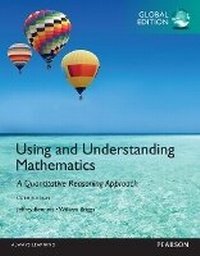
Using and Understanding Mathematics: A Quantitative Reasoning Approach, Global Edition
6th Edition
Published on 13. November 2014
Book
Paperback/Softback
768 pages
978-1-292-06230-3 (ISBN)
Description
Using and Understanding Mathematics: A Quantitative Reasoning Approach prepares students for the mathematics they will encounter in college courses, their future career, and life in general. Its quantitative reasoning approach helps students to build the skills needed to understand major issues in everyday life, and compels students to acquire the problem-solving tools that they will need to think critically about quantitative issues in contemporary society. This program will provide a better teaching and learning experience-for you and your students. Here's how: *The real-world focus turns students' attention to the math they will need for college, career, and life. * A wide range of exercises and problem types end each unit, making it easy for instructors to create assignments to fit their course goals. *Study and review features in every chapter are designed to help students use their time effectively.
More details
Edition
6th edition
Language
English
Place of publication
Harlow
United Kingdom
Target group
College/higher education
Dimensions
Height: 275 mm
Width: 215 mm
Thickness: 36 mm
Weight
1600 gr
ISBN-13
978-1-292-06230-3 (9781292062303)
Copyright in bibliographic data and cover images is held by Nielsen Book Services Limited or by the publishers or by their respective licensors: all rights reserved.
Schweitzer Classification
Other editions
Additional editions
Jeffrey Bennett | William Briggs
Using and Understanding Mathematics: A Quantitative Reasoning Approach, Global Edition
E-Book
02/2015
6th Edition
Pearson Education Limited
from
€42.80
Available for download
Previous edition
Jeffrey O. Bennett | William L. Briggs
Using and Understanding Mathematics
A Quantitative Reasoning Approach: International Edition
Book
02/2010
5th Edition
Pearson
€142.36
Article exhausted; check for reprint
Persons
About our authors Jeffrey Bennett served as the first director of the program "Quantitative Reasoning and Mathematical Skills" at the University of Colorado at Boulder, where he developed the groundbreaking curriculum that became the basis of this textbook. He holds a BA in biophysics (University of California, San Diego) and an MS and a PhD in astrophysics (University of Colorado), and has focused his career on math and science education.
In addition to co-authoring this textbook, he is also the lead author of best-selling college textbooks on statistical reasoning, astronomy, and astrobiology, and of more than a dozen books for children and adults. All 6 of his children's books have been selected for NASA's Story Time From Space. Among his other projects, Dr. Bennett proposed and co-led the development of the Voyage Scale Model Solar System in Washington, DC; created the free Totality app to help people learn about total solar eclipses; wrote an online primer on global warming; and developed a free, online curriculum for middle school Earth and Space Science. Learn more at Dr. Bennett's websites, Jeffrey Bennett: Astronomer, Teacher, & Writer, and Big Kid Science.
William L. Briggs was on the mathematics faculty at Clarkson University for 6 years and at the University of Colorado at Denver for 23 years, where he taught both undergraduate and graduate courses, with a special interest in applied mathematics. During much of that time he designed and taught courses in quantitative reasoning. In addition to this book, he has co-authored textbooks on statistical reasoning and calculus, as well as monographs in computational mathematics. He is also author of How America Got Its Guns (University of New Mexico Press). Dr. Briggs is a University of Colorado President's Teaching Scholar and the recipient of a Fulbright Fellowship to Ireland; he holds a BA degree from the University of Colorado and an MS and a PhD from Harvard University.
In addition to co-authoring this textbook, he is also the lead author of best-selling college textbooks on statistical reasoning, astronomy, and astrobiology, and of more than a dozen books for children and adults. All 6 of his children's books have been selected for NASA's Story Time From Space. Among his other projects, Dr. Bennett proposed and co-led the development of the Voyage Scale Model Solar System in Washington, DC; created the free Totality app to help people learn about total solar eclipses; wrote an online primer on global warming; and developed a free, online curriculum for middle school Earth and Space Science. Learn more at Dr. Bennett's websites, Jeffrey Bennett: Astronomer, Teacher, & Writer, and Big Kid Science.
William L. Briggs was on the mathematics faculty at Clarkson University for 6 years and at the University of Colorado at Denver for 23 years, where he taught both undergraduate and graduate courses, with a special interest in applied mathematics. During much of that time he designed and taught courses in quantitative reasoning. In addition to this book, he has co-authored textbooks on statistical reasoning and calculus, as well as monographs in computational mathematics. He is also author of How America Got Its Guns (University of New Mexico Press). Dr. Briggs is a University of Colorado President's Teaching Scholar and the recipient of a Fulbright Fellowship to Ireland; he holds a BA degree from the University of Colorado and an MS and a PhD from Harvard University.
Content
PART ONE: LOGIC AND PROBLEM SOLVING
1. Thinking Critically
2. Approaches to Problem Solving
PART TWO: QUANTITATIVE INFORMATION IN EVERYDAY LIFE
3. Numbers in the Real World
4. Managing Money
PART THREE: PROBABILITY AND STATISTICS
5. Statistical Reasoning
6. Putting Statistics to Work
7. Probability: Living with the Odds
PART FOUR: MODELING
8. Exponential Astonishment
9. Modeling Our World
10. Modeling with Geometry
PART FIVE: FURTHER APPLICATIONS
11. Mathematics and the Arts
12. Mathematics and Politics
1. Thinking Critically
2. Approaches to Problem Solving
PART TWO: QUANTITATIVE INFORMATION IN EVERYDAY LIFE
3. Numbers in the Real World
4. Managing Money
PART THREE: PROBABILITY AND STATISTICS
5. Statistical Reasoning
6. Putting Statistics to Work
7. Probability: Living with the Odds
PART FOUR: MODELING
8. Exponential Astonishment
9. Modeling Our World
10. Modeling with Geometry
PART FIVE: FURTHER APPLICATIONS
11. Mathematics and the Arts
12. Mathematics and Politics