

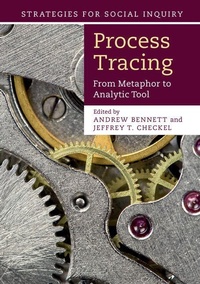
Process Tracing
From Metaphor to Analytic Tool
Published on 13. November 2014
Book
Paperback/Softback
342 pages
978-1-107-68637-3 (ISBN)
Description
Advances in qualitative methods and recent developments in the philosophy of science have led to an emphasis on explanation via reference to causal mechanisms. This book argues that the method known as process tracing is particularly well suited to developing and assessing theories about such mechanisms. The editors begin by establishing a philosophical basis for process tracing - one that captures mainstream uses while simultaneously being open to applications by interpretive scholars. Equally important, they go on to establish best practices for individual process-tracing accounts - how micro to go, when to start (and stop), and how to deal with the problem of equifinality. The contributors then explore the application of process tracing across a range of subfields and theories in political science. This is an applied methods book which seeks to shrink the gap between the broad assertion that 'process tracing is good' and the precise claim 'this is an instance of good process tracing'.
Reviews / Votes
'Bennett and Checkel have assembled an impressive group of scholars on the cutting-edge methodological issues involved in process tracing, while at the same time providing concrete, practical advice for scholars who wish to use this technique of analysis in a variety of different research programs. As a result of this dual approach, this volume represents a steep change from earlier methodological studies on process tracing and fills a real gap in scholarship. There is no doubt that it will be compulsory reading on graduate-level courses in qualitative methodology for a long time to come.' Giovanni Capoccia, University of Oxford 'Bennett and Checkel's remarkable book ?will bring process tracing to the attention of a wide spectrum of disciplines - sociology, anthropology, history, public policy analysis and beyond. This valuable tool for causal inference has been developed primarily by political scientists, and ?their volume ?will accelerate much wider adoption of the method.' David Collier, Robson Professor, University of California, Berkeley 'This volume is the next milestone in the dynamic debate over causal mechanisms and the standards and practices of process tracing. These contributions by leading figures in the discipline covering a broad range of topics and research areas are a must-read for anyone interested in and using qualitative methods.' Ingo Rohlfing, Bremen International Graduate School of Social SciencesMore details
Series
Language
English
Place of publication
Cambridge
United Kingdom
Target group
Professional and scholarly
Product notice
Paperback (trade)
Illustrations
9 Tables, black and white; 13 Line drawings, black and white
Dimensions
Height: 244 mm
Width: 170 mm
Thickness: 19 mm
Weight
595 gr
ISBN-13
978-1-107-68637-3 (9781107686373)
Copyright in bibliographic data and cover images is held by Nielsen Book Services Limited or by the publishers or by their respective licensors: all rights reserved.
Schweitzer Classification
Other editions
Additional editions
Book
11/2014
Cambridge University Press
€127.00
Shipment within 15-20 days
E-Book
10/2014
1st Edition
Cambridge University Press
€27.99
Available for download
Persons
Andrew Bennett is Professor of Government at Georgetown University. He is also President of the Consortium on Qualitative Research Methods, which sponsors the annual Institute on Qualitative and Multi-Method Research at Syracuse University. He is the co-author, with Alexander L. George, of Case Studies and Theory Development (2005), which won the Giovanni Sartori Prize in 2005 for the best book on qualitative methods. Jeffrey T. Checkel is Professor of International Studies and Simons Chair in International Law and Human Security at Simon Fraser University. He is also a Global Research Fellow at the Peace Research Institute Oslo. He has published extensively in leading European and North American journals, and is the author of Ideas and International Political Change: Soviet/Russian Behavior and the End of the Cold War (1997), editor of International Institutions and Socialization in Europe (Cambridge, 2007), co-editor (with Peter J. Katzenstein) of European Identity (Cambridge, 2009), and editor of Transnational Dynamics of Civil War (Cambridge, 2013).
Content
Preface; Part I. Introduction: 1. Process tracing: from philosophical roots to best practices Andrew Bennett and Jeffrey T. Checkel; Part II. Process Tracing in Action: 2. Process tracing the effects of ideas Alan M. Jacobs; 3. Mechanisms, process, and the study of international institutions Jeffrey T. Checkel; 4. Efficient process tracing: analyzing the causal mechanisms of European integration Frank Schimmelfennig; 5. What makes process tracing good? Causal mechanisms, causal inference, and the completeness standard in comparative politics David Waldner; 6. Explaining the Cold War's end: process tracing all the way down? Matthew Evangelista; 7. Process tracing, causal inference, and civil war Jason Lyall; Part III. Extensions, Controversies, and Conclusions: 8. Improving process tracing: the case of multi-method research Thad Dunning; 9. Practice tracing Vincent Pouliot; 10. Beyond metaphors: standards, theory, and the 'where next' for process tracing Jeffrey T. Checkel and Andrew Bennett; Appendix. Disciplining our conjectures: systematizing process tracing with Bayesian analysis.