

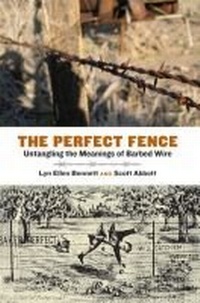
The Perfect Fence
Untangling the Meanings of Barbed Wire
Will be published approx. on 30. November 2017
Book
Hardback
288 pages
978-1-62349-582-4 (ISBN)
Description
Barbed wire is made of two strands of galvanized steel wire twisted together for strength and to hold sharp barbs in place. As creative advertisers sought ways to make an inherently dangerous product attractive to customers concerned about the welfare of their livestock, and as barbed wire became commonplace on battlefields and in concentration camps, the fence accrued a fascinating and troubling range of meanings beyond the material facts of its construction.
In The Perfect Fence, Lyn Ellen Bennett and Scott Abbott explore the multiple uses and meanings of barbed wire, a technological innovation that contributes to America's shift from a pastoral ideal to an industrial one. They survey the vigorous public debate over the benign or "infernal" fence, investigate legislative attempts to ban or regulate wire fences as a result of public outcry, and demonstrate how the industry responded to ameliorate the image of its barbed product.
Because of the rich metaphorical possibilities suggested by a fence that controls through pain, barbed wire developed into an important motif in works of literature from the late nineteenth century to the present day.
Early advertisements proclaimed that barbed wire was "the perfect fence," keeping "the ins from being outs, and the outs from being ins." Bennett and Abbott conclude that while barbed wire is not the perfect fence touted by manufacturers, it is indeed a meaningful thing that continues to influence American identities.
In The Perfect Fence, Lyn Ellen Bennett and Scott Abbott explore the multiple uses and meanings of barbed wire, a technological innovation that contributes to America's shift from a pastoral ideal to an industrial one. They survey the vigorous public debate over the benign or "infernal" fence, investigate legislative attempts to ban or regulate wire fences as a result of public outcry, and demonstrate how the industry responded to ameliorate the image of its barbed product.
Because of the rich metaphorical possibilities suggested by a fence that controls through pain, barbed wire developed into an important motif in works of literature from the late nineteenth century to the present day.
Early advertisements proclaimed that barbed wire was "the perfect fence," keeping "the ins from being outs, and the outs from being ins." Bennett and Abbott conclude that while barbed wire is not the perfect fence touted by manufacturers, it is indeed a meaningful thing that continues to influence American identities.
More details
Series
Language
English
Place of publication
College Station
United States
Target group
Professional and scholarly
Illustrations
42 black & white photographs, 2 figures, table
Dimensions
Height: 235 mm
Width: 156 mm
Thickness: 22 mm
Weight
643 gr
ISBN-13
978-1-62349-582-4 (9781623495824)
Copyright in bibliographic data and cover images is held by Nielsen Book Services Limited or by the publishers or by their respective licensors: all rights reserved.
Schweitzer Classification
Persons
Lyn Ellen Bennett is professor of history at Utah Valley University in Orem, Utah. Her research focuses on the American West, gender, and material culture studies.
Scott Abbott is professor of humanities, philosophy, and integrated studies at Utah Valley University. He is the author of five books, most recently, Immortal for Quite Some Time: Fraternal Meditations.
Scott Abbott is professor of humanities, philosophy, and integrated studies at Utah Valley University. He is the author of five books, most recently, Immortal for Quite Some Time: Fraternal Meditations.