

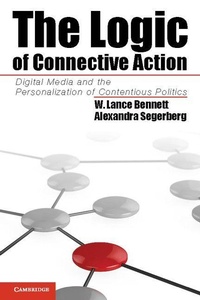
The Logic of Connective Action
Digital Media and the Personalization of Contentious Politics
Published on 26. August 2013
Book
Paperback/Softback
256 pages
978-1-107-64272-0 (ISBN)
Description
The Logic of Connective Action explains the rise of a personalized digitally networked politics in which diverse individuals address the common problems of our times such as economic fairness and climate change. Rich case studies from the United States, the United Kingdom and Germany illustrate a theoretical framework for understanding how large-scale connective action is coordinated. In many of these mobilizations, communication operates as an organizational process that may replace or supplement familiar forms of collective action based on organizational resource mobilization, leadership, and collective action framing. In some cases, connective action emerges from crowds that shun leaders, as when Occupy protesters created media networks to channel resources and create loose ties among dispersed physical groups. In other cases, conventional political organizations deploy personalized communication logics to enable large-scale engagement with a variety of political causes. The Logic of Connective Action shows how power is organized in communication-based networks, and what political outcomes may result.
Reviews / Votes
'W. Lance Bennett and Alexandra Segerberg's The Logic of Connective Action is a welcome introduction to the topic and should, I hope, convince more sociologists that our theories of movements should consider social media as a distinctive resource, one that transforms the way people engage in activism rather than simply augmenting traditional communications ... This book makes a strong case that social media and other forms of online activism should grab the attention of social movement scholars.' Brayden G. King, American Journal of Sociology 'Playing off Olson's title, Bennett and Segerberg describe the emerging development of 'connective' action, in which the lower costs of social media and the ability to claim credit for one's substantive contribution to policy debates have fueled new modes for personal political involvement. Through the development of a sophisticated matrix of mobilization types and techniques and a set of widely divergent case studies of social movement in a variety of political settings, they show the potential for technology to motivate, inform, and engage previously uninvolved individuals in the policy process ... Summing up: recommended.' S. E. Frantzich, Choice 'Scholars interested in social movements or activism, political organizing, political communication, civic engagement, new information and communications technologies, and media studies would find the book particularly useful. This path-breaking work, along with others (Bimber, Flanagin, and Stohl, 2012, and Castells, 2012), will change how we think about organization and contentious action for years to come.' Hao Cao, International Journal of CommunicationMore details
Series
Language
English
Place of publication
Cambridge
United Kingdom
Target group
Professional and scholarly
Product notice
Paperback (trade)
Illustrations
5 Tables, unspecified; 16 Halftones, unspecified
Dimensions
Height: 234 mm
Width: 156 mm
Thickness: 16 mm
Weight
442 gr
ISBN-13
978-1-107-64272-0 (9781107642720)
Copyright in bibliographic data and cover images is held by Nielsen Book Services Limited or by the publishers or by their respective licensors: all rights reserved.
Schweitzer Classification
Other editions
Additional editions
W. Lance Bennett | Alexandra Segerberg
The Logic of Connective Action
Digital Media and the Personalization of Contentious Politics
E-Book
10/2013
1st Edition
Cambridge University Press
€26.49
Available for download
W. Lance Bennett | Alexandra Segerberg
The Logic of Connective Action
Digital Media and the Personalization of Contentious Politics
Book
08/2013
Cambridge University Press
€117.10
Shipment within 15-20 days
Persons
W. Lance Bennett is Ruddick C. Lawrence Professor of Communication and Professor of Political Science at the University of Washington, Seattle, where he is also director of the Center for Communication and Civic Engagement (www.engagedcitizen.org). His research and writing addresses how communication processes and technologies can enhance citizen engagement with politics and social life. Bennett has received the Ithiel de Sola Pool Lectureship and the Murray Edelman Distinguished Career Award from the American Political Science Association; a Doctor of Philosophy, honoris causa, from Uppsala University; the Olof Palme Visiting Professorship in Sweden; and the National Communication Association Distinguished Scholar career award. Alexandra Segerberg is a Research Fellow in the Department of Political Science at Stockholm University and Associate Editor of the ECPR Press, the publishing imprint of the European Consortium of Political Research. Her research centers on philosophical, political and empirical theories of collective action.
Content
Introduction; 1. The logic of connective action; 2. Personalized communication in protest networks; 3. Digital media and the organization of connective action; 4. How organizationally enabled networks engage publics; 5. Networks, power, and political outcomes; 6. Conclusion: when logics collide.