

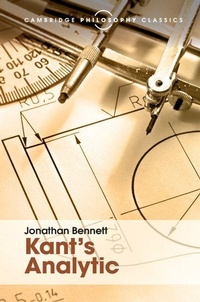
Kant's Analytic
Published on 26. August 2016
Book
Hardback
264 pages
978-1-107-14054-7 (ISBN)
Description
This engaging and instructive analysis of the first half of Kant's Critique of Pure Reason continues to be valuable to both practiced Kant scholars and newcomers. Jonathan Bennett examines the arguments and themes of Kant's work in relation to those of the works of philosophers old and new, including Locke, Leibniz, Berkeley, Hume, Wittgenstein, Ryle, Ayler, Quine, Warnock, and others. Presented in a fresh twenty-first-century series livery, and including a specially commissioned preface written by James Van Cleve, illuminating its continuing importance and relevance to philosophical enquiry, this influential work is available for a new generation of readers.
More details
Series
Language
English
Place of publication
Cambridge
United Kingdom
Target group
College/higher education
Illustrations
2 Tables, black and white; 2 Line drawings, unspecified
Dimensions
Height: 235 mm
Width: 157 mm
Thickness: 19 mm
Weight
543 gr
ISBN-13
978-1-107-14054-7 (9781107140547)
Copyright in bibliographic data and cover images is held by Nielsen Book Services Limited or by the publishers or by their respective licensors: all rights reserved.
Schweitzer Classification
Other editions
Additional editions
Jonathan Bennett
Kant's Analytic
E-Book
08/2016
Cambridge University Press
€15.99
Available for download
Jonathan Bennett
Kant's Analytic
Book
08/2016
Cambridge University Press
€32.90
Shipment within 15-20 days
Jonathan Bennett
Kant's Analytic
E-Book
07/2016
Cambridge University Press
€17.49
Available for download
Person
Jonathan Bennett is Emeritus Professor of Philosophy at Syracuse University. He has published extensively on early modern philosophy, ethics, metaphysics and the philosophy of language.
Content
Frontispiece Saul Steinberg; Preface to this edition James Van Cleve; Analytical table of contents; Part I. Aesthetic: 1. Synthetic a priori judgements; 2. The outer-sense theory; 3. Space and objects; 4. The inner-sense theory; 5. Intuitions of space and time; Part II. Analytic of Concepts: 6. The metaphysical deduction; 7. The categories considered; 8. Transcendental deduction: the main thread; 9. Transcendental deduction: further aspects; Part III. Analytic of Principles: 10. Schematism; 11. Causal necessity; 12. The axioms, anticipations, and postulates; 13. The first analogy; 14. The refutation of idealism; 15. The second analogy; Notes; Index.