

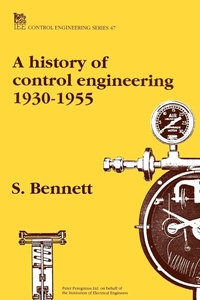
A History of Control Engineering 1930-1955
Published on 10. December 1993
Book
Paperback/Softback
262 pages
978-0-86341-299-8 (ISBN)
Description
In the twenty-five years between 1930 and 1955 crucial changes in our understanding of feedback control systems occurred. The history of these developments is traced in this book.
Feedback control devices were used for general industrial control, in process control, in aircraft and ships, in the telephone system and in analogue computing systems. The significant developments that occurred during the 1930s in several of these areas are analysed in detail.
During the Second World War the ideas and techniques that had been developed in disparate areas were brought together to form what we now know as the classical frequency response methods of analysis and design. Work on methods for dealing with non-linear systems, sampled-data systems and stochastic systems began. The immediate post-war years saw the consolidation and dissemination of the classical methods and the addition of the root locus method for analysis and design. The final chapters cover the beginnings of so-called modern control with the introduction of state-space methods of analysis and design.
As well as being of interest to engineers the book is also relevant to historians concerned with social, economic and labour history.
Feedback control devices were used for general industrial control, in process control, in aircraft and ships, in the telephone system and in analogue computing systems. The significant developments that occurred during the 1930s in several of these areas are analysed in detail.
During the Second World War the ideas and techniques that had been developed in disparate areas were brought together to form what we now know as the classical frequency response methods of analysis and design. Work on methods for dealing with non-linear systems, sampled-data systems and stochastic systems began. The immediate post-war years saw the consolidation and dissemination of the classical methods and the addition of the root locus method for analysis and design. The final chapters cover the beginnings of so-called modern control with the introduction of state-space methods of analysis and design.
As well as being of interest to engineers the book is also relevant to historians concerned with social, economic and labour history.
More details
Series
Language
English
Place of publication
Stevenage
United Kingdom
Target group
College/higher education
Professional and scholarly
Dimensions
Height: 234 mm
Width: 156 mm
Thickness: 14 mm
Weight
406 gr
ISBN-13
978-0-86341-299-8 (9780863412998)
Copyright in bibliographic data and cover images is held by Nielsen Book Services Limited or by the publishers or by their respective licensors: all rights reserved.
Schweitzer Classification
Person
Stuart Bennett is a senior lecturer in the Department of Automatic Control and Systems Engineering at the University of Sheffield. He has written extensively about the history of control engineering and about the influence of technological developments on the process industries. His other interests include computer control, real-time system design methodologies and intelligent simulation systems.
Content
Chapter 1: Control technology in the 1930s
Chapter 2: Process control: technology and theory
Chapter 3: The electronic negative feedback amplifier
Chapter 4: Theory and design of servomechanisms
Chapter 5: Wartime: problems and organisations
Chapter 6: Development of design techniques for servomechanisms 1939-1945
Chapter 7: Smoothing and prediction: 1939-1945
Chapter 8: The classical years: 1945-1955
Chapter 2: Process control: technology and theory
Chapter 3: The electronic negative feedback amplifier
Chapter 4: Theory and design of servomechanisms
Chapter 5: Wartime: problems and organisations
Chapter 6: Development of design techniques for servomechanisms 1939-1945
Chapter 7: Smoothing and prediction: 1939-1945
Chapter 8: The classical years: 1945-1955