

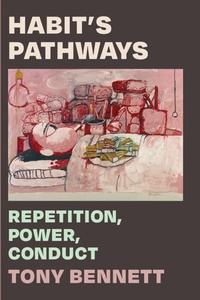
Habit's Pathways
Repetition, Power, Conduct
Published on 15. September 2023
Book
Paperback/Softback
272 pages
978-1-4780-2498-9 (ISBN)
Description
Habit has long preoccupied a wide range of theologians, philosophers, sociologists, psychologists, and neuroscientists. In Habit's Pathways Tony Bennett explores the political consequences of the varied ways in which habit's repetitions have been acted on to guide or direct conduct. Bennett considers habit's uses and effects across the monastic regimens of medieval Europe, in plantation slavery and the factory system, through colonial forms of rule, and within a range of medicalized pathologies. He brings these episodes in habit's political histories to bear on contemporary debates ranging from its role in relation to the politics of white supremacy to the digital harvesting of habits in practices of algorithmic governance. Throughout, Bennett tracks how habit's repetitions have been articulated differently across divisions of class, race, and gender, demonstrating that although habit serves as an apparatus for achieving success, self-fulfillment, and freedom for the powerful, it has simultaneously served as a means of control over women, racialized peoples, and subordinate classes.
Reviews / Votes
"Habit's Pathways makes a valuable contribution to discussions and theories of habit in its assemblage and detailed analysis of all the important thinkers on the subject, from Augustine, Kant, and Dewey to Deleuze, Foucault, and Malabou, devising what surely must be the new standard account of habit in contemporary Western thought. A tremendous achievement." - Susan Zieger, author of (The Mediated Mind: Affect, Ephemera, and Consumerism in the Nineteenth Century) "Tony Bennett, one of our most important cultural critics, reckons with the many meanings of habit in an argument that is both wide-ranging and fine-grained. Delving into its intellectual and political histories, he delivers a trenchant and highly illuminating analysis of habit's relations to freedom and constraint." - Rita Felski, John Stewart Bryan Professor, University of VirginiaMore details
Language
English
Place of publication
North Carolina
United States
Target group
Professional and scholarly
Product notice
Paperback (trade)
Illustrations
5 illustrations
Dimensions
Height: 229 mm
Width: 152 mm
Thickness: 16 mm
Weight
440 gr
ISBN-13
978-1-4780-2498-9 (9781478024989)
Copyright in bibliographic data and cover images is held by Nielsen Book Services Limited or by the publishers or by their respective licensors: all rights reserved.
Schweitzer Classification
Other editions
Additional editions
E-Book
08/2023
1st Edition
De Gruyter
€36.99
Available for download
Person
Tony Bennett is Emeritus Professor at the Institute for Culture and Society at Western Sydney University and Honorary Professor in the Humanities Research Centre at the Australian National University. Among his many books are Making Culture, Changing Society and, as coauthor, Collecting, Ordering, Governing: Anthropology, Museums, and Liberal Government.
Content
Note on the Text vii
Acknowledgments ix
Introduction. Habit-Then and Now 1
1. Powering Habit 19
2. Dead Ends and Nonstarters: Habit, Discipline, Biopower, and the Circulation of Capital 46
3. Unwilled Habits: Descending Pathways 70
4. Pathways to Virtue 97
5. Unfolding Pathways: Habit, Freedom, Becoming 111
6. Exploded Pathways: Plasticity's Mentors 137
7. Progressive Pathways: The Dynamics of Modernity, Race, and the Unconscious 160
8. Contested Pathways: Habit and the Conduct of Conduct 184
Conclusion. The Arbitrariness of Habit 206
Notes 211
References 225
Index 243
Acknowledgments ix
Introduction. Habit-Then and Now 1
1. Powering Habit 19
2. Dead Ends and Nonstarters: Habit, Discipline, Biopower, and the Circulation of Capital 46
3. Unwilled Habits: Descending Pathways 70
4. Pathways to Virtue 97
5. Unfolding Pathways: Habit, Freedom, Becoming 111
6. Exploded Pathways: Plasticity's Mentors 137
7. Progressive Pathways: The Dynamics of Modernity, Race, and the Unconscious 160
8. Contested Pathways: Habit and the Conduct of Conduct 184
Conclusion. The Arbitrariness of Habit 206
Notes 211
References 225
Index 243