

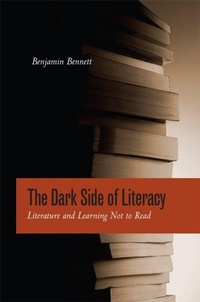
The Dark Side of Literacy
Literature and Learning not to Read
Published on 14. November 2008
Book
Hardback
300 pages
978-0-8232-2916-1 (ISBN)
Description
Reading is good for us. The reading of literature, we are told, enlarges our horizons, extends our experience beyond our own lives. But the moral and political dangers that attend the association of reading with experience have long been understood. And is that association even valid? What if precisely our most important literary texts are constructed so as to challenge or disrupt it?
This book is a radical criticism of the concept of "reading," especially of the concept of "the" reader, as commonly used in literary criticism. Bennett starts with the point that "reading" does not name a single, identifiable type of experience or class of experiences. Her then sketches in broad terms the historical provenance of "the" reader, in an argument that includes discussions of Dante, Boccaccio, Cervantes, Marlowe, and German idealist philosophy.
In two concluding chapters on modern German novellas, he suggests that most major European literary works since the eighteenth century are written in direct opposition to the central concepts by which criticism has sought to lay hold of them.
This book is a radical criticism of the concept of "reading," especially of the concept of "the" reader, as commonly used in literary criticism. Bennett starts with the point that "reading" does not name a single, identifiable type of experience or class of experiences. Her then sketches in broad terms the historical provenance of "the" reader, in an argument that includes discussions of Dante, Boccaccio, Cervantes, Marlowe, and German idealist philosophy.
In two concluding chapters on modern German novellas, he suggests that most major European literary works since the eighteenth century are written in direct opposition to the central concepts by which criticism has sought to lay hold of them.
Reviews / Votes
A seamless narrative, in which theory, intellectual history, and explication de texte join hands to advance a relentless flow of thought.----Stanley Corngold, Princeton University Literary theory has contributed many well-informed readings to literature. The theorist-readers themselves have also been brilliant. But herein lies the rub for Bennett (German, Univ. of Virginia). Their examples do not necessarily mean that others will be either as well informed or as brilliant. Engaging such theorists as Stanley Fish, Georges Poulet, and Wolfgang Iser, et al., the author contests their rigorous models as incompatible with how all readers of literature actually read. Bennett's own readings of the modern novel are well integrated into his questioning of "whether there really is such a thing as 'general literary competence' or a right way to read." He identifies the beginning of modern reading in Dante's Commedia, as explained by Susan Noakes (Timely Reading, CH, Mar'89, 26- 3713). Bennett goes further by identifying Dante's models for "the reader for thrills" and "the reader for art," a duality Bennett invented and traces historically. Bennett admirably exemplifies this duality through his readings of Thomas Mann's Dr. Faustus and Death in Venice. Despite his insistence on less-demanding models, Bennett's own readings are rigorous, but his elaboration of "the reader" is too abstract and cloying. The lack of a bibliography and the imprecise editing are noteworthy. Summing Up: Recommended. With reservations. Graduate students through faculty. (-Choice) A study of how literary authors have challenged notions of reading as an extension of experience. (-The Chronicle of Higher Education) Smart, insightful, and distinctive in range, theme, and approach.----Marshall Brown, University of WashingtonMore details
Language
English
Place of publication
New York
United States
Target group
College/higher education
Product notice
Cloth
Dimensions
Height: 235 mm
Width: 157 mm
Thickness: 26 mm
Weight
746 gr
ISBN-13
978-0-8232-2916-1 (9780823229161)
Copyright in bibliographic data and cover images is held by Nielsen Book Services Limited or by the publishers or by their respective licensors: all rights reserved.
Schweitzer Classification
Person
Benjamin Bennett is Kenan Professor of German at the University of Virginia. His most recent books are Goethe as Woman: The Undoing of Literature and All Theater Is Revolutionary Theater.