

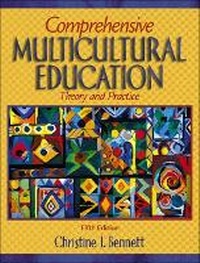
Comprehensive Multicultural Education
Theory and Practice
5th Edition
Published on 20. August 2002
Book
Paperback/Softback
434 pages
978-0-205-35838-0 (ISBN)
Description
This text provides preservice teachers the historical background, basic terminology, and social science concepts of multicultural education to assist them as they enter the field.
Comprehensive Multicultural Education provides a curriculum model with six goals and numerous lesson plans illustrating how each goal can be implemented in the classroom. The text includes conceptual frameworks from the social sciences and historical backgrounds. Both theory and practice in the text present interdisciplinary content through primary source material and vignettes of actual teachers and students, and encourage interactions between students' cultural and individual differences.
Bennett aims to foster the idea that understanding and valuing students' individual differences allows teachers to encourage each student to reach his or her fullest potential.
Comprehensive Multicultural Education provides a curriculum model with six goals and numerous lesson plans illustrating how each goal can be implemented in the classroom. The text includes conceptual frameworks from the social sciences and historical backgrounds. Both theory and practice in the text present interdisciplinary content through primary source material and vignettes of actual teachers and students, and encourage interactions between students' cultural and individual differences.
Bennett aims to foster the idea that understanding and valuing students' individual differences allows teachers to encourage each student to reach his or her fullest potential.
More details
Edition
5th edition
Language
English
Place of publication
United States
Publishing group
Pearson Education (US)
Target group
Professional and scholarly
Weight
640 gr
ISBN-13
978-0-205-35838-0 (9780205358380)
Copyright in bibliographic data and cover images is held by Nielsen Book Services Limited or by the publishers or by their respective licensors: all rights reserved.
Schweitzer Classification
Other editions
New editions
Book
05/2006
6th Edition
Pearson
€90.55
Article exhausted; check for reprint
Previous edition
Book
09/1998
4th Edition
Pearson
€59.60
Article exhausted; check for reprint
Content
Every chapter concludes with "Notes." Most chapters conclude with "Conclusions," Compare and Contrast," "Activities and Questions," and "Selected Sources for Further Study."
Preface.
I. The Case for Multicultural Education A Conceptual Framework for Multicultural Education.
The Case of Fred Young.
The Case of Sarah Stein.
The Case of Jimmy Miller.
The Case of Isaac Washington.
The Case of Marcia Patton.
The Case of Jesus Martinez.
The Case of Sam Johnson.
Overview.
1. Multicultural Schools: What, Why, and How.
What Is Multicultural Education?
Core Values in Multicultural Education.
Why Is Multicultural Education Essential?
The Need for Academic Excellence and Equity.
The Existence of a Multiethnic Society.
The Existence of an Interconnected World.
Equity and Democratic Values.
Conditions for Multicultural Schools.
The Example of Effective School Desegregation in Urban Settings.
How the Host School Responds.
Multicultural School Conditions.
Positive Teacher Expectations.
A Learning Environment That Supports Positive Interracial Contact.
A Multicultural Curriculum.
2. The Nature of Culture and the Contexts for Multicultural Teaching.
What Is Culture?
The Importance of a World View.
High- and Low-Context Cultures.
Differences Between Culture and Race.
What Do We Mean by Ethnic Groups?
Diversity Within Ethnic Groups.
When Is an Ethnic Group a Minority Group?
Cultural Assimilation and Cultural Pluralism.
Guidelines for Understanding Cultural Differences in the Classroom: Aspects of Ethnicity.
Verbal Communication.
Nonverbal Communication.
Orientation Modes.
Social Values.
Intellectual Modes.
3. Race Relations and the Nature of Prejudice.
The Prevalence of Prejudice and Racism.
The Nature of Prejudice.
The Nature of Racism.
Distinguishing Individual, Institutional, and Cultural Racism.
Theories of Ethnic Identity.
"The Negro-to-Black Conversion Experience."
The Banks Typology of Ethnic Identity Development.
White Racial Identity Development.
The Nature of Stereotypes and Multicultural Teaching.
An Illustration of Racism and the Need for Curriculum Reform.
Africa: Common Misconceptions.
Some Effects of Misconceptions About Africa.
4. Conflicting Themes of Assimilation and Pluralism Among European Americans, Jewish, and African Americans.
Sources of Cultural Diversity in the United States: An Overview.
European Americans.
Origins: The Roots of Diversity and Community.
Assimilation in the Face of Prejudice and Discrimination.
Jewish Americans.
Origins: Roots of Diversity and Community.
Accommodation in the Face of Anti-Semitism.
African Americans.
Opposition and Liberation Amidst the Legacy of Slavery.
Who Has Assimilated?
5. Conflicting Themes of Assimilation and Pluralism Among American Indians, Latinos, Asians, Muslims, and Arabs in the United States.
American Indians.
Origins: Roots of Diversity Within the Native American Community.
Conflict, Accommodation, and the Legacy of Genocide.
Latinos.
Origins: Roots of Diversity and Community.
Accommodation and the Legacy of Colonialism.
Asian Americans.
Origins: Roots of Diversity and Community.
Accommodation in the Face of Prejudice and Discrimination.
Muslims in America and Arab Americans by Salman H. Al-Ani.
Muslims in the United States.
Community and Diversity: Immigrant and Indigenous Origins.
African American Muslims.
Muslim Concerns.
Arab Americans.
II. Individual Differences That Affect Teaching and Learning.
Warren Benson's Classroom.
The Case of Kevin Armstrong.
The Case of Rachael Jones.
The Case of Max Britten.
The Case of Maria Chacon.
6. Learning Styles: Interactions Between Culture and the Individual.
An Introduction to Learning Style.
What Is Learning Style?
Why Be Concerned About Learning Styles.
Four Strategies for Discovering Learning Styles.
Field Independence-Dependence.
Students' Need for Structure.
Perceptual Modalities.
Learning Style Inventory.
Relationships Between Culture and Learning Style.
Learning Styles and Teaching Styles.
Learning Styles and Effective Teaching.
7. Beyond Learning Style: An Overview of Other Key Individual Differences.
Learning Skills.
Levels of Achievement and Aptitudes.
Motivation.
Self-Concept.
Gender.
Special Interests.
Exceptionalities.
Physical Characteristics.
Peer Relations.
Family Conditions.
Beliefs, Attitudes, and Values.
Sense of Ethnic Identity.
Teacher Perceptions of Individual Differences Related to Ethnicity and Poverty.
Failure, the Deficit Argument.
Failure, the Difference Argument.
8. Teaching Concepts and Strategies: The Development of Positive Classroom Climates.
The Empowering Nature of Respect.
The Promise of Culturally Relevant Teaching.
Principles of Culturally Relevant Teaching.
Examples of Culturally Relevant Teaching.
Funds of Knowledge Research and Teaching.
Individualizing Instruction: A Response To Cultural and Individual Differences.
The Basics of Mastery Learning.
Experiential Learning.
Bilingual Education.
The Theory of Multiple Intelligences.
Cooperative Learning: Student Team Learning.
III. Strengthening Multicultural Perspectives in Curriculum and Instruction.
The Case of Lisa Stuart.
Sam Johnson's Classroom Revisited.
Integrating Global and Multicultural Perspectives.
9. Multicultural Curriculum Development: A Decision-Making Model and Lesson Plans.
Introductions: Getting Started.
Developing a Course Rationale.
Developing Plans for Instruction.
The Importance of Fair-Minded Critical Thinking.
The Curriculum Model: Goals, Assumptions, and Content.
Goal One: Understanding Multiple Historical Perspectives.
Lesson Plans That Develop Multiple Historical Perspectives.
LESSON 8.1: Three Views of History-David Page.
LESSON 8.2: Maps as a Metaphor: The Power of Perspectives.
LESSON 8.3: Introduction to the Blues-Allison Hoadley.
LESSON 8.4: Revisiting the Crusades-Ashley de Waal-Lucas.
Goal Two: Developing Cultural Consciousness.
Lesson Plans That Develop Cultural Consciousness.
LESSON 8.5: The Many Faces (and Shoes) of Cinderella-Patricia A. O'Connor.
LESSON 8.6: Five Great Values of the Lakota Sioux-Gayle Reiten.
LESSON 8.7: Modeling toward Understanding-Elizabeth Ellis.
LESSON 8.8: Scrapbook Americana-Cindy Ort.
Goal Three: Developing Intercultural Competence.
Lesson Plans That Develop Intercultural Competence.
LESSON 8.9: Faces, Families, and Friends.
LESSON 8.10: Nobody Speaks My Language-Pamela L. Tiedt and Iris M. Tiedt.
LESSON 8.11: Negro Spirituals for the School Choir-Arlessa Barnes.
LESSON 8.12: Misunderstandings in Cross-Cultural Interactions-Delora Medina and Hilda Vazquez.
LESSON 8.13: For the Good of the People-Susan Goodman.
Goal Four: Comating Racism, Sexism, Prejudice, and All Forms of Discrimination.
Lessons Plans That Combat Racism, Sexism, Prejudice, and Discrimination.
LESSON 8.14: Can You Recognize Racism?.
LESSON 8.15: Hidden Messages in Children's Literature.
LESSON 8.16: Reading, Constructing, and Interpreting Graphs-Jean Seger.
LESSON 8.17: Women in the World-Georgia Duncan-Ladd.
Goal Five: Raising Awareness of the State of the Planet and Global Dynamics.
Lesson Plans That Develop State of the Planet Awareness.
LESSON 8.18: Rethinking & Acting Peace.
LESSON 8.19: Poverty and World Resources-Susan Hersh and Bob Peterson.
LESSON 8.20: Acid Rain-Maureen Reynolds.
LESSON 8.21: Global Conflict and Consequences-Alta Bertrand.
Goal Six: Developing Social Action Skills.
Lesson Plans That Develop Social Action Skills.
LESSON 8.22: The Cycle of Personal Alienation.
LESSON 8.23: To Take a Stand or to Not Take a Stand.
LESSON 8.24: No Man Is an Island: The Importance of Perspective in Decision Making-Karen Kulp.
LESSON 8.25: Global Economics and the U.S. Consumer: Nike Goes Global-Kathy Ellis.
Implementing the Model through an Interdisciplinary Unit.
Historical Fiction and Multicultural Education in a World War II Unit-John Kornfeld.
Index.
Appendix.
Sample Multicultural Teaching Competencies/Standards.
Multicultural Self-Report Inventory.
Kofi Annan's Astonishing Facts!
Sample Job Interview.
Preface.
I. The Case for Multicultural Education A Conceptual Framework for Multicultural Education.
The Case of Fred Young.
The Case of Sarah Stein.
The Case of Jimmy Miller.
The Case of Isaac Washington.
The Case of Marcia Patton.
The Case of Jesus Martinez.
The Case of Sam Johnson.
Overview.
1. Multicultural Schools: What, Why, and How.
What Is Multicultural Education?
Core Values in Multicultural Education.
Why Is Multicultural Education Essential?
The Need for Academic Excellence and Equity.
The Existence of a Multiethnic Society.
The Existence of an Interconnected World.
Equity and Democratic Values.
Conditions for Multicultural Schools.
The Example of Effective School Desegregation in Urban Settings.
How the Host School Responds.
Multicultural School Conditions.
Positive Teacher Expectations.
A Learning Environment That Supports Positive Interracial Contact.
A Multicultural Curriculum.
2. The Nature of Culture and the Contexts for Multicultural Teaching.
What Is Culture?
The Importance of a World View.
High- and Low-Context Cultures.
Differences Between Culture and Race.
What Do We Mean by Ethnic Groups?
Diversity Within Ethnic Groups.
When Is an Ethnic Group a Minority Group?
Cultural Assimilation and Cultural Pluralism.
Guidelines for Understanding Cultural Differences in the Classroom: Aspects of Ethnicity.
Verbal Communication.
Nonverbal Communication.
Orientation Modes.
Social Values.
Intellectual Modes.
3. Race Relations and the Nature of Prejudice.
The Prevalence of Prejudice and Racism.
The Nature of Prejudice.
The Nature of Racism.
Distinguishing Individual, Institutional, and Cultural Racism.
Theories of Ethnic Identity.
"The Negro-to-Black Conversion Experience."
The Banks Typology of Ethnic Identity Development.
White Racial Identity Development.
The Nature of Stereotypes and Multicultural Teaching.
An Illustration of Racism and the Need for Curriculum Reform.
Africa: Common Misconceptions.
Some Effects of Misconceptions About Africa.
4. Conflicting Themes of Assimilation and Pluralism Among European Americans, Jewish, and African Americans.
Sources of Cultural Diversity in the United States: An Overview.
European Americans.
Origins: The Roots of Diversity and Community.
Assimilation in the Face of Prejudice and Discrimination.
Jewish Americans.
Origins: Roots of Diversity and Community.
Accommodation in the Face of Anti-Semitism.
African Americans.
Opposition and Liberation Amidst the Legacy of Slavery.
Who Has Assimilated?
5. Conflicting Themes of Assimilation and Pluralism Among American Indians, Latinos, Asians, Muslims, and Arabs in the United States.
American Indians.
Origins: Roots of Diversity Within the Native American Community.
Conflict, Accommodation, and the Legacy of Genocide.
Latinos.
Origins: Roots of Diversity and Community.
Accommodation and the Legacy of Colonialism.
Asian Americans.
Origins: Roots of Diversity and Community.
Accommodation in the Face of Prejudice and Discrimination.
Muslims in America and Arab Americans by Salman H. Al-Ani.
Muslims in the United States.
Community and Diversity: Immigrant and Indigenous Origins.
African American Muslims.
Muslim Concerns.
Arab Americans.
II. Individual Differences That Affect Teaching and Learning.
Warren Benson's Classroom.
The Case of Kevin Armstrong.
The Case of Rachael Jones.
The Case of Max Britten.
The Case of Maria Chacon.
6. Learning Styles: Interactions Between Culture and the Individual.
An Introduction to Learning Style.
What Is Learning Style?
Why Be Concerned About Learning Styles.
Four Strategies for Discovering Learning Styles.
Field Independence-Dependence.
Students' Need for Structure.
Perceptual Modalities.
Learning Style Inventory.
Relationships Between Culture and Learning Style.
Learning Styles and Teaching Styles.
Learning Styles and Effective Teaching.
7. Beyond Learning Style: An Overview of Other Key Individual Differences.
Learning Skills.
Levels of Achievement and Aptitudes.
Motivation.
Self-Concept.
Gender.
Special Interests.
Exceptionalities.
Physical Characteristics.
Peer Relations.
Family Conditions.
Beliefs, Attitudes, and Values.
Sense of Ethnic Identity.
Teacher Perceptions of Individual Differences Related to Ethnicity and Poverty.
Failure, the Deficit Argument.
Failure, the Difference Argument.
8. Teaching Concepts and Strategies: The Development of Positive Classroom Climates.
The Empowering Nature of Respect.
The Promise of Culturally Relevant Teaching.
Principles of Culturally Relevant Teaching.
Examples of Culturally Relevant Teaching.
Funds of Knowledge Research and Teaching.
Individualizing Instruction: A Response To Cultural and Individual Differences.
The Basics of Mastery Learning.
Experiential Learning.
Bilingual Education.
The Theory of Multiple Intelligences.
Cooperative Learning: Student Team Learning.
III. Strengthening Multicultural Perspectives in Curriculum and Instruction.
The Case of Lisa Stuart.
Sam Johnson's Classroom Revisited.
Integrating Global and Multicultural Perspectives.
9. Multicultural Curriculum Development: A Decision-Making Model and Lesson Plans.
Introductions: Getting Started.
Developing a Course Rationale.
Developing Plans for Instruction.
The Importance of Fair-Minded Critical Thinking.
The Curriculum Model: Goals, Assumptions, and Content.
Goal One: Understanding Multiple Historical Perspectives.
Lesson Plans That Develop Multiple Historical Perspectives.
LESSON 8.1: Three Views of History-David Page.
LESSON 8.2: Maps as a Metaphor: The Power of Perspectives.
LESSON 8.3: Introduction to the Blues-Allison Hoadley.
LESSON 8.4: Revisiting the Crusades-Ashley de Waal-Lucas.
Goal Two: Developing Cultural Consciousness.
Lesson Plans That Develop Cultural Consciousness.
LESSON 8.5: The Many Faces (and Shoes) of Cinderella-Patricia A. O'Connor.
LESSON 8.6: Five Great Values of the Lakota Sioux-Gayle Reiten.
LESSON 8.7: Modeling toward Understanding-Elizabeth Ellis.
LESSON 8.8: Scrapbook Americana-Cindy Ort.
Goal Three: Developing Intercultural Competence.
Lesson Plans That Develop Intercultural Competence.
LESSON 8.9: Faces, Families, and Friends.
LESSON 8.10: Nobody Speaks My Language-Pamela L. Tiedt and Iris M. Tiedt.
LESSON 8.11: Negro Spirituals for the School Choir-Arlessa Barnes.
LESSON 8.12: Misunderstandings in Cross-Cultural Interactions-Delora Medina and Hilda Vazquez.
LESSON 8.13: For the Good of the People-Susan Goodman.
Goal Four: Comating Racism, Sexism, Prejudice, and All Forms of Discrimination.
Lessons Plans That Combat Racism, Sexism, Prejudice, and Discrimination.
LESSON 8.14: Can You Recognize Racism?.
LESSON 8.15: Hidden Messages in Children's Literature.
LESSON 8.16: Reading, Constructing, and Interpreting Graphs-Jean Seger.
LESSON 8.17: Women in the World-Georgia Duncan-Ladd.
Goal Five: Raising Awareness of the State of the Planet and Global Dynamics.
Lesson Plans That Develop State of the Planet Awareness.
LESSON 8.18: Rethinking & Acting Peace.
LESSON 8.19: Poverty and World Resources-Susan Hersh and Bob Peterson.
LESSON 8.20: Acid Rain-Maureen Reynolds.
LESSON 8.21: Global Conflict and Consequences-Alta Bertrand.
Goal Six: Developing Social Action Skills.
Lesson Plans That Develop Social Action Skills.
LESSON 8.22: The Cycle of Personal Alienation.
LESSON 8.23: To Take a Stand or to Not Take a Stand.
LESSON 8.24: No Man Is an Island: The Importance of Perspective in Decision Making-Karen Kulp.
LESSON 8.25: Global Economics and the U.S. Consumer: Nike Goes Global-Kathy Ellis.
Implementing the Model through an Interdisciplinary Unit.
Historical Fiction and Multicultural Education in a World War II Unit-John Kornfeld.
Index.
Appendix.
Sample Multicultural Teaching Competencies/Standards.
Multicultural Self-Report Inventory.
Kofi Annan's Astonishing Facts!
Sample Job Interview.