

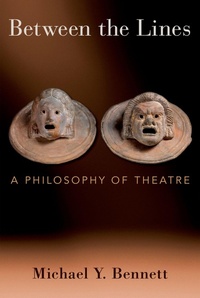
Between the Lines
A Philosophy of Theatre
Published on 29. August 2024
Book
Hardback
208 pages
978-0-19-769167-0 (ISBN)
Description
In Between the Lines: A Philosophy of Theatre, theatre theorist, Michael Y. Bennett offers a systematic account of theatre--thinking about theatre metaphysically, epistemologically, and ethically. To investigate theatre and its in-between spaces, Bennett introduces some basic ideas about coherence and correspondence and, much more prominently, conversations surrounding subsumption and distinctness in order to better describe theatre as a form of art. Instead of limiting the concept and use of subsumption to suggest that constituent parts are subsumed within a distinct whole, Bennett broadens the concept to claim that many of the properties of a theatrical character and/or a theatrical world are subsumed within the text.
Unlike some forms of literary fiction in which a narrator describes the properties of characters in general terms, theatre (particularly for the theatregoer) is largely devoid of distinct properties attributed to theatrical characters. Outside of the fact that theatrical characters speak and perform actions during the time of the play, there are little-to-no specified properties regarding theatrical characters and/or theatrical worlds. In thinking about the conceptual empty spaces of theatre, Bennett investigates three main topics: theatre as an art form, the properties of theatrical characters and theatrical worlds, and the difference between truth and truthfulness in the theatre.
Unlike some forms of literary fiction in which a narrator describes the properties of characters in general terms, theatre (particularly for the theatregoer) is largely devoid of distinct properties attributed to theatrical characters. Outside of the fact that theatrical characters speak and perform actions during the time of the play, there are little-to-no specified properties regarding theatrical characters and/or theatrical worlds. In thinking about the conceptual empty spaces of theatre, Bennett investigates three main topics: theatre as an art form, the properties of theatrical characters and theatrical worlds, and the difference between truth and truthfulness in the theatre.
Reviews / Votes
An astute and illuminating exploration of some highways and byways in the theory and philosophy of theatre, with the author teasing out, and helping to resolve, often intriguing complexities in such topics as representation, characters, spectators, performance, metaphor, truthfulness, curiosity, and empty spaces, relating to theatre. All in all, a valuable addition to the field. * Peter Lamarque, Author of The Philosophy of Literature, and Work and Object: Explorations in the Metaphysics of Art * Nearly every issue of philosophical aesthetics applies specifically to theater, combining as it does elements of literature, poetry, music, dance, architecture. Bennett's ambitious study addresses a hefty subset of these issues, but also explores, what he takes to be rather unique to theater, the space between text and performance, where much of the action and much of the fun happens. * Kendall L. Walton, Author of Mimesis as Make-Believe * Michael Y. Bennett's compelling book, Between the Lines: A Philosophy of Theatre, examines the relationship between theater's words, or dramatic dialogue, and the conceptual theatricality inhabited by actual performers with real bodies onstage... The book is a disquisition on the fundamental substance of theatrical reality and the audience's engagement with this reality... This complex, thought-provoking book will stimulate discussions among philosophers and theater practitioners. * David Krasner, Journal of Aesthetics and Art Criticism * It is unfortunate that in the world of philosophical aesthetics, theater is underexplored, and Between the Lines is a welcome addition to the field... Bennett has attempted to capture and describe the ephemeral nature of theater in performance, and this book offers an intriguing direction one might take in answering the fundamental philosophical questions about the practice. * Jeremy Killian, Eugene O'Neill Review *More details
Language
English
Place of publication
New York
United States
Target group
College/higher education
Product notice
sewn/stitched
Cloth over boards
Dimensions
Height: 217 mm
Width: 147 mm
Thickness: 20 mm
Weight
354 gr
ISBN-13
978-0-19-769167-0 (9780197691670)
Copyright in bibliographic data and cover images is held by Nielsen Book Services Limited or by the publishers or by their respective licensors: all rights reserved.
Schweitzer Classification
Other editions
Additional editions
E-Book
05/2024
OUP eBook
€64.99
Available for download
E-Book
05/2024
OUP eBook
€64.99
Available for download
Person
Michael Y. Bennett is an Associate Professor of English and Affiliated Faculty in Philosophy at the University of Wisconsin-Whitewater. In addition to being a past fellow at the Institute for Research in the Humanities at the University of Wisconsin-Madison, he is a Life Member of Clare Hall, University of Cambridge, where he was a Visiting Fellow. Known for his work on absurd drama and on the philosophy of theatre, he is the author or editor of fifteen books.
Content
- Acknowledgments
- Glossary of Terms and Concepts
- Introduction: The Conceptual Spaces of Theatre and Performance
- PART I: Pieces of Theatre: Defining Theatre and its Empty Spaces
- Chapter 1. Previous Conceptions of Theatre
- Chapter 2. The Nature of Theatre
- Chapter 3. The Nature of Viewing Theatre
- Chapter 4. The Nature of Theatre's Empty Spaces
- PART II: Spaces of Theatre: Offstage Characters, Imagined Objects, and Other Prickly Philosophical Problems
- Chapter 5. Distinctness in the Theatre: Theatrical Language and Events
- Chapter 6. Subsumption in the Theatre: The Question of Lady Bracknell's Nose and Offstage Characters
- Chapter 7. Truthfulness in the Theatre: Actors and Acting and Imagined Objects
- Conclusion: Teatri Topia for the Curious: Constants, Variables, and Theatre's Rules of Engagement
- Notes
- Bibliography
- Index