

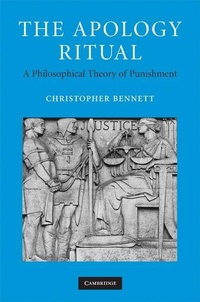
The Apology Ritual
A Philosophical Theory of Punishment
Published on 21. August 2008
Book
Hardback
222 pages
978-0-521-88072-5 (ISBN)
Description
Christopher Bennett presents a theory of punishment grounded in the practice of apology, and in particular in reactions such as feeling sorry and making amends. He argues that offenders have a 'right to be punished' - that it is part of taking an offender seriously as a member of a normatively demanding relationship (such as friendship or collegiality or citizenship) that she is subject to retributive attitudes when she violates the demands of that relationship. However, while he claims that punishment and the retributive attitudes are the necessary expression of moral condemnation, his account of these reactions has more in common with restorative justice than traditional retributivism. He argues that the most appropriate way to react to crime is to require the offender to make proportionate amends. His book is a rich and intriguing contribution to the debate over punishment and restorative justice.
More details
Language
English
Place of publication
Cambridge
United Kingdom
Target group
Professional and scholarly
College/higher education
Dimensions
Height: 235 mm
Width: 157 mm
Thickness: 18 mm
Weight
518 gr
ISBN-13
978-0-521-88072-5 (9780521880725)
Copyright in bibliographic data and cover images is held by Nielsen Book Services Limited or by the publishers or by their respective licensors: all rights reserved.
Schweitzer Classification
Other editions
Additional editions
E-Book
09/2008
1st Edition
Cambridge University Press
€27.99
Available for download
Person
Christopher Bennett is a Lecturer in the Department of Philosophy, University of Sheffield.
Content
Acknowledgements; Part I. Justifying Punishment: Introduction: a different perspective on criminal justice; 1. The problem of punishment and the restorative alternative; 2. Some retributivist themes; Part II. Responding to Wrongdoing: 3. Responsibility, reactive attitudes and the right to be punished; 4. Non-retributive dialogue; 5. The cycle of blame and apology; Part III. The Apology Ritual: 6. Restorative justice and state condemnation of crime; 7. Institutional blame and apology; 8. The apology ritual and its rivals; Bibliography; Index.