

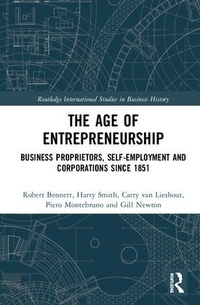
The Age of Entrepreneurship
Business Proprietors, Self-employment and Corporations Since 1851
1st Edition
Published on 17. July 2019
Book
Hardback
352 pages
978-1-138-06443-0 (ISBN)
Description
This landmark research volume provides the first detailed history of entrepreneurship in Britain from the nineteenth century to the present. Using a remarkable new database of more than nine million entrepreneurs, it gives new understanding to the development of Britain as the world's 'first industrial nation'.
Based on the first long-term whole-population analysis of British small business, it uses novel methods to identify from the 10-yearly population census the two to four million people per year who operated businesses in the period 1851-1911. Using big data analytics, it reveals how British businesses evolved over time, supplementing the census-derived data on individuals with other sources on companies and business histories. By comparing to modern data, it reveals how the late-Victorian period was a 'golden age' for smaller and medium-sized business, driven by family firms, the accelerating participation of women and the increasing use of incorporation as significant vehicles for development.
A unique resource and citation for future research on entrepreneurship, of crucial significance to economic development policies for small business around the world, and above all the key entry point for researchers to the database which is deposited at the UK Data Archive, this major publication will change our understanding of the scale and economic significance of small businesses in the nineteenth century.
Based on the first long-term whole-population analysis of British small business, it uses novel methods to identify from the 10-yearly population census the two to four million people per year who operated businesses in the period 1851-1911. Using big data analytics, it reveals how British businesses evolved over time, supplementing the census-derived data on individuals with other sources on companies and business histories. By comparing to modern data, it reveals how the late-Victorian period was a 'golden age' for smaller and medium-sized business, driven by family firms, the accelerating participation of women and the increasing use of incorporation as significant vehicles for development.
A unique resource and citation for future research on entrepreneurship, of crucial significance to economic development policies for small business around the world, and above all the key entry point for researchers to the database which is deposited at the UK Data Archive, this major publication will change our understanding of the scale and economic significance of small businesses in the nineteenth century.
More details
Series
Language
English
Place of publication
London
United Kingdom
Publishing group
Taylor & Francis Ltd
Target group
College/higher education
Illustrations
52 s/w Zeichnungen, 71 s/w Tabellen
71 Tables, black and white; 52 Line drawings, black and white
Dimensions
Height: 234 mm
Width: 156 mm
Weight
678 gr
ISBN-13
978-1-138-06443-0 (9781138064430)
Copyright in bibliographic data and cover images is held by Nielsen Book Services Limited or by the publishers or by their respective licensors: all rights reserved.
Schweitzer Classification
Other editions
Additional editions
Robert Bennett | Harry Smith | Carry van Lieshout
The Age of Entrepreneurship
Business Proprietors, Self-employment and Corporations Since 1851
Book
03/2021
1st Edition
Routledge
€69.20
Shipment within 15-20 days
Robert Bennett | Harry Smith | Carry van Lieshout
The Age of Entrepreneurship
Business Proprietors, Self-employment and Corporations Since 1851
E-Book
06/2019
1st Edition
Routledge
€61.99
Available for download
Robert Bennett | Harry Smith | Carry van Lieshout
The Age of Entrepreneurship
Business Proprietors, Self-employment and Corporations Since 1851
E-Book
06/2019
1st Edition
Routledge
€61.99
Available for download
Persons
Robert J. Bennett is Professor Emeritus and Research Director in Geography at the University of Cambridge, UK. His research covers SME policy, economic development and the history of entrepreneurship, chambers of commerce, and business associations. His recent publications include Entrepreneurship, Small Business and Public Policy (2014) and papers in multiple journals, including Business History.
Harry Smith is a Research Associate at the Cambridge Group for the History of Population and Social Structure, UK. He is a historian with interests in eighteenth- and nineteenth-century social and economic history, entrepreneurship and the history of class and towns (especially Birmingham). He has published articles in journals, including Business History and Midland History.
Carry van Lieshout is a Research Associate at the Cambridge Group for the History of Population and Social Structure, UK. She is a historical geographer with interests in gender, entrepreneurship and natural resources. She has published articles in various journals, including The London Journal and Geopolitics.
Piero Montebruno is a Research Associate at the Cambridge Group for the History of Population and Social Structure, UK. He holds a PhD in economic geography and is a trained medical doctor with interests in entrepreneurship, surrogacy, and slums, and heavy-tailed distributions. He has published articles in journals, including Business History.
Gill Newton is a Research Associate at the Cambridge Group for the History of Population and Social Structure, UK. She is a data scientist whose interests include large-scale datasets and demographic behaviour, mortality and the occupational structure of nineteenth-century Britain. She has published widely in population history and its methodologies.
Harry Smith is a Research Associate at the Cambridge Group for the History of Population and Social Structure, UK. He is a historian with interests in eighteenth- and nineteenth-century social and economic history, entrepreneurship and the history of class and towns (especially Birmingham). He has published articles in journals, including Business History and Midland History.
Carry van Lieshout is a Research Associate at the Cambridge Group for the History of Population and Social Structure, UK. She is a historical geographer with interests in gender, entrepreneurship and natural resources. She has published articles in various journals, including The London Journal and Geopolitics.
Piero Montebruno is a Research Associate at the Cambridge Group for the History of Population and Social Structure, UK. He holds a PhD in economic geography and is a trained medical doctor with interests in entrepreneurship, surrogacy, and slums, and heavy-tailed distributions. He has published articles in journals, including Business History.
Gill Newton is a Research Associate at the Cambridge Group for the History of Population and Social Structure, UK. She is a data scientist whose interests include large-scale datasets and demographic behaviour, mortality and the occupational structure of nineteenth-century Britain. She has published widely in population history and its methodologies.
Content
Part 1: New methods to interpret historical trends 1. Entrepreneurship over time 2. Entrepreneurship in theory and historical practice 3. New insights from historical big data Part 2: Overview of trends 4. Proprietor numbers, aggregate trends and sector change 5. Business size and organisation Part 3: Understanding entrepreneurship at the individual level 6. Explaining entrepreneurship: Correlates and decision choices 7. Demography, the household and entrepreneurship 8. Gender 9. The geography of entrepreneurship 10. Migration 11. Portfolio businesses 12. Conclusion: Re-positioning the entrepreneur in history and the present day