

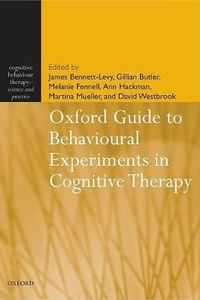
Oxford Guide to Behavioural Experiments in Cognitive Therapy
Published on 1. June 2004
Book
Hardback
482 pages
978-0-19-852915-6 (ISBN)
Description
Foreword; 1. Behavioural experiments: historical and conceptual underpinnings; 2. Devising effective behavioural experiments; 3. Panic disorder and agoraphobia; 4. Health anxiety; 5. Obsessive- compulsive disorder; 6. Generalised anxiety disorder; 7. Social anxiety; 8. Specific phobias; 9. Post Traumatic Stress Disorder; 10.
Reviews / Votes
This book offers an excellent practical guide in how to carry out effective behavioural experiments ... I am glad that I will have [it] on my bookshelf and I foresee using it with profit for the rest of my professional career. If you have only a limited budget for professional books, I would certainly recommend this one as a useful one to own. Clinical Psychology ... an enjoyable and stimulating read with lots of useful insights. The Psychologist This book is easy to read with clearly structured chapters set out in a consistent format that will appeal to new and experienced therapists alike, and will be invaluable in both the practice of CT and the delivery of training in it. BABCP MagazineMore details
Language
English
Place of publication
Oxford
United Kingdom
Target group
Professional and scholarly
Illustrations
numerous tables and line drawings
ISBN-13
978-0-19-852915-6 (9780198529156)
Copyright in bibliographic data and cover images is held by Nielsen Book Services Limited or by the publishers or by their respective licensors: all rights reserved.
Schweitzer Classification
Persons
Content
Foreword; 1. Behavioural experiments: historical and conceptual underpinnings; 2. Devising effective behavioural experiments; 3. Panic disorder and agoraphobia; 4. Health anxiety; 5. Obsessive-compulsive disorder; 6. Generalised anxiety disorder; 7. Social anxiety; 8. Specific phobias; 9. Post Traumatic Stress Disorder; 10. Depression; 11. Bipolar affective disorders; 12. Psychotic symptoms; 13. Eating disorders; 14. Insomnia; 15. Physical illness and disability; 16. Acquired brain injury; 17. Avoidance of affect; 18. Self-injurious behaviour; 19. Interpersonal difficulties; 20. Low self-esteem; 21. Behavioural experiments: at the crossroads