

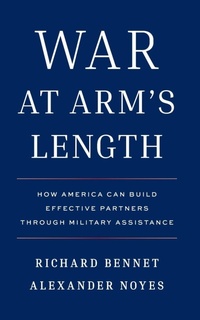
War at Arm's Length
How America Can Build Effective Partners Through Military Assistance
Will be published approx. on 26. May 2026
Book
Hardback
288 pages
978-0-300-27830-9 (ISBN)
Description
An in-depth examination of how the United States can build more effective partner militaries
Military assistance has a bad reputation. Large-scale attempts to build partner militaries in Afghanistan, Iraq, and Vietnam cost the United States billions of dollars and ended ignominiously, with the collapse of local forces as American troops withdrew. Arms transfers of sophisticated, American-made weapons often appear to do more harm than good. Yet military assistance and support-operating indirectly through partners-when done right, can deliver remarkable strategic results for the United States and its partners. How to work effectively with partner militaries is one of the most pressing national security challenges for the United States today.
Richard Bennet and Alexander Noyes offer a systematic look at military assistance in the twenty-first century, examining a frequently deployed but often misunderstood set of tools that allows the United States to leverage partner militaries to achieve national security objectives. Bennet and Noyes posit that two main factors-the degree of interest alignment on security issues and the level of institutional capacity of the receiving force-will be the most important variables in Washington's ability to build militarily effective partners.
Military assistance has a bad reputation. Large-scale attempts to build partner militaries in Afghanistan, Iraq, and Vietnam cost the United States billions of dollars and ended ignominiously, with the collapse of local forces as American troops withdrew. Arms transfers of sophisticated, American-made weapons often appear to do more harm than good. Yet military assistance and support-operating indirectly through partners-when done right, can deliver remarkable strategic results for the United States and its partners. How to work effectively with partner militaries is one of the most pressing national security challenges for the United States today.
Richard Bennet and Alexander Noyes offer a systematic look at military assistance in the twenty-first century, examining a frequently deployed but often misunderstood set of tools that allows the United States to leverage partner militaries to achieve national security objectives. Bennet and Noyes posit that two main factors-the degree of interest alignment on security issues and the level of institutional capacity of the receiving force-will be the most important variables in Washington's ability to build militarily effective partners.
Reviews / Votes
"A must-read. All serious defense officials should be armed with this useful playbook."-Mara Karlin, former U.S. Assistant Secretary of Defense for Strategy, Plans, and Capabilities"It is great to read political science books that choose an important topic, create a logical and parsimonious theory to try to understand it, and use interesting cases with real, rich history to test the hypothesis. That is what Bennet and Noyes have achieved in this compelling book."-Michael O'Hanlon, author of To Dare Mighty Things: U.S. Defense Strategy Since the Revolution
"Bennet and Noyes offer vital insights into how to fix one of the most important but underperforming tools in the national security toolbox, and they do it in an immensely readable manner. This should be essential reading for every policymaker involved in military assistance."-Thomas W. Ross, Jr., former Deputy Assistant Secretary of Defense, Security Cooperation
More details
Language
English
Place of publication
United States
Target group
Professional and scholarly
Product notice
Cloth over boards
Illustrations
5 b-w illus.
Dimensions
Height: 235 mm
Width: 156 mm
ISBN-13
978-0-300-27830-9 (9780300278309)
Copyright in bibliographic data and cover images is held by Nielsen Book Services Limited or by the publishers or by their respective licensors: all rights reserved.
Schweitzer Classification
Persons
Richard Bennet is a senior research associate at the Center for International and Security Studies at Maryland (CISSM) in the University of Maryland's School of Public Policy. Alexander Noyes is a fellow at the Brookings Institution.