

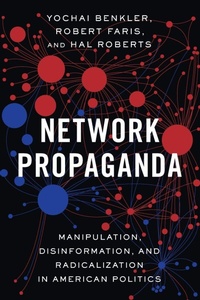
Network Propaganda
Manipulation, Disinformation, and Radicalization in American Politics
Published on 22. November 2018
Book
Paperback/Softback
472 pages
978-0-19-092363-1 (ISBN)
Description
This is an open access title available under the terms of a CC BY-NC-ND 4.0 International licence. It is free to read at Oxford Scholarship Online and offered as a free PDF download from OUP and selected open access locations.
Is social media destroying democracy? Are Russian propaganda or "Fake news" entrepreneurs on Facebook undermining our sense of a shared reality? A conventional wisdom has emerged since the election of Donald Trump in 2016 that new technologies and their manipulation by foreign actors played a decisive role in his victory and are responsible for the sense of a "post-truth" moment in which disinformation and propaganda thrives.
Network Propaganda challenges that received wisdom through the most comprehensive study yet published on media coverage of American presidential politics from the start of the election cycle in April 2015 to the one year anniversary of the Trump presidency. Analysing millions of news stories together with Twitter and Facebook shares, broadcast television and YouTube, the book provides a comprehensive overview of the architecture of contemporary American political communications. Through data analysis and detailed qualitative case studies of coverage of immigration, Clinton scandals, and the Trump Russia investigation, the book finds that the right-wing media ecosystem operates fundamentally differently than the rest of the media environment.
The authors argue that longstanding institutional, political, and cultural patterns in American politics interacted with technological change since the 1970s to create a propaganda feedback loop in American conservative media. This dynamic has marginalized centre-right media and politicians, radicalized the right wing ecosystem, and rendered it susceptible to propaganda efforts, foreign and domestic. For readers outside the United States, the book offers a new perspective and methods for diagnosing the sources of, and potential solutions for, the perceived global crisis of democratic politics.
Is social media destroying democracy? Are Russian propaganda or "Fake news" entrepreneurs on Facebook undermining our sense of a shared reality? A conventional wisdom has emerged since the election of Donald Trump in 2016 that new technologies and their manipulation by foreign actors played a decisive role in his victory and are responsible for the sense of a "post-truth" moment in which disinformation and propaganda thrives.
Network Propaganda challenges that received wisdom through the most comprehensive study yet published on media coverage of American presidential politics from the start of the election cycle in April 2015 to the one year anniversary of the Trump presidency. Analysing millions of news stories together with Twitter and Facebook shares, broadcast television and YouTube, the book provides a comprehensive overview of the architecture of contemporary American political communications. Through data analysis and detailed qualitative case studies of coverage of immigration, Clinton scandals, and the Trump Russia investigation, the book finds that the right-wing media ecosystem operates fundamentally differently than the rest of the media environment.
The authors argue that longstanding institutional, political, and cultural patterns in American politics interacted with technological change since the 1970s to create a propaganda feedback loop in American conservative media. This dynamic has marginalized centre-right media and politicians, radicalized the right wing ecosystem, and rendered it susceptible to propaganda efforts, foreign and domestic. For readers outside the United States, the book offers a new perspective and methods for diagnosing the sources of, and potential solutions for, the perceived global crisis of democratic politics.
Reviews / Votes
Overall, this book is a necessary inquiry into the state of propaganda and disinformation networks today. * Julia Rose DeCook, Convergence: The International Journal of Research into New Media Technologies * Network Propaganda presents a great comprehensive overview of the architecture of the U.S. media ecosystem, using various methods such as data analysis, case studies, and textual analysis. With ample data and insightful analysis, this book is an important guide to seek ways to make democracy survive the current epistemic crisis. * Yeahin (Jane) Pyo, University of Illinois at Urbana-Champaign, International Journal of Communication * [Network Propaganda] provides one of the most comprehensive studies of the US media ecosystem surrounding the 2016 election. * Felix Simon, journalist and researcher * [Network Propaganda is] instantly a necessary text for those of us who study media ecologies. * Mike Goodwin, Senior Fellow at R Street Institute * "There are a lot of books on networks, social media, propaganda, polarization and American politics. This is the best." - Cass Sunstein,Bloomberg, Best Books of 2018More details
Language
English
Place of publication
New York
United States
Target group
College/higher education
Dimensions
Height: 234 mm
Width: 156 mm
Thickness: 31 mm
Weight
1060 gr
ISBN-13
978-0-19-092363-1 (9780190923631)
Copyright in bibliographic data and cover images is held by Nielsen Book Services Limited or by the publishers or by their respective licensors: all rights reserved.
Schweitzer Classification
Other editions
Additional editions
Yochai Benkler | Robert Faris | Hal Roberts
Network Propaganda
Manipulation, Disinformation, and Radicalization in American Politics
Book
11/2018
Oxford University Press Inc
€200.90
Shipment within 15-20 days
Yochai Benkler | Robert Faris | Hal Roberts
Network Propaganda
Manipulation, Disinformation, and Radicalization in American Politics
E-Book
09/2018
1st Edition
OUP eBook
€24.99
Available for download
Persons
Yochai Benkler is the Berkman Professor of Entrepreneurial Legal Studies at Harvard Law School, and faculty co-director of the Berkman Klein Center for Internet and Society at Harvard University.
Robert Faris is the Research Director of the Berkman Klein Center for Internet and Society at Harvard University.
Hal Roberts is a Fellow at the Berkman Klein Center for Internet & Society at Harvard University.
Robert Faris is the Research Director of the Berkman Klein Center for Internet and Society at Harvard University.
Hal Roberts is a Fellow at the Berkman Klein Center for Internet & Society at Harvard University.
Author
Berkman Professor of Entrepreneurial Legal StudiesBerkman Professor of Entrepreneurial Legal Studies, Harvard Law School, and Co-Director, Berkman Klein Center for Internet and Society, Harvard University
Research Director of the Berkman Klein Center for Internet and SocietyResearch Director of the Berkman Klein Center for Internet and Society, Harvard University
Fellow at the Berkman Klein Center for Internet & SocietyFellow at the Berkman Klein Center for Internet & Society, Harvard University
Content
Part I Mapping Disorder
1. Epistemic Crisis
2. The Architecture of our Discontent
3. The Propaganda Feedback Loop
Part II Dynamics of Network Propaganda
4. Immigration and Islamophobia: Breitbart and the Trump Party
5. The Fox Diet
6. Mainstream Media Failure Modes and Self-Healing in a Propaganda-Rich Environment
Part III The Usual Suspects
7. The Propaganda Pipeline: Hacking the core from the periphery
8. Are the Russians Coming?
9. Mammon's Algorithm: Marketing, Manipulation, and Clickbait on Facebook
Part IV Can Democracy Survive the Internet?
10. Polarization in American Politics
11. The Origins of Asymmetry
12. Can the Internet Survive Democracy?
13. What can Men do against such Reckless Hate?
14. Conclusion
1. Epistemic Crisis
2. The Architecture of our Discontent
3. The Propaganda Feedback Loop
Part II Dynamics of Network Propaganda
4. Immigration and Islamophobia: Breitbart and the Trump Party
5. The Fox Diet
6. Mainstream Media Failure Modes and Self-Healing in a Propaganda-Rich Environment
Part III The Usual Suspects
7. The Propaganda Pipeline: Hacking the core from the periphery
8. Are the Russians Coming?
9. Mammon's Algorithm: Marketing, Manipulation, and Clickbait on Facebook
Part IV Can Democracy Survive the Internet?
10. Polarization in American Politics
11. The Origins of Asymmetry
12. Can the Internet Survive Democracy?
13. What can Men do against such Reckless Hate?
14. Conclusion