

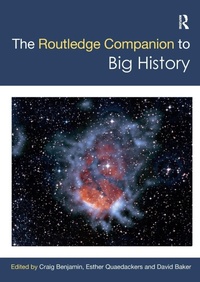
The Routledge Companion to Big History
1st Edition
Published on 30. June 2021
Book
Paperback/Softback
506 pages
978-1-032-09049-8 (ISBN)
Description
The Routledge Companion to Big History guides readers though the variety of themes and concepts that structure contemporary scholarship in the field of big history.
The volume is divided into five parts, each representing current and evolving areas of interest to the community, including big history's relationship to science, social science, the humanities, and the future, as well as teaching big history and 'little big histories'. Considering an ever-expanding range of theoretical, pedagogical and research topics, the book addresses such questions as what is the relationship between big history and scientific research, how are big historians working with philosophers and religious thinkers to help construct 'meaning', how are leading theoreticians making sense of big history and its relationship to other creation narratives and paradigms, what is 'little big history', and how does big history impact on thinking about the future? The book highlights the place of big history in historiographical traditions and the ways in which it can be used in education and public discourse across disciplines and at all levels.
A timely collection with contributions from leading proponents in the field, it is the ideal guide for those wanting to engage with the theories and concepts behind big history.
The volume is divided into five parts, each representing current and evolving areas of interest to the community, including big history's relationship to science, social science, the humanities, and the future, as well as teaching big history and 'little big histories'. Considering an ever-expanding range of theoretical, pedagogical and research topics, the book addresses such questions as what is the relationship between big history and scientific research, how are big historians working with philosophers and religious thinkers to help construct 'meaning', how are leading theoreticians making sense of big history and its relationship to other creation narratives and paradigms, what is 'little big history', and how does big history impact on thinking about the future? The book highlights the place of big history in historiographical traditions and the ways in which it can be used in education and public discourse across disciplines and at all levels.
A timely collection with contributions from leading proponents in the field, it is the ideal guide for those wanting to engage with the theories and concepts behind big history.
Reviews / Votes
Big history is the most innovative and intellectually daring kind of historical scholarship on offer. It is the historical genre that can be used to appraise the biggest challenges that we face as a species, such as our burgeoning numbers, our relationships with other species, and the way we have so far engaged with the natural environment. This volume showcases the remarkable potential of the field. It is especially useful because it brings together Big History's leading figures, as well as important fellow travellers in the social and natural sciences. And all of them bring to this volume their 'best game'.Nick Doumanis, University of New South Wales, Sydney, Australia
Big History is a rapidly evolving research and teaching field that seeks to unite natural and human history into a single compelling narrative. To capture the current state of this scholarship, the editors of The Routledge Companion to Big History have assembled and thematically organized twenty-one chapters, each authored by a leading proponent. For the reader interested in, or simply curious about, big history, this volume is the perfect entree.
Kevin Jon Fernlund, University of Missouri - St. Louis, USA
More details
Series
Language
English
Place of publication
London
United Kingdom
Publishing group
Taylor & Francis Ltd
Target group
College/higher education
Postgraduate and Undergraduate
Dimensions
Height: 246 mm
Width: 174 mm
Thickness: 27 mm
Weight
892 gr
ISBN-13
978-1-032-09049-8 (9781032090498)
Copyright in bibliographic data and cover images is held by Nielsen Book Services Limited or by the publishers or by their respective licensors: all rights reserved.
Schweitzer Classification
Other editions
Additional editions
Craig Benjamin | Esther Quaedackers | David Baker
The Routledge Companion to Big History
Book
08/2019
1st Edition
Routledge
€334.80
Shipment within 10-20 days
Craig Benjamin | Esther Quaedackers | David Baker
The Routledge Companion to Big History
E-Book
08/2019
1st Edition
Routledge
€65.99
Available for download
Craig Benjamin | Esther Quaedackers | David Baker
The Routledge Companion to Big History
E-Book
08/2019
1st Edition
Routledge
€65.99
Available for download
Persons
Craig Benjamin is a Professor of History at Grand Valley State University in Michigan, USA, where he researches and teaches big history and ancient Eurasian history. Recent books include Big History: Between Nothing and Everything (co-authored with David Christian and Cynthia Stokes Brown, 2014); and Empires of Ancient Eurasia. The First Silk Roads Era 100 BCE - 250 CE (2018).
Esther Quaedackers is a Lecturer in Big History at the University of Amsterdam, the Netherlands, where she has been developing, coordinating, and teaching big history courses for over a decade. She is the inventor of the 'little big history' approach, which is a research and teaching method in which small subjects are connected to aspects of big history in order to generate creative new ideas about how these subjects came to be the way they are.
David Baker is Lecturer of Big History at Macquarie University, Australia, and is the first scholar worldwide to achieve a PhD in that field. He is co-designer of Big History School (three K-12 curricula), Big History: Connecting Knowledge on Coursera, and contributor to the Big History Project. He was scriptwriter for two seasons of Crash Course: Big History with over 12 million views on Youtube. He has produced numerous research articles, chapters, and edited volumes, including works in the Journal of World History and Proceedings of the National Academy of Sciences.
Esther Quaedackers is a Lecturer in Big History at the University of Amsterdam, the Netherlands, where she has been developing, coordinating, and teaching big history courses for over a decade. She is the inventor of the 'little big history' approach, which is a research and teaching method in which small subjects are connected to aspects of big history in order to generate creative new ideas about how these subjects came to be the way they are.
David Baker is Lecturer of Big History at Macquarie University, Australia, and is the first scholar worldwide to achieve a PhD in that field. He is co-designer of Big History School (three K-12 curricula), Big History: Connecting Knowledge on Coursera, and contributor to the Big History Project. He was scriptwriter for two seasons of Crash Course: Big History with over 12 million views on Youtube. He has produced numerous research articles, chapters, and edited volumes, including works in the Journal of World History and Proceedings of the National Academy of Sciences.
Content
Introductory chapters
Introduction to The Routledge Companion to Big History
Craig Benjamin, Esther Quaedackers and David Baker
1 What is big history?
David Christian
PART I
Big history and science
2 Big history and the study of time: the underlying
temporalities of big history
Barry Wood
3 Big history and astronomy - space is big: the Fermi
paradox: its relevance to big history and the human race
Jonathan Markley
4 Big history and macro-evolution: evolutionary principles
and mechanisms at biological and social phases of the
big history
Leonid E. Grinin, Andrey Korotayev and Alexander Markov
PART II
Big history, social science and the humanities
5 Big history and anthropology: our place in the
multiverse: anthropology, civilization and big history
Barry H. Rodrigue
6 Big history and archaeology: archaeology is big history
Brian Fagan
7 Big history and philosophy: philosophical foundations
of big history: why big history makes sense
Armando Menendez Viso
8 Big history and political science: science, the deep past,
and the political
Lowell Gustafson
9 Big history and historiography: deep tides and swirling
foam: the influence of macro-historical trends on micro-historical
events
David Baker
10 Big history and critical theory: science, history and why
theory matters
David Blanks
11 Big history, morality and religion
Cynthia Stokes Brown
PART III
Little big histories
12 A case for little big histories
Esther Quaedackers
13 The little big history of the Nalon River, Asturias, Spain
Olga Garcia-Moreno, Diego Alvarez-Lao, Miguel Arbizu,
Eduardo Dopico, Eva Garcia-Vazquez, Joaquin Garcia Sansegundo,
Montserrat Jimenez-Sanchez, Laura Miralles, Icaro Obeso,
Angel Rodriguez-Rey, Marco de la Rasilla Vives,
Luis Vicente Sanchez Fernandez, Luis Rodriguez Terente,
Luigi Toffolatti and Pablo Turrero
14 Sketch of a little big history of Private E.E. Benjamin
and the Great War
Craig Benjamin
PART IV
Teaching big history
15 The Big History Project in Australia
Tracy Sullivan
16 Big history teaching in Korea
Seohyung Kim
17 Crossing thresholds: using big history to meet challenges
in teaching and learning in the United States
Robert B. Bain
PART V
Big history and the future
18 Big history and the future of technology
Leonid E. Grinin and Anton L. Grinin
19 Big history and the Singularity
Akop P. Nazaretyan
20 Underground metro systems: a durable geological proxy
of rapid urban population growth and energy consumption
during the Anthropocene
Mark Williams, Matt Edgeworth, Jan Zalasiewicz,
Colin N. Waters, Will Steffen, Alexander P. Wolfe,
Introduction to The Routledge Companion to Big History
Craig Benjamin, Esther Quaedackers and David Baker
1 What is big history?
David Christian
PART I
Big history and science
2 Big history and the study of time: the underlying
temporalities of big history
Barry Wood
3 Big history and astronomy - space is big: the Fermi
paradox: its relevance to big history and the human race
Jonathan Markley
4 Big history and macro-evolution: evolutionary principles
and mechanisms at biological and social phases of the
big history
Leonid E. Grinin, Andrey Korotayev and Alexander Markov
PART II
Big history, social science and the humanities
5 Big history and anthropology: our place in the
multiverse: anthropology, civilization and big history
Barry H. Rodrigue
6 Big history and archaeology: archaeology is big history
Brian Fagan
7 Big history and philosophy: philosophical foundations
of big history: why big history makes sense
Armando Menendez Viso
8 Big history and political science: science, the deep past,
and the political
Lowell Gustafson
9 Big history and historiography: deep tides and swirling
foam: the influence of macro-historical trends on micro-historical
events
David Baker
10 Big history and critical theory: science, history and why
theory matters
David Blanks
11 Big history, morality and religion
Cynthia Stokes Brown
PART III
Little big histories
12 A case for little big histories
Esther Quaedackers
13 The little big history of the Nalon River, Asturias, Spain
Olga Garcia-Moreno, Diego Alvarez-Lao, Miguel Arbizu,
Eduardo Dopico, Eva Garcia-Vazquez, Joaquin Garcia Sansegundo,
Montserrat Jimenez-Sanchez, Laura Miralles, Icaro Obeso,
Angel Rodriguez-Rey, Marco de la Rasilla Vives,
Luis Vicente Sanchez Fernandez, Luis Rodriguez Terente,
Luigi Toffolatti and Pablo Turrero
14 Sketch of a little big history of Private E.E. Benjamin
and the Great War
Craig Benjamin
PART IV
Teaching big history
15 The Big History Project in Australia
Tracy Sullivan
16 Big history teaching in Korea
Seohyung Kim
17 Crossing thresholds: using big history to meet challenges
in teaching and learning in the United States
Robert B. Bain
PART V
Big history and the future
18 Big history and the future of technology
Leonid E. Grinin and Anton L. Grinin
19 Big history and the Singularity
Akop P. Nazaretyan
20 Underground metro systems: a durable geological proxy
of rapid urban population growth and energy consumption
during the Anthropocene
Mark Williams, Matt Edgeworth, Jan Zalasiewicz,
Colin N. Waters, Will Steffen, Alexander P. Wolfe,