

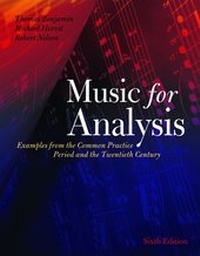
Music for Analysis
6th Edition
Published on 28. September 2006
Book
Mixed media product
544 pages
978-0-19-518815-8 (ISBN)
Description
This superbly varied collection offers more than 400 pieces of music from the Baroque period to the present. Selected by Thomas Benjamin, Michael Horvit, and Robert Nelson--three nationally respected composers and music theory teachers--the selections enable students to analyze a wide variety of genres, styles, textures, and composers that illustrate standard usage and idiomatic procedures. Featuring both excerpts and many complete pieces, Music for Analysis, Sixth Edition, is the perfect vehicle for analysis of style, musical idiom, small forms, tonal harmony, and contemporary techniques. "Questions for Analysis" in each unit provide pointed, perceptive guidance throughout the book. A detailed checklist and model analysis in Appendix A provide a useful summary for students who are learning to analyze music. Features of the Sixth Edition: * Includes a free audio CD of more than 140 examples from the text played on the piano, harpsichord, or organ by Dr.
Rosilee Walker Russell, Artist-in-Residence at the University of Arkansas - Fort Smith * In addition to the complete pieces included from the previous edition, the authors have added several new complete works, including "Gavea" by Darius Milhaud and a complete Mozart sonata * Integrates many new model analyses into the body of the text, helping students to achieve a comprehensive analysis of the music * Includes contrapuntal examples from composers other than Bach * Provides precise measure numbers for all excerpts from larger pieces * Adds an index of all complete pieces (supplementing the index of composers and making selections easier to find)
Rosilee Walker Russell, Artist-in-Residence at the University of Arkansas - Fort Smith * In addition to the complete pieces included from the previous edition, the authors have added several new complete works, including "Gavea" by Darius Milhaud and a complete Mozart sonata * Integrates many new model analyses into the body of the text, helping students to achieve a comprehensive analysis of the music * Includes contrapuntal examples from composers other than Bach * Provides precise measure numbers for all excerpts from larger pieces * Adds an index of all complete pieces (supplementing the index of composers and making selections easier to find)
More details
Edition
6th Revised edition
Language
English
Place of publication
New York
United States
Target group
College/higher education
Professional and scholarly
Edition type
Revised edition
Dimensions
Height: 278 mm
Width: 215 mm
Thickness: 20 mm
Weight
1121 gr
ISBN-13
978-0-19-518815-8 (9780195188158)
Copyright in bibliographic data and cover images is held by Nielsen Book Services Limited or by the publishers or by their respective licensors: all rights reserved.
Schweitzer Classification
Other editions
Previous edition

Thomas Benjamin | Michael E. Horvit | Robert Nelson
Music for Analysis
Examples from the Common Practice Period and the Twentieth Century
Book
09/2000
5th Edition
Wadsworth Publishing Company
€88.52
Article exhausted; check for reprint
Content
PART I: DIATONIC MATERIALS; 1. Tonic Triad; 2. Dominant Triad in Root Position; 3. Dominant Seventh and Ninth in Root Position; 4. Subdominant Triad in Root Position; 5. Cadential Tonic Six-Four Chord; 6. Tonic, Subdominant, and Dominant Triads in First Inversion; 7. Supertonic Triad; 8. Inversions of the Dominant Seventh Chord; 9. Linear (Embellishing) Six-Four Chords; 10. Submediant and Mediant Triads; 11. Leading Tone Triad; 12. Variant Qualities of Diatonic Triads; 13. Supertonic Seventh Chord; 14. Leading Tone Seventh Chord; 15. Other Diatonic Seventh Chords; 16. Complete Pieces for Analysis I; PART II: CHROMATIC MATERIALS; 17. Secondary (Applied, Borrowed) Dominants; 18. Modulation to Closely Related Keys; 19. Complete Pieces for Analysis II; 20. Linear (Embellishing) Diminished Seventh Chords; 21. Neapolitan Triad; 22. Augmented Sixth Chords, Submediant Degree as Lowest Note; 23. Augumented Sixth Chords, Other Scale Degrees as Lowest Note; 24. Augumented Sixth Chords, Other Uses; 25. Other Means of Modulation; 26. Ninth Chords; 27. Extended Linear Usages; 28. Complete Pieces for Analysis III; 29. Examples of Contrapuntal Forms; PART III: CONTEMPORARY MATERIALS; 30. Extended and Altered Tertian Harmony; 31. Diatonic (Church) Modes; 32. Pandiatonicism and Additive Harmony; 33. Exotic (Artificial, Synthetic) Scales; 34. Quartal and Secundal Harmony; 35. Polyharmony and Polytonality; 36. Free Atonality; 37. Twelve-Tone Serialism; 38. Music Since 1945; 39. Complete Pieces for Analysis IV; Appendix A: For Further Reference; Appendix B: Checklist for Analysis and Sample Analysis; Appendix C: Textbook Correlation Chart