

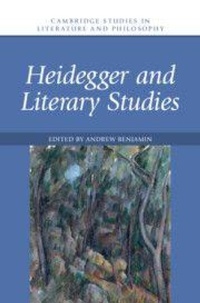
Heidegger and Literary Studies
Published on 23. November 2023
Book
Hardback
386 pages
978-1-316-51310-1 (ISBN)
Description
Martin Heidegger is one of the most influential philosophers of the 20th Century, and a key philosophical resource for literary critics. Not only has he written about poetry, generations of poets have engaged his writings. And yet, for Heidegger poetry and literature are separate. An essential part of the project of this book therefore is to show how both the distinction and connection between literature and poetry is staged within Heidegger's thought. It offers Heidegger's perspective on a range of key themes, topics, poets, and writers, including Poetry and Poetics, Ancient Greek theatre and tragedies and then specifically Friedrich Hoelderlin, Thomas Mann, Paul Celan, Euripides and Sophocles. As the Chapters comprising this book make clear, Heidegger's work remains indispensable for any serious engagement with either literature or poetry today.
Reviews / Votes
'... of great use for specialists working on bridging the fields of literary studies and Heideggerian philosophy. ... Highly recommended.' A. Jaeger, CHOICEMore details
Series
Language
English
Place of publication
Cambridge
United Kingdom
Product notice
sewn/stitched
Cloth over boards
Illustrations
Worked examples or Exercises
Dimensions
Height: 229 mm
Width: 152 mm
Thickness: 25 mm
Weight
735 gr
ISBN-13
978-1-316-51310-1 (9781316513101)
Copyright in bibliographic data and cover images is held by Nielsen Book Services Limited or by the publishers or by their respective licensors: all rights reserved.
Schweitzer Classification
Other editions
Additional editions
Andrew Benjamin
Heidegger and Literary Studies
E-Book
11/2023
Cambridge University Press
€105.99
Available for download
Andrew Benjamin
Heidegger and Literary Studies
E-Book
11/2023
Cambridge University Press
€105.99
Available for download
Person
Content
Introduction Andrew Benjamin; Part I. Literature and Poetry; 1. Heidegger's literary secret Joseph Cohen; 2. The event's foreign vernacular: Denken and Dichten in Heidegger Krzysztof Ziarek; 3. Shared habits: love, time and the magic mountain in 1925 Ben Morgan; 4. From tool to poem: the emergence of the antagonism between technics and poetry in Heidegger's work Justin Clemens; 5. Heidegger's use of poetry Christophe Fynsk; Part II. Heidegger and Greek Literature: 6. Heidegger and sophocles: Antigone's Ethos of intimating and waiting Sean Kirkland; 7. Playing with shadows in Heidegger's reading of Greek tragedy: encountering Oedipus, Antigone and (absent) Medea Silvia Benso; Part III. Heidegger and Literary Works: 8. Places of pain: Heidegger's reading of Trakl Claudia Baracchi; 9. The (Im)possibility of homecoming: Heidegger, Celan and the Aporia of language Charles Bambach; 10. Heidegger and Blanchot: 'Wherefore poets in time of distress?' (Hoelderlin, Rilke)' Leslie Hill; 11. Thomas Mann and Martin Heidegger: two distinct paths of the 'conservative revolution' in Germany Ingo Farin; 12. Travels in Greece: Heidegger and Henry Miller Andrew Mitchell; 13. Hoelderlin's Heidegger, Heidegger's Mourning David Ferris.