

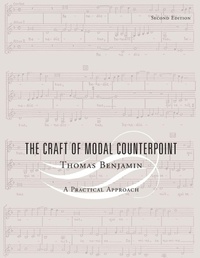
The Craft of Modal Counterpoint
A Practical Approach
2nd Edition
Published on 1. January 2005
Book
Paperback/Softback
202 pages
978-0-415-97172-0 (ISBN)
Description
"The Craft of Modal Counterpoint" is the companion book to Benjamin's "The Craft of Tonal Counterpoint," recently republished in a second edition by Routledge. Modal counterpoint is the style of composition that was employed until the "tonal" revolution pioneered by Bach; it is the basis for most Early Music.
Benjamin, a composer and pedagogue, offers a complete analysis of this important musical style. He begins by covering general aspects of the style, then covers in detail two, three, and four-part counterpoint. The Motet, an important form of vocal composition in this period, is studied separately. The book concludes with a brief anthology of key scores, 15 in all, for the student to study further. Also includes 132 musical examples.
Benjamin, a composer and pedagogue, offers a complete analysis of this important musical style. He begins by covering general aspects of the style, then covers in detail two, three, and four-part counterpoint. The Motet, an important form of vocal composition in this period, is studied separately. The book concludes with a brief anthology of key scores, 15 in all, for the student to study further. Also includes 132 musical examples.
Reviews / Votes
"Here, at last, is a book that dealt with the modal contrapuntal style in a musical and compositional way... the emphasis is always on the music itself and... on the craft of composing in this style. This is a very significant addition to the library of books on modal counterpoint." -- Dr. Robert Nelson, Professor of Music Theory and Composition, University of Houston"The author is quite well-respected in the field, known as a composer but even more particularly as a teacher devoted to issues of effective pedagogy. This is a thoughtful and significant contribution to the study of Renaissance (or modal) counterpoint." -- Dr. Sharon G. Levy, Professor of Theory and Composition at Peabody Conservatory "Here, at last, is a book that dealt with the modal contrapuntal style in a musical and compositional way... the emphasis is always on the music itself and... on the craft of composing in this style. This is a very significant addition to the library of books on modal counterpoint."
- Dr. Robert Nelson, Professor of Music Theory and Composition, University of Houston
"The author is quite well-respected in the field, known as a composer but even more particularly as a teacher devoted to issues of effective pedagogy. This is a thoughtful and significant contribution to the study of Renaissance (or modal) counterpoint."
- Dr. Sharon G. Levy, Professor of Theory and Composition at Peabody Conservatory
More details
Edition
2nd edition
Language
English
Place of publication
London
United Kingdom
Publishing group
Taylor & Francis Ltd
Illustrations
132 s/w Abbildungen
132 Illustrations, black and white
Dimensions
Height: 280 mm
Width: 216 mm
Thickness: 12 mm
Weight
528 gr
ISBN-13
978-0-415-97172-0 (9780415971720)
Copyright in bibliographic data and cover images is held by Nielsen Book Services Limited or by the publishers or by their respective licensors: all rights reserved.
Schweitzer Classification
Other editions
Additional editions
Thomas Benjamin
The Craft of Modal Counterpoint
E-Book
07/2005
2nd Edition
Routledge
€83.49
Available for download
Thomas Benjamin
The Craft of Modal Counterpoint
E-Book
07/2005
2nd Edition
Routledge
€83.49
Available for download

Book
01/2005
2nd Edition
Routledge
€215.77
Shipment within 15-20 days
Person
Content
1. General Stylistic Aspects
Texture
Text Setting
Notation and Performance Practice
Rhythm and Meter
Note Values
Rests
Dots and Ties
Harmony
General Observations
Accidentals (Musica ficta)
Cadences
Chords
Melody
General Observations
Intervals and Treatment of Leaps
Other Aspects of Melody
Typical Quarter-Note Idioms
2. Two-Voice Counterpoint
General Observations
Rhythm
Texture
Phrase and Form
Motivic (Thematic) Organization
Technical Details
Motion Relationships
Intervallic Relationships
Cadential Idioms
Comments on Two-Voice Composition
Imitation in Two-Voice Texture
General Observations
Invertible Counterpoint at the Octave
Invertible Counterpoint at the Twelfth
3. Three-Voice Counterpoint
General Observations
Texture and Rhythm
Harmony
Dissonance Treatment
Cadential Idioms
Imitation
Comments on Imitation
Comments on Three-Voice Composition
4. Counterpoint in Four Voices
5. The Motet
General Observations
Imitation
Comments on Motet Writing
Suggestions for Further Study
Appendix: An Anthology of Complete Works
Bibliography
Discography
Index
Texture
Text Setting
Notation and Performance Practice
Rhythm and Meter
Note Values
Rests
Dots and Ties
Harmony
General Observations
Accidentals (Musica ficta)
Cadences
Chords
Melody
General Observations
Intervals and Treatment of Leaps
Other Aspects of Melody
Typical Quarter-Note Idioms
2. Two-Voice Counterpoint
General Observations
Rhythm
Texture
Phrase and Form
Motivic (Thematic) Organization
Technical Details
Motion Relationships
Intervallic Relationships
Cadential Idioms
Comments on Two-Voice Composition
Imitation in Two-Voice Texture
General Observations
Invertible Counterpoint at the Octave
Invertible Counterpoint at the Twelfth
3. Three-Voice Counterpoint
General Observations
Texture and Rhythm
Harmony
Dissonance Treatment
Cadential Idioms
Imitation
Comments on Imitation
Comments on Three-Voice Composition
4. Counterpoint in Four Voices
5. The Motet
General Observations
Imitation
Comments on Motet Writing
Suggestions for Further Study
Appendix: An Anthology of Complete Works
Bibliography
Discography
Index