

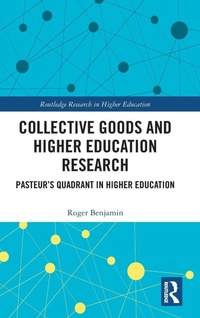
Collective Goods and Higher Education Research
Pasteur's Quadrant in Higher Education
1st Edition
Published on 5. October 2018
Book
Hardback
212 pages
978-1-138-32076-5 (ISBN)
Description
With this volume, the author demonstrates how a collective goods approach to higher education research can alleviate problems of rising costs, declining resources, and growing concerns about undergraduate learning. In taking this approach, the author presents new tools of analysis-borrowed from cognitive science, economics, data analytics, education technology and measurement science-to investigate higher education's place in society as a public or private good. By showing how these tools can be utilized to re-orient current research, this volume offers scholars and policy makers an argument for the large-scale use of scientific and economic approaches to higher education's most pressing issues.
More details
Series
Language
English
Place of publication
London
United Kingdom
Publishing group
Taylor & Francis Ltd
Target group
College/higher education
Illustrations
12 s/w Abbildungen, 5 s/w Photographien bzw. Rasterbilder, 7 s/w Zeichnungen, 7 s/w Tabellen
7 Tables, black and white; 7 Line drawings, black and white; 5 Halftones, black and white; 12 Illustrations, black and white
Dimensions
Height: 235 mm
Width: 157 mm
Thickness: 17 mm
Weight
493 gr
ISBN-13
978-1-138-32076-5 (9781138320765)
Copyright in bibliographic data and cover images is held by Nielsen Book Services Limited or by the publishers or by their respective licensors: all rights reserved.
Schweitzer Classification
Other editions
Additional editions
Book
06/2020
1st Edition
Routledge
€63.20
Shipment within 15-20 days
E-Book
09/2018
1st Edition
Routledge
€55.49
Available for download
Person
Roger Benjamin has been president of CAE, an education assessment testing organization since 2005.
Content
Part I The Framework
Chapter 1 Introduction
Chapter 2 The Framework: Pasteur's Quadrant in Higher Education
Part II Evidence-Based Applications to Policy Questions
Chapter 3 The Future Higher Education Policy Landscape From the Pasteur's Quadrant Perspective
Chapter 4 The Focus on Critical Thinking Skills for the Classroom, the Instructor, and New Sources of Content
Chapter 5 Recreating the Faculty Role in University Governance
Chapter 6 Leveling the Playing Field From College to Career
Chapter 7 The Role of Generic Skills Assessment in Measuring Academic Quality
Part III The Rationale for Standardized Assessments in Higher Education
Chapter 8 The Case for Comparative Institutional Assessment of Higher-Order
Thinking Skills
Chapter 9 The Case for Performance-based Assessments and Critical Thinking Tests
Chapter 10 Two Questions About Critical Thinking Tests
Chapter 11 Conclusion
Coda CLA+ Analytics: Making Data Relevant Through Data Mining in Real Time
Chapter 1 Introduction
Chapter 2 The Framework: Pasteur's Quadrant in Higher Education
Part II Evidence-Based Applications to Policy Questions
Chapter 3 The Future Higher Education Policy Landscape From the Pasteur's Quadrant Perspective
Chapter 4 The Focus on Critical Thinking Skills for the Classroom, the Instructor, and New Sources of Content
Chapter 5 Recreating the Faculty Role in University Governance
Chapter 6 Leveling the Playing Field From College to Career
Chapter 7 The Role of Generic Skills Assessment in Measuring Academic Quality
Part III The Rationale for Standardized Assessments in Higher Education
Chapter 8 The Case for Comparative Institutional Assessment of Higher-Order
Thinking Skills
Chapter 9 The Case for Performance-based Assessments and Critical Thinking Tests
Chapter 10 Two Questions About Critical Thinking Tests
Chapter 11 Conclusion
Coda CLA+ Analytics: Making Data Relevant Through Data Mining in Real Time